












Synthesis and characterization of novel organic–inorganic hybrid block copolymers
Literature Information
Publication Date
2004-03-02
DOI
10.1039/B314601B
Impact Factor
3.676
Authors
Patrick Theato, Kook J. Kim, Do Y. Yoon
View Original
Abstract
Novel organic–inorganic hybrid block copolymers based on poly(methylsilsesquioxanes) (PMSSQs) have been synthesized. Two routes to functionalized PMSSQs are presented and from both atom transfer radical polymerization of methylmethacrylate could be performed. Copolymers with different block ratios have been polymerized and were characterized. In particular, thermal properties were investigated by TGA and the promising thermal decomposition behaviour makes the copolymers potential candidates as pore generators in future nanoporous materials. Additionally, these copolymers were analysed as surface coatings of regular PMMA. Contact angle measurements proved the dramatic effect on the surface properties of such modified PMMA.
Related Literature
Chemoselective synthesis of isolated and fused fluorenones and their photophysical and antiviral properties
Ismail Althagafi, Ranjay Shaw, Rahul Panwar, Shally, Chanda Sinha, Amit Kumar, Yong-Tang Zheng, Ramendra Pratap
2018-09-19
Paper
DOI: 10.1039/C8OB01733F
Synthesis of two novel [18F]fluorobenzene-containing radiotracers via spirocyclic iodonium ylides and positron emission tomography imaging of translocator protein (18 kDa) in ischemic brain
Masayuki Fujinaga, Katsushi Kumata, Yiding Zhang, Akiko Hatori, Tomoteru Yamasaki, Wakana Mori, Lin Xie, Ming-Rong Zhang
2018-08-31
Paper
DOI: 10.1039/C8OB01700J
Synthesis of nitrogen-tethered 1,6-enynes through CuI/TFA catalysis
Leilei Cao, Liliang Huang, Xianjun Xu
2021-12-03
Research Article
DOI: 10.1039/D1QO01358K
Catalytic asymmetric Henry reactions of silyl nitronates with aldehydes
Tine Risgaard, Kurt V. Gothelf, Karl Anker Jørgensen
2002-12-03
Paper
DOI: 10.1039/B208859M
One-pot synthesis of polyfunctionalized quinolines via a copper-catalyzed tandem cyclization
Dianpeng Chen, Xuejun Sun, Yingying Shan, Jinmao You
2018-09-28
Paper
DOI: 10.1039/C8OB02078G
Aminative Umpolung cyclization for synthesis of chiral exocyclic vicinal diamines
Feng Liu, Guoqing Zhao, Weiqi Cai, Dongfang Xu, Baoguo Zhao
2018-09-26
Paper
DOI: 10.1039/C8OB02000K
Dual function of amino acid ionic liquids (Bmim[AA]) on the degradation of the organophosphorus pesticide, Paraoxon®
Javiera I. Morales, Roberto Figueroa, Mabel Rojas, Daniela Millán, Ricardo A. Tapia, Paulina Pavez
2018-09-18
Paper
DOI: 10.1039/C8OB01928B
Rhodium-catalyzed cyclization of acceptor-substituted biphenyl α-diazoketones: a study of the substitution effect on chemoselectivity
Kuo-Hsin Chen, Yi-Jung Chiang, Jia-Liang Zhu
2018-09-04
Paper
DOI: 10.1039/C8OB01489B
You might also like
Compound Q&A
Is 6-(3-Fluorophenyl)picolinic acid (CAS: 887982-40-3) safe?
6-(3-Fluorophenyl)picolinic acid is generally considered safe for laboratory use...
887982-40-36-(3-Fluorophenyl)pi...
Compound Q&A
What industries use (3R)-3-Pyrrolidinol (CAS: 2799-21-5)?
(3R)-3-Pyrrolidinol is used in the pharmaceutical industry as a precursor for dr...
2799-21-5(3R)-3-Pyrrolidinol
Compound Q&A
What precautions should be taken when handling (4R,5R)-4,5-Diethoxycarbonyl-2,2-dimethyldioxolane (CAS: 59779-75-8)?
When handling (4R,5R)-4,5-Diethoxycarbonyl-2,2-dimethyldioxolane (CAS: 59779-75-...
59779-75-8(4R,5R)-4,5-Diethoxy...
Compound Q&A
How is 1-(6-Chloroimidazo[1,2-b]pyridazin-3-yl)ethanone (CAS: 90734-71-7) typically synthesized?
1-(6-Chloroimidazo[1,2-b]pyridazin-3-yl)ethanone is often synthesized via a mult...
90734-71-71-(6-Chloroimidazo[1...
Compound Q&A
What is the market or research trend for N-Ethyl-3,4-dimethylbenzylamine (CAS: 39180-83-1)?
The market for N-Ethyl-3,4-dimethylbenzylamine (CAS: 39180-83-1) remains steady,...
39180-83-1N-Ethyl-3,4-dimethyl...
Compound Q&A
What is Tert-butyl 3-(pyrrolidin-1-yl)azetidine-1-carboxylate (CAS: 1019008-21-9)?
Tert-butyl 3-(pyrrolidin-1-yl)azetidine-1-carboxylate is a chemical compound wit...
1019008-21-9Tert-butyl 3-(pyrrol...
Compound Q&A
What regulatory guidelines apply to 1-Bromo-3-chloro-2,4-dimethoxybenzene (CAS: 1228956-93-1)?
1-Bromo-3-chloro-2,4-dimethoxybenzene (CAS: 1228956-93-1) falls under the classi...
1228956-93-11-Bromo-3-chloro-2,4...
Compound Q&A
Is 8-Bromo-2-methyl-3,4-dihydroisoquinolin-1(2H)-one (CAS: 1368622-07-4) safe?
The safety of 8-Bromo-2-methyl-3,4-dihydroisoquinolin-1(2H)-one (CAS: 1368622-07...
1368622-07-48-Bromo-2-methyl-3,4...
Compound Q&A
Is Benzyl [(3S)-2,6-dioxo-3-piperidinyl]carbamate (CAS: 22785-43-9) safe?
Benzyl [(3S)-2,6-dioxo-3-piperidinyl]carbamate is generally safe when handled wi...
22785-43-9Benzyl [(3S)-2,6-dio...
Compound Q&A
How should 1-{[4-(4,4,5,5-Tetramethyl-1,3,2-dioxaborolan-2-yl)phenyl]sulfonyl}pyrrolidine (CAS: 928657-21-0) be stored?
1-{[4-(4,4,5,5-Tetramethyl-1,3,2-dioxaborolan-2-yl)phenyl]sulfonyl}pyrrolidine s...
928657-21-01-{[4-(4,4,5,5-Tetra...
Source Journal
Physical Chemistry Chemical Physics

CiteScore:
5.5
Self-citation Rate:
10.3%
Articles per Year:
3036
Physical Chemistry Chemical Physics (PCCP) is an international journal co-owned by 19 physical chemistry and physics societies from around the world. This journal publishes original, cutting-edge research in physical chemistry, chemical physics and biophysical chemistry. To be suitable for publication in PCCP, articles must include significant innovation and/or insight into physical chemistry; this is the most important criterion that reviewers and Editors will judge against when evaluating submissions. The journal has a broad scope and welcomes contributions spanning experiment, theory, computation and data science. Topical coverage includes spectroscopy, dynamics, kinetics, statistical mechanics, thermodynamics, electrochemistry, catalysis, surface science, quantum mechanics, quantum computing and machine learning. Interdisciplinary research areas such as polymers and soft matter, materials, nanoscience, energy, surfaces/interfaces, and biophysical chemistry are welcomed if they demonstrate significant innovation and/or insight into physical chemistry. Joined experimental/theoretical studies are particularly appreciated when complementary and based on up-to-date approaches.
Recommended Compounds
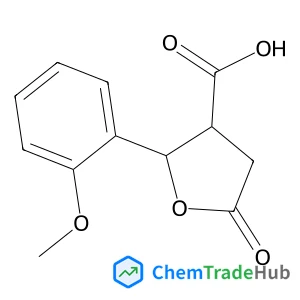
trans-2-(2-Methoxyphenyl)-5-oxotetrahydrofuran-3-carboxylic acid
CAS Number:
99226-02-5
Molecular Formula:
C12H12O5
Recommended Suppliers



Disclaimer
This page provides academic journal information for reference and research purposes only. We are not affiliated with any journal publishers and do not handle publication submissions. For publication-related inquiries, please contact the respective journal publishers directly.
If you notice any inaccuracies in the information displayed, please contact us at support@chemtradehub.com. We will promptly review and address your concerns.