












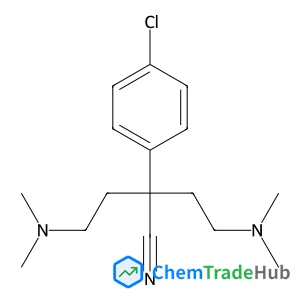
2-(4-Chlorophenyl)-4-(dimethylamino)-2-(2-(dimethylamino)ethyl)butanenitrile
CAS Number:
1246816-57-8
Molecular Formula:
C16H24ClN3
Chia-min Yang, Yanqin Wang, Bodo Zibrowius, Ferdi Schüth
Cyanide-functionalized mesoporous silica SBA-15 (CN/SBA-15) with pore diameters larger than 6 nm has been prepared by a one-pot synthesis. The structure of CN/SBA-15 is affected by the amount of the functional silane 2-cyanoethyltriethoxysilane (CTES) and the conditions of co-condensation in the acidic aqueous solution of the triblock copolymer Pluronic P123: whereas direct mixing of the silica sources CTES and tetraethoxysilane (TEOS) leads to a disordered hybrid material, a highly ordered CN/SBA-15 is obtained if the synthesis solution containing CTES is prepared first and TEOS added afterwards. Treatment of the as-synthesized materials with concentrated sulfuric acid removes the copolymer template through ether cleavage and hydrolyses the –CN groups in one step, resulting in carboxylate-functionalized SBA-15 (CA/SBA-15). 13C CP/MAS NMR spectra show that for some CN/SBA-15 materials the copolymer template can be totally removed in this way, suggesting that all the hydrophilic ethylene oxide (EO) chains of the template are accessible to the acid. Nitrogen sorption measurements also indicate that these materials contain nearly no micropores in contrast to the pure-silica SBA-15 synthesized under the same conditions, which has a considerable proportion of micropores. The results suggest that the structural order and microstructures of the resulting CN/SBA-15 materials are strongly affected by assembly kinetics, which involve the hydrolysis and condensation of silica species and their interaction with the template.
A. Subha Mahadevi, Y. Indra Neela, G. Narahari Sastry
DOI: 10.1039/C1CP21346F
Yoshinobu Akinaga, Jaewoon Jung, Seiichiro Ten-no
DOI: 10.1039/C1CP21001G
Carlos Randino, Marcin Ziółek, Ricard Gelabert, Juan Angel Organero, Michal Gil, Miquel Moreno, José M. Lluch, Abderrazzak Douhal
DOI: 10.1039/C1CP21039D
Princia Salvatore, Allan Glargaard Hansen, Thomas Bjørnholm, Richard John Nichols, Jens Ulstrup
DOI: 10.1039/C1CP21197H
I. D. Seymour, A. Chroneos, J. A. Kilner, R. W. Grimes
DOI: 10.1039/C1CP21471C
ChiYung Yam, Lingyi Meng, GuanHua Chen, Quan Chen, Ngai Wong
DOI: 10.1039/C1CP20766K
M. Busch, E. Ahlberg, I. Panas
DOI: 10.1039/C1CP20487D
Rodrigo Galindo-Murillo, Joseelyne Hernandez-Lima, Mayra González-Rendón, Lena Ruíz-Azuara, Rafael Moreno-Esparza
DOI: 10.1039/C1CP20183B
Qing-Jiang Pan, Yuan-Ru Guo, Li Li, Samuel O. Odoh, Hong-Gang Fu, Hong-Xing Zhang
DOI: 10.1039/C1CP00030F
This compound is mainly used as an intermediate in the synthesis of antipsychoti...
Waste containing 1-(D-Ribofuranosyl)-1,4-dihydro-3-pyridinecarboxamide (CAS: 191...
2-Methyl-2-propanyl 3-bromo-3-(hydroxymethyl)-1-azetidinecarboxylate (CAS: 20079...
N-(4-Chloro-2-pyridinyl)acetamide (CAS: 245056-66-0) is a chemical compound with...
5-Chloro-2-hydroxybenzoic acid, also known as 5-chlorosalicylic acid, is an arom...
When handling 1,1-Dichloro-1-fluoroethane (CAS: 1717-00-6), it is important to u...
Fmoc-(2S,3R)-3-phenylpyrrolidine-2-carboxylic acid is a white crystalline solid ...
4-Amino-5-bromo-2-pyridinecarboxylic acid is primarily used as a precursor in th...
Handling this compound should be done with personal protective equipment (PPE) i...
When handling 8-bromo-2,2-dimethyl-3,4-dihydro-2H-1,4-benzoxazin-3-one, use prop...

Physical Chemistry Chemical Physics (PCCP) is an international journal co-owned by 19 physical chemistry and physics societies from around the world. This journal publishes original, cutting-edge research in physical chemistry, chemical physics and biophysical chemistry. To be suitable for publication in PCCP, articles must include significant innovation and/or insight into physical chemistry; this is the most important criterion that reviewers and Editors will judge against when evaluating submissions. The journal has a broad scope and welcomes contributions spanning experiment, theory, computation and data science. Topical coverage includes spectroscopy, dynamics, kinetics, statistical mechanics, thermodynamics, electrochemistry, catalysis, surface science, quantum mechanics, quantum computing and machine learning. Interdisciplinary research areas such as polymers and soft matter, materials, nanoscience, energy, surfaces/interfaces, and biophysical chemistry are welcomed if they demonstrate significant innovation and/or insight into physical chemistry. Joined experimental/theoretical studies are particularly appreciated when complementary and based on up-to-date approaches.
![2,6-Bis({(2R)-2-[hydroxy(diphenyl)methyl]-1-pyrrolidinyl}methyl)-4-methylphenol structure](https://static.chemtradehub.com/structs/877/877395-58-9-70bf.webp "2,6-Bis({(2R)-2-[hydroxy(diphenyl)methyl]-1-pyrrolidinyl}methyl)-4-methylphenol structure")





