












![1-[6-(1H-Imidazol-1-yl)-3-pyridinyl]methanamine structure](https://static.chemtradehub.com/structs/914/914637-08-4-8825.webp "1-[6-(1H-Imidazol-1-yl)-3-pyridinyl]methanamine structure")
Free-standing mesoporous titania films with anatase nanocrystallites synthesized at 80 °C
Literature Information
Publication Date
2004-03-23
DOI
10.1039/B313609D
Impact Factor
6.222
Authors
View Original
Abstract
Free-standing 10 µm thick mesoporous titania films containing anatase nanocrystallites have been prepared and their structural evolution as a function of calcination temperature is reported.
Related Literature
Bundles of identical double-walled carbon nanotubes
J.-F. Colomer, L. Henrard, P. Launois, G. Van Tendeloo, A. A. Lucas, Ph. Lambin
2004-09-30
Communication
DOI: 10.1039/B410930A
A C3-symmetric molecular scaffold for the construction of large receptors
Gebhard Haberhauer, Thomas Oeser, Frank Rominger
2004-08-06
Communication
DOI: 10.1039/B406335J
Polysulfones: solid organic catalysts for the chemoselective cleavage of methyl-substituted allyl ethers under neutral conditions
Dean Marković, Peter Steunenberg, Martin Ekstrand, Pierre Vogel
2004-09-21
Communication
DOI: 10.1039/B410965A
The mechanism of the oxidative addition of aryl halides to Pd-catalysts: a DFT investigation
Lukas J. Gooßen, Debasis Koley, Holger Hermann, Walter Thiel
2004-08-20
Communication
DOI: 10.1039/B409144B
First lanthanide dipolar complexes for second-order nonlinear optics
Katell Sénéchal, Loïc Toupet, Isabelle Ledoux, Joseph Zyss, Hubert Le Bozec, Olivier Maury
2004-09-08
Communication
DOI: 10.1039/B407073A
Biomimetic thermo-responsive star diblock gelators
Yuting Li, Ravin Narain, Yinghua Ma, Andrew L. Lewis, Steven P. Armes
2004-10-18
Communication
DOI: 10.1039/B410150B
Self-assembled zinc(ii) Schiff basepolymers for applications in polymer light-emitting devices
Chi-Chung Kwok, Sze-Chit Yu, Iona H. T. Sham, Chi-Ming Che
2004-10-20
Communication
DOI: 10.1039/B412762E
Highly efficient epoxidation method of olefins with hydrogen peroxide as terminal oxidant, bicarbonate as a co-catalyst and oxodiperoxo molybdenum(vi) complex as catalyst
Narottam Gharah, Santu Chakraborty, Alok K. Mukherjee, Ramgopal Bhattacharyya
2004-09-28
Communication
DOI: 10.1039/B408946D
A modular ditopic crown-shielded phosphate ion-pair receptor
Patrick Gunning, Andrew C. Benniston, Robert D. Peacock
2004-08-20
Communication
DOI: 10.1039/B409132A
Role of pore curvature on the thermal stability of gold nanoparticles in mesoporous silica
Mangesh T. Bore, Hien N. Pham, Timothy L. Ward, Abhaya K. Datye
2004-10-04
Communication
DOI: 10.1039/B407575G
You might also like
Compound Q&A
What is the market or research trend for N-(4-Methoxybenzyl)-2-pyridinamine (CAS: 52818-63-0)?
N-(4-Methoxybenzyl)-2-pyridinamine (CAS: 52818-63-0) is increasingly being used ...
52818-63-0N-(4-Methoxybenzyl)-...
Compound Q&A
What precautions should be taken when handling Ethyl 4-(2-chlorophenyl)-1,3-thiazole-2-carboxylate (CAS: 1050507-06-6)?
When handling Ethyl 4-(2-chlorophenyl)-1,3-thiazole-2-carboxylate, appropriate p...
1050507-06-6Ethyl 4-(2-chlorophe...
Compound Q&A
What regulatory guidelines apply to diethyldiselane (CAS: 628-39-7)?
Diethyldiselane (CAS: 628-39-7) is classified under the Globally Harmonized Syst...
628-39-7Diethyldiselane
Compound Q&A
What is the market or research trend for oxocopper (CAS: 12053-18-8)?
The market for oxocopper (CAS: 12053-18-8) is primarily driven by its use in cat...
12053-18-8oxocopper; oxo-(oxoc...
Compound Q&A
What is the market or research trend for 5-{[(2-Methyl-2-propanyl)oxy]carbonyl}-5-azaspiro[2.4]heptane-7-carboxylic acid?
The market for 5-{[(2-Methyl-2-propanyl)oxy]carbonyl}-5-azaspiro[2.4]heptane-7-c...
1268519-54-55-{[(2-Methyl-2-prop...
Compound Q&A
What is 2-(1-Pyrrolidinyl)-4-pyridinamine (CAS: 35981-63-6)?
2-(1-Pyrrolidinyl)-4-pyridinamine is a chemical compound with the CAS number 359...
35981-63-62-(1-Pyrrolidinyl)-4...
Compound Q&A
What are the physical and chemical properties of 2-(3-Pyridinyl)-1-azabicyclo[2.2.2]octane (CAS: 91556-75-1)?
2-(3-Pyridinyl)-1-azabicyclo[2.2.2]octane (CAS: 91556-75-1) is a crystalline sol...
91556-75-12-(3-Pyridinyl)-1-az...
Compound Q&A
How is (S)-Alpha-allyl-proline hydrochloride (CAS: 129704-91-2) typically synthesized?
(S)-Alpha-allyl-proline hydrochloride is usually synthesized via a Wittig reacti...
129704-91-2(S)-Alpha-allyl-prol...
Compound Q&A
What is 3-Methyl-1,2-oxazole-5-carboxylic acid (CAS: 4857-42-5)?
3-Methyl-1,2-oxazole-5-carboxylic acid (CAS: 4857-42-5) is an organic compound w...
4857-42-53-Methyl-1,2-oxazole...
Compound Q&A
How is Lys-SMCC-DM1 (CAS: 1281816-04-3) typically synthesized?
Lys-SMCC-DM1 is synthesized via a multi-step process involving the coupling of S...
1281816-04-3Lys-SMCC-DM1
Source Journal
Chemical Communications

CiteScore:
8.6
Self-citation Rate:
4.7%
Articles per Year:
2458
ChemComm publishes urgent research which is of outstanding significance and interest to experts in the field, while also appealing to the journal’s broad chemistry readership. Our communication format is ideally suited to short, urgent studies that are of such importance that they require accelerated publication. Our scope covers all topics in chemistry, and research at the interface of chemistry and other disciplines (such as materials science, nanoscience, physics, engineering and biology) where there is a significant novelty in the chemistry aspects. Major topic areas covered include: Analytical Chemistry Catalysis Chemical Biology and medicinal chemistry Computational Chemistry and Machine Learning Energy and sustainable chemistry Environmental Chemistry Green Chemistry Inorganic Chemistry Materials Chemistry Nanoscience Organic Chemistry Physical Chemistry Polymer Chemistry Supramolecular Chemistry
Recommended Compounds
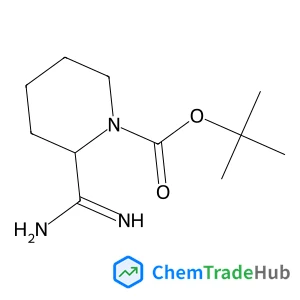
2-Methyl-2-propanyl 2-carbamimidoyl-1-piperidinecarboxylate
CAS Number:
1258640-98-0
Molecular Formula:
C11H21N3O2
Recommended Suppliers






Disclaimer
This page provides academic journal information for reference and research purposes only. We are not affiliated with any journal publishers and do not handle publication submissions. For publication-related inquiries, please contact the respective journal publishers directly.
If you notice any inaccuracies in the information displayed, please contact us at support@chemtradehub.com. We will promptly review and address your concerns.