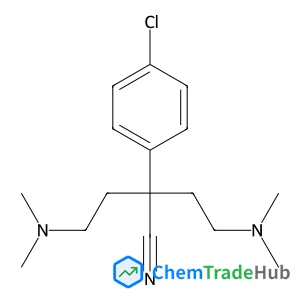
2-(4-Chlorophenyl)-4-(dimethylamino)-2-(2-(dimethylamino)ethyl)butanenitrile
CAS Number:
1246816-57-8
Molecular Formula:
C16H24ClN3
A model is constructed to investigate in atomistic detail the structure and dynamics of protonated water networks on the extracellular side of the transmembrane proton pump bacteriorhodopsin. The protein is embedded in a solvated lipid bilayer membrane described by established force fields. Most importantly, the protonated water network is treated in the framework of a mixed density functional electronic structure theory/molecular mechanics approach. This QM/MM Car–Parrinello molecular dynamics approach employed allows for stable dynamics on a picosecond time scale. The structural building process, force field parameterizations and subsequent equilibration of the total system consisting of the protein, the lipid membrane and the hydration layer is described in detail followed by a QM/MM simulation of the protonated water network. It is found that hydrogen-bonded networks around both H3O+ and H5O2+ cores can be stabilized in the protein matrix, leading to so-called Eigen and solvated Zundel complexes, H3O+· (H2O)3 and H5O2+·(H2O)4, respectively. It turns out that both complexes behave qualitatively similarly to the gas phase, implying that the H5O2+ core displays an essentially symmetric hydrogen bond with the excess proton being equally shared between two water molecules. The dynamics of this hydrogen bond is found to be complex featuring slow large-amplitude motion of the central proton as well as complex dynamics of the protonated water cluster hydrogen bonds formed with the protein matrix. These findings are consistent with the proposal that an essential component of the so-called proton release group “XH” could consist of a protonated water network stabilized by polar aminoacids.
Guannan Li, Hong He
DOI: 10.1039/C8CP00354H
Henning Schraknepper, Thomas E. Weirich, Roger A. De Souza
DOI: 10.1039/C8CP02191K
Chunkan Yu, Viatcheslav Bykov, Ulrich Maas
DOI: 10.1039/C7CP07213A
Efracio Mamani Flores, Rogério Almeida Gouvea, Maurício Jeomar Piotrowski, Mário Lucio Moreira
DOI: 10.1039/C7CP08177D
Shashi Kant Shukla
DOI: 10.1039/C8CP03724H
Aayush R. Singh, Brian A. Rohr, Yanjing Su, Lijie Qiao
DOI: 10.1039/C7CP05484J
V. V. Mulloyarova, M. A. Kostin, G. S. Denisov, I. G. Shenderovich, P. M. Tolstoy
DOI: 10.1039/C7CP08130H
S. Sarkar, A. Mondal, N. Giri, R. Ray
DOI: 10.1039/C8CP06659K
Hongmei Liu, Xiaolong Li, Changmin Shi, Dongchao Wang, Li Chen, Yuanyuan He, Jianwei Zhao
DOI: 10.1039/C8CP00900G
Hao Chen, Qinghua Lu, Chunhai Yi, Bolun Yang, Suitao Qi
DOI: 10.1039/C7CP08562A
This compound is mainly used as an intermediate in the synthesis of antipsychoti...
Waste containing 1-(D-Ribofuranosyl)-1,4-dihydro-3-pyridinecarboxamide (CAS: 191...
2-Methyl-2-propanyl 3-bromo-3-(hydroxymethyl)-1-azetidinecarboxylate (CAS: 20079...
N-(4-Chloro-2-pyridinyl)acetamide (CAS: 245056-66-0) is a chemical compound with...
5-Chloro-2-hydroxybenzoic acid, also known as 5-chlorosalicylic acid, is an arom...
When handling 1,1-Dichloro-1-fluoroethane (CAS: 1717-00-6), it is important to u...
Fmoc-(2S,3R)-3-phenylpyrrolidine-2-carboxylic acid is a white crystalline solid ...
4-Amino-5-bromo-2-pyridinecarboxylic acid is primarily used as a precursor in th...
Handling this compound should be done with personal protective equipment (PPE) i...
When handling 8-bromo-2,2-dimethyl-3,4-dihydro-2H-1,4-benzoxazin-3-one, use prop...

Physical Chemistry Chemical Physics (PCCP) is an international journal co-owned by 19 physical chemistry and physics societies from around the world. This journal publishes original, cutting-edge research in physical chemistry, chemical physics and biophysical chemistry. To be suitable for publication in PCCP, articles must include significant innovation and/or insight into physical chemistry; this is the most important criterion that reviewers and Editors will judge against when evaluating submissions. The journal has a broad scope and welcomes contributions spanning experiment, theory, computation and data science. Topical coverage includes spectroscopy, dynamics, kinetics, statistical mechanics, thermodynamics, electrochemistry, catalysis, surface science, quantum mechanics, quantum computing and machine learning. Interdisciplinary research areas such as polymers and soft matter, materials, nanoscience, energy, surfaces/interfaces, and biophysical chemistry are welcomed if they demonstrate significant innovation and/or insight into physical chemistry. Joined experimental/theoretical studies are particularly appreciated when complementary and based on up-to-date approaches.
![2,6-Bis({(2R)-2-[hydroxy(diphenyl)methyl]-1-pyrrolidinyl}methyl)-4-methylphenol structure](https://static.chemtradehub.com/structs/877/877395-58-9-70bf.webp "2,6-Bis({(2R)-2-[hydroxy(diphenyl)methyl]-1-pyrrolidinyl}methyl)-4-methylphenol structure")