












Structural study of poly (N-isopropylacrylamide) microgels interpenetrated with polypyrrole
Literature Information
Publication Date
2004-01-23
DOI
10.1039/B313072J
Impact Factor
3.676
Authors
D. Mecerreyes, B. Sierra-Martín, M. S. Romero-Cano, P. Strunz, A. Fernández-Barbero
View Original
Abstract
Thermosensitive cross-linked poly(N-isopropylacrylamide)[poly(NIPAM)] microgels in D2O present a continuous volume phase transition from swollen to deswollen states at a temperature within 32–34 °C and the process is thermoreversible without hysteresis. The poly(NIPAM) microgels with 0.25% (w/w) cross-linker content were used as a matrix to entrap polypyrrole. Pyrrole was dissolved in the colloidal microgel dispersion and polymerisation was performed at three selected temperatures: 20 °C in the swollen state of the microgel, at 37 °C having the microgel collapsed and at 32.5 °C corresponding to the beginning of the volume phase transition of the microgel. Dynamic light scattering, differential scanning calorimetry, small angle neutron scattering and transmission electron microscopy have been used to study the structural modifications induced by polypyrrole in these microgels. The small angle neutron scattering pattern was analysed using an expression that consists of solution-like concentration fluctuations given by an Orstein–Zernike type function, a solid-like concentration fluctuations described by a Gauss function and a contribution arising from the surface of the colloidal microgel. It seems that polymerisation of pyrrole, when the microgel particles are in the swollen state (20 °C), results in a uniform distribution of polypyrrole within the particles. However, when the polymerisation is carried out at the beginning of the volume phase transition (32.5 °C) an outer shell of polypyrrole could be formed. Finally, polymerisation of pyrrole at 37 °C produced non-stable colloidal particles.
Recommended Journals
Related Literature
Cl-Loss dynamics in the dissociative photoionization of CF3Cl with threshold photoelectron–photoion coincidence imaging
Xiangkun Wu, Guoqiang Tang, Hanhui Zhang, Xiaoguo Zhou, Shilin Liu, Fuyi Liu, Liusi Sheng, Bing Yan
2018-01-31
Paper
DOI: 10.1039/C7CP07502B
Cyclic trimers of phosphinic acids in polar aprotic solvent: symmetry, chirality and H/D isotope effects on NMR chemical shifts
V. V. Mulloyarova, M. A. Kostin, G. S. Denisov, I. G. Shenderovich, P. M. Tolstoy
2018-01-23
Paper
DOI: 10.1039/C7CP08130H
Investigations on the charge transfer mechanism at donor/acceptor interfaces in the quest for descriptors of organic solar cell performance
Kenji Mishima, Hiroki Matsunaga
2018-04-04
Paper
DOI: 10.1039/C8CP01253A
The excess electron at polyethylene interfaces
Fernan Saiz, David Cubero, Nick Quirke
2018-07-27
Paper
DOI: 10.1039/C8CP01330F
Structural definition of the BIL and DL: a new universal methodology to rationalize non-linear χ(2)(ω) SFG signals at charged interfaces, including χ(3)(ω) contributions
Simone Pezzotti, Daria Ruth Galimberti, Y. Ron Shen, Marie-Pierre Gaigeot
2018-01-23
Paper
DOI: 10.1039/C7CP06110B
Hexagonal SiC with spatially separated active sites on polar and nonpolar facets achieving enhanced hydrogen production from photocatalytic water reduction
Ning Liu, Zhongnan Guo, Wenjun Wang, Liwei Guo, Wenxia Yuan
2018-01-17
Paper
DOI: 10.1039/C7CP08363G
X-ray absorption near edge structure and first-principles spectral investigations of cationic disorder in MgAl2O4 induced by swift heavy ions
S. Yoshioka, K. Tsuruta, T. Yamamoto, K. Yasuda, S. Matsumura, N. Ishikawa, E. Kobayashi
2018-02-01
Paper
DOI: 10.1039/C7CP07591J
Direct visualization of diffuse unoccupied molecular orbitals at a rubrene/graphite interface
Takashi Yamada, Mariko Kinoshita, Kento Araragi, Yu Watanabe, Takahiro Ueba, Hiroyuki S. Kato, Toshiaki Munakata
2018-06-05
Paper
DOI: 10.1039/C8CP01796D
Reduction of the thermal conductivity of a graphene/hBN heterobilayer via interlayer sp3 bonds
T. Iwata, K. Shintani
2018-01-23
Paper
DOI: 10.1039/C7CP07345C
Combinatorial selection of a two-dimensional 3d-TM-tetracyanoquinodimethane (TM-TCNQ) monolayer as a high-activity nanocatalyst for CO oxidation
Tiantian Wu, Guibin Chen, Heine Anton Hansen, Tejs Vegge
2018-01-18
Paper
DOI: 10.1039/C7CP07988E
You might also like
Compound Q&A
What are the main uses of 1-(3-Aminophenyl)-3-[(3R)-1-(3,3-dimethyl-2-oxobutyl)-2-oxo-5-(2-pyridinyl)-2,3-dihydro-1H-1,4-benzodiazepin-3-yl]urea (CAS: 155412-88-7)?
This compound is mainly used as an intermediate in the synthesis of antipsychoti...
155412-88-71-(3-Aminophenyl)-3-...
Compound Q&A
How should waste containing 1-(D-Ribofuranosyl)-1,4-dihydro-3-pyridinecarboxamide (CAS: 19132-12-8) be handled?
Waste containing 1-(D-Ribofuranosyl)-1,4-dihydro-3-pyridinecarboxamide (CAS: 191...
19132-12-81-(D-Ribofuranosyl)-...
Compound Q&A
What regulatory guidelines apply to 2-Methyl-2-propanyl 3-bromo-3-(hydroxymethyl)-1-azetidinecarboxylate (CAS: 2007919-81-3)?
2-Methyl-2-propanyl 3-bromo-3-(hydroxymethyl)-1-azetidinecarboxylate (CAS: 20079...
2007919-81-32-Methyl-2-propanyl ...
Compound Q&A
What is N-(4-Chloro-2-pyridinyl)acetamide (CAS: 245056-66-0)?
N-(4-Chloro-2-pyridinyl)acetamide (CAS: 245056-66-0) is a chemical compound with...
245056-66-0N-(4-Chloro-2-pyridi...
Compound Q&A
What is 5-Chloro-2-hydroxybenzoic acid (CAS: 321-14-2)?
5-Chloro-2-hydroxybenzoic acid, also known as 5-chlorosalicylic acid, is an arom...
321-14-25-Chloro-2-hydroxybe...
Compound Q&A
What precautions should be taken when handling 1,1-Dichloro-1-fluoroethane (CAS: 1717-00-6)?
When handling 1,1-Dichloro-1-fluoroethane (CAS: 1717-00-6), it is important to u...
1717-00-61,1-Dichloro-1-fluor...
Compound Q&A
What are the physical and chemical properties of Fmoc-(2S,3R)-3-phenylpyrrolidine-2-carboxylic acid (CAS: 281655-32-1)?
Fmoc-(2S,3R)-3-phenylpyrrolidine-2-carboxylic acid is a white crystalline solid ...
281655-32-1Fmoc-(2S,3R)-3-pheny...
Compound Q&A
What are the main uses of 4-Amino-5-bromo-2-pyridinecarboxylic acid (CAS: 1363381-01-4)?
4-Amino-5-bromo-2-pyridinecarboxylic acid is primarily used as a precursor in th...
1363381-01-44-Amino-5-bromo-2-py...
Compound Q&A
What precautions should be taken when handling (S)-tert-butyl 2-((2-(4-bromophenyl)-2-oxoethyl)carbamoyl)pyrrolidine-1-carboxylate (CAS: 1007881-98-2)?
Handling this compound should be done with personal protective equipment (PPE) i...
1007881-98-2(S)-tert-butyl 2-((2...
Compound Q&A
What precautions should be taken when handling 8-bromo-2,2-dimethyl-3,4-dihydro-2H-1,4-benzoxazin-3-one (CAS: 688363-73-7)?
When handling 8-bromo-2,2-dimethyl-3,4-dihydro-2H-1,4-benzoxazin-3-one, use prop...
688363-73-78-bromo-2,2-dimethyl...
Source Journal
Physical Chemistry Chemical Physics

CiteScore:
5.5
Self-citation Rate:
10.3%
Articles per Year:
3036
Physical Chemistry Chemical Physics (PCCP) is an international journal co-owned by 19 physical chemistry and physics societies from around the world. This journal publishes original, cutting-edge research in physical chemistry, chemical physics and biophysical chemistry. To be suitable for publication in PCCP, articles must include significant innovation and/or insight into physical chemistry; this is the most important criterion that reviewers and Editors will judge against when evaluating submissions. The journal has a broad scope and welcomes contributions spanning experiment, theory, computation and data science. Topical coverage includes spectroscopy, dynamics, kinetics, statistical mechanics, thermodynamics, electrochemistry, catalysis, surface science, quantum mechanics, quantum computing and machine learning. Interdisciplinary research areas such as polymers and soft matter, materials, nanoscience, energy, surfaces/interfaces, and biophysical chemistry are welcomed if they demonstrate significant innovation and/or insight into physical chemistry. Joined experimental/theoretical studies are particularly appreciated when complementary and based on up-to-date approaches.
Recommended Compounds
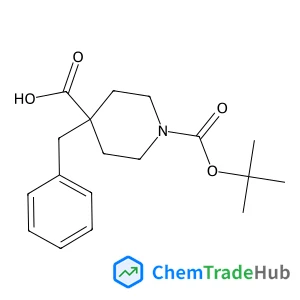
4-Benzyl-1-(tert-butoxycarbonyl)piperidine-4-carboxylic acid
CAS Number:
170838-87-6
Molecular Formula:
C18H25NO4
Recommended Suppliers





Disclaimer
This page provides academic journal information for reference and research purposes only. We are not affiliated with any journal publishers and do not handle publication submissions. For publication-related inquiries, please contact the respective journal publishers directly.
If you notice any inaccuracies in the information displayed, please contact us at support@chemtradehub.com. We will promptly review and address your concerns.