












Ns strategies: a highly versatile synthetic method for amines
Literature Information
Publication Date
2003-11-25
DOI
10.1039/B311203A
Impact Factor
6.222
Authors
Toshiyuki Kan, Tohru Fukuyama
View Original
Abstract
A highly efficient and versatile synthetic method for amines was established using nitrobenzenesulfonamides (Ns-amides) as both a protecting and activating group. The alkylation of N-monosubstituted Ns-amides either proceeded conventionally or under Mitsunobu conditions to provide the N,N-disubstituted sulfonamides, and the Ns group was removed easily with soft nucleophiles via Meisenheimer complexes to give the corresponding secondary amines. The major advantage of this protocol is that both alkylation and deprotection proceed under mild conditions. Thus, with this methodology, the total synthesis of linear and/or macrocyclic natural polyamines can be accomplished efficiently.
Related Literature
Combining oxyanionic polymerization and click-chemistry: a general strategy for the synthesis of polyether polyol macromonomers
Anja Thomas, Kerstin Niederer, Frederik Wurm, Holger Frey
2013-09-26
Paper
DOI: 10.1039/C3PY01078C
Multi-stimuli responsive supramolecular diblock copolymers
L. Sambe, F. Stoffelbach, J. Lyskawa, F. Delattre, M. Bria, F. X. Sauvage, M. Sliwa, V. Humblot, B. Charleux, G. Cooke, P. Woisel
2013-10-03
Paper
DOI: 10.1039/C3PY01093G
A biomimic pH-sensitive polymeric prodrug based on polycarbonate for intracellular drug delivery
Haibo Wang, Yin Wang, Yangjun Chen, Qiao Jin, Jian Ji
2013-09-09
Paper
DOI: 10.1039/C3PY00861D
Synthesis of high molar mass poly(n-butyl acrylate) and poly(2-ethylhexyl acrylate) by SET-LRP in mixtures of fluorinated alcohols with DMSO
Shampa R. Samanta, Virgil Percec
2013-08-09
Paper
DOI: 10.1039/C3PY01008B
Polymer patchy colloids with sticky patches
Yi Zhao, Rüdiger Berger, Katharina Landfester, Daniel Crespy
2013-09-12
Paper
DOI: 10.1039/C3PY01096A
RAFT/MADIX (co)polymerization of vinyl trifluoroacetate: a means to many ends
Jean-Daniel Marty, Mathias Destarac
2013-10-01
Paper
DOI: 10.1039/C3PY01109G
Synthesis of well-defined amphiphilic branched polyethylene-graft-poly (N-isopropylacrylamide) copolymers by coordination copolymerization in tandem with RAFT polymerization and their self-assembled vesicles
Ye Zhao, Haiyang Gao, Guodong Liang, Fangming Zhu, Qing Wu
2013-09-27
Paper
DOI: 10.1039/C3PY01289A
Reversibly crosslinked thermo- and redox-responsive nanogels for controlled drug release
Christophe Detrembleur, Marie Hurtgen, Antoine Debuigne, Marie-Claire De Pauw-Gillet, Stéphane Mornet, Etienne Duguet, Christine Jérôme
2013-07-31
Paper
DOI: 10.1039/C3PY00839H
Synthesis and optoelectronic properties of new D–A copolymers based on fluorinated benzothiadiazole and benzoselenadiazole
Yi Zhang
2013-09-03
Paper
DOI: 10.1039/C3PY00968H
Glutathione-triggered disassembly of isothermally responsive polymer nanoparticles obtained by nanoprecipitation of hydrophilic polymers
Daniel J. Phillips, Joseph P. Patterson, Rachel K. O'Reilly, Matthew I. Gibson
2013-08-15
Paper
DOI: 10.1039/C3PY00991B
You might also like
Compound Q&A
What are the main uses of 1H-Indazole-6-carbonitrile (CAS: 141290-59-7)?
1H-Indazole-6-carbonitrile finds applications in pharmaceuticals, where it serve...
141290-59-71H-Indazole-6-carbon...
Compound Q&A
How should waste containing Dioctyl (2E)-2-butenedioate (CAS: 2997-85-5) be handled?
Waste containing Dioctyl (2E)-2-butenedioate (CAS: 2997-85-5) should be collecte...
2997-85-5Dioctyl (2E)-2-buten...
Compound Q&A
What industries use Sodium [(1,2-benzoxazol-3-ylmethyl)sulfonyl]azanide (CAS: 68291-98-5)?
Sodium [(1,2-benzoxazol-3-ylmethyl)sulfonyl]azanide is primarily used in pharmac...
68291-98-5Sodium [(1,2-benzoxa...
Compound Q&A
Are there alternatives to Dimethyl 4-(4,4,5,5-tetramethyl-1,3,2-dioxaborolan-2-yl)-2,6-pyridinedicarboxylate (CAS: 741709-66-0) in synthesis?
Dimethyl 4-(4,4,5,5-tetramethyl-1,3,2-dioxaborolan-2-yl)-2,6-pyridinedicarboxyla...
741709-66-0Dimethyl 4-(4,4,5,5-...
Compound Q&A
How should waste containing 2-Fluoro-6-hydrazinopyridine (CAS: 80714-39-2) be handled?
Waste containing 2-Fluoro-6-hydrazinopyridine (CAS: 80714-39-2) should be manage...
80714-39-22-Fluoro-6-hydrazino...
Compound Q&A
What is 6-Formyl-2-pyridinecarboxylic acid (CAS: 499214-11-8)?
6-Formyl-2-pyridinecarboxylic acid is an organic compound with the molecular for...
499214-11-86-Formyl-2-pyridinec...
Compound Q&A
What is the market or research trend for 3-(3,4-dimethoxyphenyl)-2,5-dimethyl-N-(2-morpholin-4-ylethyl)pyrazolo[1,5-a]pyrimidin-7-amine (CAS: 900874-91-1)?
Research trends for this compound indicate a focus on its potential applications...
900874-91-13-(3,4-dimethoxyphen...
Compound Q&A
How is 9H-Tribenzo[b,d,f]azepine (CAS: 29875-73-8) typically synthesized?
9H-Tribenzo[b,d,f]azepine is typically synthesized via a multi-step process invo...
29875-73-89H-Tribenzo[b,d,f]az...
Compound Q&A
How is 1-Cyclopropyl-7-ethoxy-6-fluoro-8-methoxy-4-oxo-1,4-dihydro-3-quinolinecarboxylic acid (CAS: 1797982-51-4) typically synthesized?
1-Cyclopropyl-7-ethoxy-6-fluoro-8-methoxy-4-oxo-1,4-dihydro-3-quinolinecarboxyli...
1797982-51-41-Cyclopropyl-7-etho...
Compound Q&A
How should waste containing Methyl 3-oxo-1,2,3,4-tetrahydro-6-quinoxalinecarboxylate (CAS: 671820-52-3) be handled?
Waste containing Methyl 3-oxo-1,2,3,4-tetrahydro-6-quinoxalinecarboxylate (CAS: ...
671820-52-3Methyl 3-oxo-1,2,3,4...
Source Journal
Chemical Communications

CiteScore:
8.6
Self-citation Rate:
4.7%
Articles per Year:
2458
ChemComm publishes urgent research which is of outstanding significance and interest to experts in the field, while also appealing to the journal’s broad chemistry readership. Our communication format is ideally suited to short, urgent studies that are of such importance that they require accelerated publication. Our scope covers all topics in chemistry, and research at the interface of chemistry and other disciplines (such as materials science, nanoscience, physics, engineering and biology) where there is a significant novelty in the chemistry aspects. Major topic areas covered include: Analytical Chemistry Catalysis Chemical Biology and medicinal chemistry Computational Chemistry and Machine Learning Energy and sustainable chemistry Environmental Chemistry Green Chemistry Inorganic Chemistry Materials Chemistry Nanoscience Organic Chemistry Physical Chemistry Polymer Chemistry Supramolecular Chemistry
Recommended Compounds
![4-Penten-1-yl 2-[(2-furylmethyl)(1H-imidazol-1-ylcarbonyl)amino]butanoate structure](https://static.chemtradehub.com/structs/101/101903-30-4-ac34.webp "4-Penten-1-yl 2-[(2-furylmethyl)(1H-imidazol-1-ylcarbonyl)amino]butanoate structure")
4-Penten-1-yl 2-[(2-furylmethyl)(1H-imidazol-1-ylcarbonyl)amino]butanoate
CAS Number:
101903-30-4
Molecular Formula:
C18H23N3O4
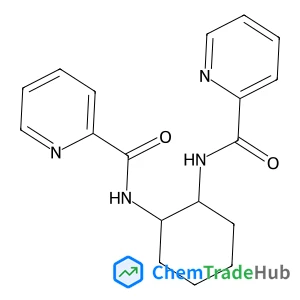
N,N'-(1R,2R)-1,2-Cyclohexanediyldi(2-pyridinecarboxamide)
CAS Number:
218290-24-5
Molecular Formula:
C18H20N4O2
Recommended Suppliers






Disclaimer
This page provides academic journal information for reference and research purposes only. We are not affiliated with any journal publishers and do not handle publication submissions. For publication-related inquiries, please contact the respective journal publishers directly.
If you notice any inaccuracies in the information displayed, please contact us at support@chemtradehub.com. We will promptly review and address your concerns.