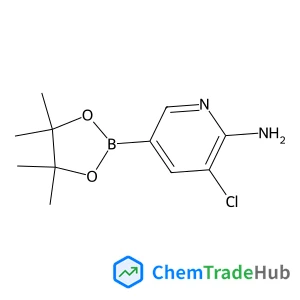
3-Chloro-5-(4,4,5,5-tetramethyl-1,3,2-dioxaborolan-2-yl)-2-pyridinamine
CAS Number:
1032758-99-8
Molecular Formula:
C11H16BClN2O2
Robert A. Thompson, Joseph S. Francisco, John B. Grutzner
Computational and experimental methods have been utilized to examine the facile dimerization of diazirinyl radicals. Two potential dimers were investigated using density functional theory. Both were shown to have low-barrier reaction coordinates leading to formation of HCN and N2. A cross-over experiment was employed to establish the relative contributions of C–N and N–N dimers towards product formation. The N–N dimerization was found to be dominant under the current conditions, and the corresponding reaction coordinate energetics were further explored using coupled-cluster methods. A detailed mechanism for dimer decomposition is presented. The competition between unimolecular and bimolecular reactions of diazirinyl radicals is explored under high dilution conditions. The high reactivity of the diazirinyl radical as a nitrogen atom transfer agent suggests a possible bimolecular contribution for “prompt” NO formation in hydrocarbon combustion with diazirinyl radicals as intermediates.
Shams Ul Mahmood, Huimin Cheng, Sreedhar R. Tummalapalli, Ramappa Chakrasali, Rammohan R. Yadav Bheemanaboina, Tamara Kreiss, Agnieska Chojnowski, Tyler Eck, John J. Siekierka, David P. Rotella
DOI: 10.1039/C9MD00511K
Filomena Mattner, Thomas Bourdier, Christian Loc'h, Paula Berghofer, Christopher Fookes, Tzong-Tyng Hung, Timothy Jackson, David Henderson, Tien Pham, Brendan J. Lee, Rachael Shepherd, Ivan Greguric, Naomi Wyatt, Thanh Le, Jackson Poon, Carl Power
DOI: 10.1039/D1MD00035G
João Paulo B. Lopes, Luana Silva, Diogo S. Lüdtke
DOI: 10.1039/D1MD00217A
Peter D. Roselt
DOI: 10.1039/D0MD00140F
Liam Berry, Marc Brizuela, Gregory Jackson
DOI: 10.1039/D1MD00206F
Runfeng Lin, Zheng Zhang, Shengtian Cao, Wen Yang, Yinglin Zuo, Xinye Yang, Jiancun Zhang, Juan Xu, Jing Li, Xiaojun Wang
DOI: 10.1039/D1MD00023C
Kelly Yang, Racquel Harrison
DOI: 10.1039/D1MD00194A
Vinicius Bonatto, Pedro Henrique Jatai Batista, Lorenzo Cianni, Daniela De Vita, Daniel G. Silva, Rodrigo Cedron, Sérgio de Albuquerque, Carolina Borsoi Moraes, Caio Haddad Franco, Andrei Leitão, Carlos A. Montanari
DOI: 10.1039/D0MD00097C
Sven N. Hobbie, Andrea Vasella, Erik C. Böttger
DOI: 10.1039/D1MD00214G
Alexander W. Weig, Samantha L. Barlock, Patrick M. O'Connor, Orry M. Marciano, Richard Smith, Robert K. Ernst, Roberta J. Melander, Christian Melander
DOI: 10.1039/D0MD00238K
This compound is mainly used as an intermediate in the synthesis of antipsychoti...
Waste containing 1-(D-Ribofuranosyl)-1,4-dihydro-3-pyridinecarboxamide (CAS: 191...
2-Methyl-2-propanyl 3-bromo-3-(hydroxymethyl)-1-azetidinecarboxylate (CAS: 20079...
N-(4-Chloro-2-pyridinyl)acetamide (CAS: 245056-66-0) is a chemical compound with...
5-Chloro-2-hydroxybenzoic acid, also known as 5-chlorosalicylic acid, is an arom...
When handling 1,1-Dichloro-1-fluoroethane (CAS: 1717-00-6), it is important to u...
Fmoc-(2S,3R)-3-phenylpyrrolidine-2-carboxylic acid is a white crystalline solid ...
4-Amino-5-bromo-2-pyridinecarboxylic acid is primarily used as a precursor in th...
Handling this compound should be done with personal protective equipment (PPE) i...
When handling 8-bromo-2,2-dimethyl-3,4-dihydro-2H-1,4-benzoxazin-3-one, use prop...

Physical Chemistry Chemical Physics (PCCP) is an international journal co-owned by 19 physical chemistry and physics societies from around the world. This journal publishes original, cutting-edge research in physical chemistry, chemical physics and biophysical chemistry. To be suitable for publication in PCCP, articles must include significant innovation and/or insight into physical chemistry; this is the most important criterion that reviewers and Editors will judge against when evaluating submissions. The journal has a broad scope and welcomes contributions spanning experiment, theory, computation and data science. Topical coverage includes spectroscopy, dynamics, kinetics, statistical mechanics, thermodynamics, electrochemistry, catalysis, surface science, quantum mechanics, quantum computing and machine learning. Interdisciplinary research areas such as polymers and soft matter, materials, nanoscience, energy, surfaces/interfaces, and biophysical chemistry are welcomed if they demonstrate significant innovation and/or insight into physical chemistry. Joined experimental/theoretical studies are particularly appreciated when complementary and based on up-to-date approaches.