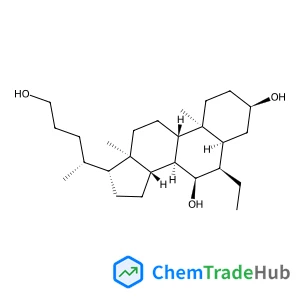
(3alpha,5beta,6alpha,7alpha)-6-Ethylcholane-3,7,24-triol
CAS Number:
1537866-49-1
Molecular Formula:
C26H46O3
Abhishek Shahi, Elangannan Arunan
One hundred complexes have been investigated exhibiting D–X⋯A interactions, where X = H, Cl or Li and DX is the ‘X bond’ donor and A is the acceptor. The optimized structures of all these complexes have been used to propose a generalized ‘Legon–Millen rule’ for the angular geometry in all these interactions. A detailed Atoms in Molecules (AIM) theoretical analysis confirms an important conclusion, known in the literature: there is a strong correlation between the electron density at the X⋯A bond critical point (BCP) and the interaction energy for all these interactions. In addition, we show that extrapolation of the fitted line leads to the ionic bond for Li-bonding (electrostatic) while for hydrogen and chlorine bonding, it leads to the covalent bond. Further, we observe a strong correlation between the change in electron density at the D–X BCP and that at the X⋯A BCP, suggesting conservation of the bond order. The correlation found between penetration and electron density at BCP can be very useful for crystal structure analysis, which relies on arbitrary van der Waals radii for estimating penetration. Various criteria proposed for shared- and closed-shell interactions based on electron density topology have been tested for H/Cl/Li bonded complexes. Finally, using the natural bond orbital (NBO) analysis it is shown that the D–X bond weakens upon X bond formation, whether it is ionic (DLi) or covalent (DH/DCl) and the respective indices such as ionicity or covalent bond order decrease. Clearly, one can think of conservation of bond order that includes ionic and covalent contributions to both D–X and X⋯A bonds, for not only X = H/Cl/Li investigated here but also any atom involved in intermolecular bonding.
Gebhard Haberhauer, Thomas Oeser, Frank Rominger
DOI: 10.1039/B406335J
Satoshi Horike, Ryotaro Matsuda, Ryo Kitaura, Susumu Kitagawa, Takahiro Iijima, Kazunaka Endo, Yoshiki Kubota, Masaki Takata
DOI: 10.1039/B406883A
S. Bordiga, C. Lamberti, G. Ricchiardi, L. Regli, F. Bonino, A. Damin, K.-P. Lillerud, M. Bjorgen, A. Zecchina
DOI: 10.1039/B407246D
Heinz-Bernhard Kraatz, Jeremy S. Lee
DOI: 10.1039/B406689H
Prasad V. Ganesan, Cameron J. Kepert
DOI: 10.1039/B409543J
Nora Iancu, Renu Sharma, Dong-Kyun Seo
DOI: 10.1039/B408702J
Xile Hu, Ingrid Castro-Rodriguez, Karsten Meyer
DOI: 10.1039/B409241D
Fouzi Mouffouk, Simon J. Higgins, Stewart J. Brown, Naser Sedghi, Bill Eccleston, Stuart Reeman
DOI: 10.1039/B408935A
Xiao-Ti Zhou, Rich G. Carter
DOI: 10.1039/B410092A
Chang-Cheng You, Chantu R. Saha-Möller, Frank Würthner
DOI: 10.1039/B407551J
N-(4-Methoxybenzyl)-2-pyridinamine (CAS: 52818-63-0) is increasingly being used ...
When handling Ethyl 4-(2-chlorophenyl)-1,3-thiazole-2-carboxylate, appropriate p...
Diethyldiselane (CAS: 628-39-7) is classified under the Globally Harmonized Syst...
The market for oxocopper (CAS: 12053-18-8) is primarily driven by its use in cat...
The market for 5-{[(2-Methyl-2-propanyl)oxy]carbonyl}-5-azaspiro[2.4]heptane-7-c...
2-(1-Pyrrolidinyl)-4-pyridinamine is a chemical compound with the CAS number 359...
2-(3-Pyridinyl)-1-azabicyclo[2.2.2]octane (CAS: 91556-75-1) is a crystalline sol...
(S)-Alpha-allyl-proline hydrochloride is usually synthesized via a Wittig reacti...
3-Methyl-1,2-oxazole-5-carboxylic acid (CAS: 4857-42-5) is an organic compound w...
Lys-SMCC-DM1 is synthesized via a multi-step process involving the coupling of S...

Physical Chemistry Chemical Physics (PCCP) is an international journal co-owned by 19 physical chemistry and physics societies from around the world. This journal publishes original, cutting-edge research in physical chemistry, chemical physics and biophysical chemistry. To be suitable for publication in PCCP, articles must include significant innovation and/or insight into physical chemistry; this is the most important criterion that reviewers and Editors will judge against when evaluating submissions. The journal has a broad scope and welcomes contributions spanning experiment, theory, computation and data science. Topical coverage includes spectroscopy, dynamics, kinetics, statistical mechanics, thermodynamics, electrochemistry, catalysis, surface science, quantum mechanics, quantum computing and machine learning. Interdisciplinary research areas such as polymers and soft matter, materials, nanoscience, energy, surfaces/interfaces, and biophysical chemistry are welcomed if they demonstrate significant innovation and/or insight into physical chemistry. Joined experimental/theoretical studies are particularly appreciated when complementary and based on up-to-date approaches.
![1-oxaspiro[4.4]nonan-6-one structure](https://static.chemtradehub.com/structs/134/134179-01-4-e051.webp "1-oxaspiro[4.4]nonan-6-one structure")