











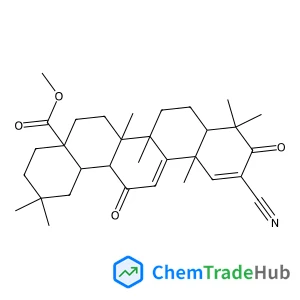
Methyl 2-cyano-3,12-dioxooleana-1,9(11)-dien-28-oate
CAS Number:
218600-53-4
Molecular Formula:
C32H43NO4
Mark R. Smith, Roger D. Jee, Anthony C. Moffat, David R. Rees, Neville W. Broad
A novel optimisation algorithm is presented for full spectrum calibration models in near-infrared (NIR) spectroscopy. The algorithm is used to investigate the affect of removing continuous spectral regions on parameters critical to the validity of the model (e.g. explained variance, bias etc.) and ultimately identify and remove problem areas of the spectrum. As an example of its application, this paper shows how to optimise partial least squares regression (PLSR) calibration models for predicting moisture content within an intact pharmaceutical product and how problems due to changes in the nature of samples since setting up the original model may be eliminated. On application of two validated calibration models to a new set of samples unacceptable results were obtained for bias (−0.26 and −0.21% m/m moisture content) between the NIR predicted values and the true values (Karl Fischer analysis). The optimisation algorithm identified small regions of the spectrum, which if included in development of the models contributed significant bias to the final prediction. On removal of these problem regions the calibration models were found to be equally accurate and precise, but with the added advantage of robustness to a variable region of the sample spectrum (bias reduced to −0.05 and −0.09% m/m).
Maxime Colpaert, Sanjib Banerjee, Vincent Ladmiral, Taizo Ono, Bruno Améduri
DOI: 10.1039/C7PY02018J
Anna Eibel, Judith Radebner, Michael Haas, David E. Fast, Hilde Freißmuth, Eduard Stadler, Paul Faschauner, Ana Torvisco, Iris Lamparth, Norbert Moszner, Harald Stueger, Georg Gescheidt
DOI: 10.1039/C7PY01590A
Bin Mu, Xingtian Hao, Jian Chen, Qian Li, Chunxiu Zhang, Dongzhong Chen
DOI: 10.1039/C7PY00364A
Karen Freytag, Stefanie Säfken, Kai Wolter, Jan C. Namyslo, Eike G. Hübner
DOI: 10.1039/C7PY01487B
Shaojun Chen, Jianfeng Ban, Luona Mu, Haitao Zhuo
DOI: 10.1039/C7PY01913K
Jianhua Han, Zhihuan Weng, Zuoqiang Wu, Jingwen Cai, Jinyan Wang, Xigao Jian
DOI: 10.1039/C7PY00802C
Minh T. Nguyen, Richard A. Jones, Bradley J. Holliday
DOI: 10.1039/C7PY00673J
P. Reinold, K. Bruchlos, S. Ludwigs
DOI: 10.1039/C7PY01688C
Yingying Zhang, Pingchuan Shen, Bairong He, Wenwen Luo, Zujin Zhao
DOI: 10.1039/C7PY01700F
Feng Wang, Charles E. Diesendruck
DOI: 10.1039/C7PY00712D
When handling 4-(2-Furylmethyl)thiomorpholine 1,1-dioxide (CAS: 79206-94-3), it ...
When handling 4-Chloro-N-[2-(4-morpholinyl)ethyl]benzamide (CAS: 71320-77-9), it...
Waste containing this compound (CAS: 62921-74-8) should be handled according to ...
Waste containing (S)-Methyl 2-amino-3-cyclohexylpropanoate should be collected i...
This compound can be synthesized using a multi-step process involving the conjug...
There are several alternatives to (2E)-3-(3,4-Dichlorophenyl)acrylic acid in syn...
Ethyl 6-(2-nitrophenyl)imidazo[2,1-b][1,3]thiazole-3-carboxylate (CAS: 925437-84...
Waste containing 2-(1,3-Thiazol-2-yl)ethanamine (CAS: 18453-07-1) should be coll...
Methyl 5-iodo-2-methylbenzoate can be synthesized through the iodination of meth...
5-Chloro[1,2,4]triazolo[1,5-a]pyridine is commonly synthesized via the condensat...

Analyst publishes analytical and bioanalytical research that reports premier fundamental discoveries and inventions, and the applications of those discoveries, unconfined by traditional discipline barriers.

![[4-Amino-2-(methylsulfanyl)-5-pyrimidinyl]methanol structure](https://static.chemtradehub.com/structs/588/588-36-3-fc73.webp "[4-Amino-2-(methylsulfanyl)-5-pyrimidinyl]methanol structure")


