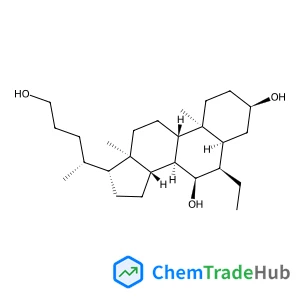
(3alpha,5beta,6alpha,7alpha)-6-Ethylcholane-3,7,24-triol
CAS Number:
1537866-49-1
Molecular Formula:
C26H46O3
James D. Crowley, Andrew J. Goshe, Brice Bosnich
Two supramolecular trigonal prisms, each bearing three molecular clefts are shown to form 1:6 and 1:7 host–guest complexes with 9-methylanthracene and one of the prisms forms a 1:2 host–guest complex with a tritopic tri-anthracene guest that registers with the recognition sites of the host.
Jianru Wang, Yan Zhao, Xiaoyan Qiao
DOI: 10.1039/C4CP02298J
Yuranan Hanlumyuang, Xiaobao Li
DOI: 10.1039/C4CP03131H
Reinhard Schweitzer-Stenner, Siobhan E. Toal
DOI: 10.1039/C4CP02108H
Shoshi Terada, Toshihiko Mandai, Risa Nozawa, Kazuki Yoshida, Kazuhide Ueno, Seiji Tsuzuki, Masayoshi Watanabe
DOI: 10.1039/C4CP00746H
Antonio Leal, David Mateo, Alberto Hernando, Martí Pi, Manuel Barranco
DOI: 10.1039/C4CP03297G
Hyun S. Park, Chong-Yong Lee, Erwin Reisner
DOI: 10.1039/C4CP03883E
Pavuluri Srinivasu, Koppoju Suresh, Gopal Datt, Ashutosh C. Abhayankar, Pothuraju Nageswara Rao, Mannepalli Lakshmi Kantam, Suresh K. Bhargava, Jing Tang, Yusuke Yamauchi
DOI: 10.1039/C4CP03216K
N-(4-Methoxybenzyl)-2-pyridinamine (CAS: 52818-63-0) is increasingly being used ...
When handling Ethyl 4-(2-chlorophenyl)-1,3-thiazole-2-carboxylate, appropriate p...
Diethyldiselane (CAS: 628-39-7) is classified under the Globally Harmonized Syst...
The market for oxocopper (CAS: 12053-18-8) is primarily driven by its use in cat...
The market for 5-{[(2-Methyl-2-propanyl)oxy]carbonyl}-5-azaspiro[2.4]heptane-7-c...
2-(1-Pyrrolidinyl)-4-pyridinamine is a chemical compound with the CAS number 359...
2-(3-Pyridinyl)-1-azabicyclo[2.2.2]octane (CAS: 91556-75-1) is a crystalline sol...
(S)-Alpha-allyl-proline hydrochloride is usually synthesized via a Wittig reacti...
3-Methyl-1,2-oxazole-5-carboxylic acid (CAS: 4857-42-5) is an organic compound w...
Lys-SMCC-DM1 is synthesized via a multi-step process involving the coupling of S...

ChemComm publishes urgent research which is of outstanding significance and interest to experts in the field, while also appealing to the journal’s broad chemistry readership. Our communication format is ideally suited to short, urgent studies that are of such importance that they require accelerated publication. Our scope covers all topics in chemistry, and research at the interface of chemistry and other disciplines (such as materials science, nanoscience, physics, engineering and biology) where there is a significant novelty in the chemistry aspects. Major topic areas covered include: Analytical Chemistry Catalysis Chemical Biology and medicinal chemistry Computational Chemistry and Machine Learning Energy and sustainable chemistry Environmental Chemistry Green Chemistry Inorganic Chemistry Materials Chemistry Nanoscience Organic Chemistry Physical Chemistry Polymer Chemistry Supramolecular Chemistry
![1-(1-Benzyl-1,2,3,6-tetrahydropyridin-4-yl)-1H-benzo[d]imidazol-2(3H)-one structure](https://static.chemtradehub.com/structs/603/60373-71-9-7dfb.webp "1-(1-Benzyl-1,2,3,6-tetrahydropyridin-4-yl)-1H-benzo[d]imidazol-2(3H)-one structure")