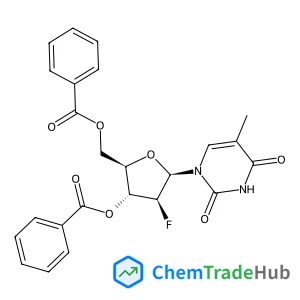
1-(3',5'-Di-O-benzoyl-2'-deoxy-2'-fluoro-b-D-arabinofuranosyl)thymine
CAS Number:
97614-47-6
Molecular Formula:
C24H21FN2O7
Hiroto Yoshida, Yasuhito Yamaryo, Joji Ohshita, Atsutaka Kunai
Oxidative homocoupling reaction of aryl- or alkynylsilanes was found to proceed without any added activators using a catalytic amount of a palladium–1,3-bis(diphenylphosphino)propane complex, affording the corresponding biaryls or 1,3-diynes in modest to excellent yields.
Mikinori Ando, Mika Sakai, Naoki Ando, Masato Hirai
DOI: 10.1039/C9OB00934E
Paige Dickson, Thomas Kodadek
DOI: 10.1039/C9OB00581A
Jingbo Yu, Chao Zhang, Xinjie Yang, Weike Su
DOI: 10.1039/C9OB00622B
Babulal Das
DOI: 10.1039/C9OB01157A
Jonathan W. Bogart, Albert A. Bowers
DOI: 10.1039/C8OB03155J
Yogesh Jaiswal, Yogesh Kumar, Amit Kumar
DOI: 10.1039/C9OB01082C
Soumi Laha, Dharmendra K. Tiwari, B. Sridhar
DOI: 10.1039/C9OB00560A
Hiromu Kashida, Yuta Kokubo, Koki Makino, Hiroyuki Asanuma
DOI: 10.1039/C9OB00946A
Vimal Kant Harit, Namakkal G. Ramesh
DOI: 10.1039/C9OB01010F
Mustafa Uygur, Olga García Mancheño
DOI: 10.1039/C9OB00834A
(3.beta.)-3-Hydroxy-N,N-dimethyl-chol-5-en-24-amide (CAS: 79066-03-8) is primari...
5-(Aminomethyl)-2-methoxyphenol (CAS: 89702-89-6) is classified under GHS as a s...
Thieno[2,3-c]pyridin-7(6H)-one (CAS: 28981-13-7) is a heterocyclic organic compo...
1-[(6-Methoxy-3-pyridinyl)methyl]-4-piperidinamine dihydrochloride is generally ...
[(2E)-3-Phenyl-2-propen-1-yl]phosphonic acid (CAS: 146404-58-2) is regulated und...
6-Bromo-7-methoxyquinoline (CAS: 1620515-86-7) falls under the scope of the Glob...
This compound is primarily used in the pharmaceutical industry for the developme...
1-Ethyl-7-[2-methyl-6-(4H-1,2,4-triazol-3-yl)-3-pyridinyl]-3,5-dihydropyrazino[2...
Alternative reagents such as 2-[(dimethylamino)methyl]phenylboronic acid or rela...
3-(Piperidin-4-yloxy)pyridine (CAS: 310881-48-2) is an organic compound with the...

ChemComm publishes urgent research which is of outstanding significance and interest to experts in the field, while also appealing to the journal’s broad chemistry readership. Our communication format is ideally suited to short, urgent studies that are of such importance that they require accelerated publication. Our scope covers all topics in chemistry, and research at the interface of chemistry and other disciplines (such as materials science, nanoscience, physics, engineering and biology) where there is a significant novelty in the chemistry aspects. Major topic areas covered include: Analytical Chemistry Catalysis Chemical Biology and medicinal chemistry Computational Chemistry and Machine Learning Energy and sustainable chemistry Environmental Chemistry Green Chemistry Inorganic Chemistry Materials Chemistry Nanoscience Organic Chemistry Physical Chemistry Polymer Chemistry Supramolecular Chemistry
![Ethanone, 1-[4-chloro-2-(methylthio)-5-pyrimidinyl]- structure](https://static.chemtradehub.com/structs/661/66116-82-3-863e.webp "Ethanone, 1-[4-chloro-2-(methylthio)-5-pyrimidinyl]- structure")
![N-[4-(Cyanoethynyl)phenyl]-16-oxo-4,7,10,13-tetraoxa-17-azahenicos-1-yn-21-amide structure](https://static.chemtradehub.com/structs/218/2183440-36-8-68cb.webp "N-[4-(Cyanoethynyl)phenyl]-16-oxo-4,7,10,13-tetraoxa-17-azahenicos-1-yn-21-amide structure")