











Dehydroamino acids: chemical multi-tools for late-stage diversification
Literature Information
Publication Date
2019-02-27
DOI
10.1039/C8OB03155J
Impact Factor
3.876
Authors
Jonathan W. Bogart, Albert A. Bowers
View Original
Abstract
α,β-Dehydroamino acids (dhAAs) are noncanonical amino acids that are found in a wide array of natural products and can be easily installed into peptides and proteins. dhAAs exhibit remarkable synthetic flexibility, readily undergoing a number of reactions, such as polar and single-electron additions, transition metal catalyzed cross-couplings, and cycloadditions. Because of the relatively mild conditions required for many of these reactions, dhAAs are increasingly being used as orthogonal chemical handles for late-stage modification of biomolecules. Still, only a fraction of the chemical reactivity of dhAAs has been exploited in such biorthogonal applications. Herein, we provide an overview of the broad spectrum of chemical reactivity of dhAAs, with special emphasis on recent efforts to adapt such transformations for biomolecules such as natural products, peptides, and proteins. We also discuss examples of enzymes from natural product biosynthetic pathways that have been found to catalyze many similar reactions; these enzymes provide mild, regio- and stereoselective, biocatalytic alternatives for future development. We anticipate that the continued investigation of the innate reactivity of dhAAs will furnish a diverse portfolio dhAA-based chemistries for use in chemical biology and drug discovery.
Related Literature
Stainless steel surfaces with thiol-terminated hyperbranched polymers for functionalization viathiol-based chemistry
Wen Jing Yang, Koon-Gee Neoh, En-Tang Kang, Serena Lay-Ming Teo, Daniel Rittschof
2013-03-01
Paper
DOI: 10.1039/C3PY00009E
Light induced molecular release from vesicles based on amphiphilic linear-dendritic block copolymers
Eva Blasco, Jesús del Barrio, Carlos Sánchez-Somolinos, Milagros Piñol, Luis Oriol
2012-12-20
Paper
DOI: 10.1039/C2PY21025H
Activation of homogenous polyolefin catalysis with a machine-assisted reactor laboratory-in-a-box (μAIR-LAB)
Benjamin A. Rizkin, Ryan L. Hartman
2020-06-18
Paper
DOI: 10.1039/D0RE00139B
A novel polytriazole-based organogel formed by the effects of copper ions
Yujing Li, Liqiang Wan, Hao Zhou, Farong Huang, Lei Du
2013-04-10
Communication
DOI: 10.1039/C3PY00227F
Optimization, automation and validation of the large-scale radiosynthesis of Al18F tracers in a custom-made automatic platform for high yield
Zhiguo Liu, Lun Yu, Kai Cheng, Yabo Feng, Pengfei Qiu, Yongkang Gai, Ming Zhou
2020-06-04
Paper
DOI: 10.1039/D0RE00144A
New insights into radical and cationic polymerizations upon visible light exposure: role of novel photoinitiator systems based on the pyrene chromophore
Mohamad-Ali Tehfe, Frédéric Dumur, Emmanuel Contal, Bernadette Graff, Fabrice Morlet-Savary, Didier Gigmes, Jean-Pierre Fouassier, Jacques Lalevée
2012-12-07
Paper
DOI: 10.1039/C2PY20950K
Ultrafine silver nanoparticles with excellent antibacterial efficacy prepared by a handover of vesicle templating to micelle stabilization
Hang Lu, Li Yu, Qiuming Liu, Jianzhong Du
2013-04-23
Communication
DOI: 10.1039/C3PY00393K
Synthesis, photophysical and photovoltaic properties of a new class of two-dimensional conjugated polymers containing donor–acceptor chromophores as pendant groups
Yu-Ying Lai, Yen-Ju Cheng, Chiu-Hsiang Chen, Sheng-Wen Cheng, Fong-Yi Cao, Chain-Shu Hsu
2013-03-18
Paper
DOI: 10.1039/C3PY00168G
Nucleophilic thiol-Michael chemistry and hyperbranched (co)polymers: synthesis and ring-opening metathesis (co)polymerization of novel difunctional exo-7-oxanorbornenes with in situ inimer formation
Meina Liu, Beng Hoon Tan, Robert P. Burford, Andrew B. Lowe
2013-04-08
Paper
DOI: 10.1039/C3PY00110E
You might also like
Compound Q&A
What is 1-(2,4,6-Trifluorophenyl)ethanol (CAS: 1250113-83-7)?
1-(2,4,6-Trifluorophenyl)ethanol is an organic compound with the CAS number 1250...
1250113-83-71-(2,4,6-Trifluoroph...
Compound Q&A
Is 1-(2,4-Dimethoxybenzyl)-4-(hydroxymethyl)-2-pyrrolidinone (CAS: 919111-34-5) safe?
1-(2,4-Dimethoxybenzyl)-4-(hydroxymethyl)-2-pyrrolidinone (CAS: 919111-34-5) is ...
919111-34-51-(2,4-Dimethoxybenz...
Compound Q&A
What are the physical and chemical properties of (7S,15R)-6β,15-Diacetoxy-7α,20-epoxy-7-hydroxykaura-2,16-dien-1-one (CAS: 51419-51-3)?
(7S,15R)-6β,15-Diacetoxy-7α,20-epoxy-7-hydroxykaura-2,16-dien-1-one is a crystal...
51419-51-3(7S,15R)-6β,15-Diace...
Compound Q&A
What regulatory guidelines apply to rac-ethyl (1r,4r)-4-hydroxycyclohexane-1-carboxylate, trans (CAS: 3618-04-0)?
The compound rac-ethyl (1r,4r)-4-hydroxycyclohexane-1-carboxylate, trans (CAS: 3...
3618-04-0rac-ethyl (1r,4r)-4-...
Compound Q&A
What is the market or research trend for 2-(2,4-Difluorophenoxy)-3-nitropyridine (CAS: 175135-62-3)?
The market for 2-(2,4-Difluorophenoxy)-3-nitropyridine (CAS: 175135-62-3) is cur...
175135-62-32-(2,4-Difluoropheno...
Compound Q&A
What are the main uses of 6-Diazo-5-oxo-L-norleucine (CAS: 157-03-9)?
The main uses of 6-Diazo-5-oxo-L-norleucine (CAS: 157-03-9) include research in ...
157-03-96-Diazo-5-oxo-L-norl...
Compound Q&A
What precautions should be taken when handling 2-Aminoethyl-mono-amide-DOTA-tris(tBu ester) (CAS: 173308-19-5)?
When handling 2-Aminoethyl-mono-amide-DOTA-tris(tBu ester) (CAS: 173308-19-5), i...
173308-19-52-Aminoethyl-mono-am...
Compound Q&A
How is 5-Methylimidazo[1,2-a]pyridine-3-carbaldehyde (CAS: 178488-37-4) typically synthesized?
5-Methylimidazo[1,2-a]pyridine-3-carbaldehyde (CAS: 178488-37-4) can be synthesi...
178488-37-45-Methylimidazo[1,2-...
Compound Q&A
Are there alternatives to 2,4,6-Trihydroxyisophthalaldehyde (CAS: 4396-13-8) in synthesis?
There are alternative reagents that can be used in the synthesis of 2,4,6-Trihyd...
4396-13-82,4,6-Trihydroxyisop...
Compound Q&A
What is (2Z)-3-(5-Fluoro-1H-indol-3-yl)-2-sulfanylacrylic acid (CAS: 179461-52-0)?
(2Z)-3-(5-Fluoro-1H-indol-3-yl)-2-sulfanylacrylic acid is a chemical compound wi...
179461-52-0(2Z)-3-(5-Fluoro-1H-...
Source Journal
Organic & Biomolecular Chemistry

CiteScore:
3.4
Self-citation Rate:
10.3%
Articles per Year:
1041
Organic & Biomolecular Chemistry (OBC) publishes original and high impact research and reviews in organic chemistry. We welcome research that shows new or significantly improved protocols or methodologies in total synthesis, synthetic methodology or physical and theoretical organic chemistry as well as research that shows a significant advance in the organic chemistry or molecular design aspects of chemical biology, catalysis, supramolecular and macromolecular chemistry, theoretical chemistry, mechanism-oriented physical organic chemistry, medicinal chemistry or natural products. Articles published in the journal should report new work which makes a highly-significant impact in the field. Routine and incremental work is generally not suitable for publication in the journal. More details about key areas of our scope are below. In all cases authors should include in their article clear rationale for why their research has been carried out.
Recommended Compounds
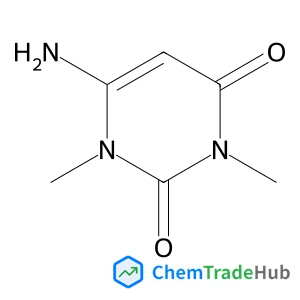
6-amino-1,3-dimethyl-1,2,3,4-tetrahydropyrimidine-2,4-dione
CAS Number:
6642-31-5
Molecular Formula:
C6H9N3O2
Recommended Suppliers





Disclaimer
This page provides academic journal information for reference and research purposes only. We are not affiliated with any journal publishers and do not handle publication submissions. For publication-related inquiries, please contact the respective journal publishers directly.
If you notice any inaccuracies in the information displayed, please contact us at support@chemtradehub.com. We will promptly review and address your concerns.