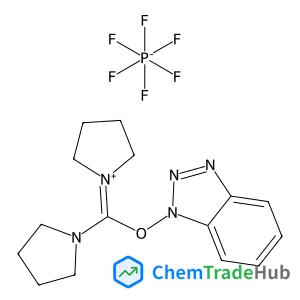
(1H-Benzotriazol-1-yloxy)(di-1-pyrrolidinyl)methylium hexafluorophosphate
CAS Number:
105379-24-6
Molecular Formula:
C15H21F6N5OP
Rachel L. Toomes
The hydrogen abstraction reactions of atomic chlorine with ethane and n-butane are studied in a skimmerless crossed molecular beam experiment by imaging of state-selected products. The differential cross section for HCl(v = 0, J = 1–5) product is directly determined from the product velocity map image. The state selection of products is achieved using (2 + 1) resonance enhanced multiphoton ionization, a method generally not used in crossed-molecular beam experiments due to sensitivity problems. This technique opens the way for a plethora of polyatomic reactions (involving more than three atoms) to be studied with scattering angle and rotational resolution.

NDT & E International

Herald of the Russian Academy of Sciences

Chinese Journal of Chemistry

Journal of Asian Natural Products Research

Main Group Chemistry

Bioorganic & Medicinal Chemistry Letters

Critical Reviews in Solid State and Materials Sciences

Medicinal Chemistry Research

Topics in Catalysis

Biocatalysis and Biotransformation
G. E. Davydyuk, H. Kamarudin, G. L. Myronchuk, S. P. Danylchuk, A. O. Fedorchuk, L. V. Piskach, M. Yu. Mozolyuk, O. V. Parasyuk
DOI: 10.1039/C3CP50836F
Ying Hua, Pascale Changenet-Barret, Thomas Gustavsson, Dimitra Markovitsi
DOI: 10.1039/C3CP00060E
Terry D. Humphries, Derek Birkmire, Bjørn C. Hauback, G. Sean McGrady, Craig M. Jensen
DOI: 10.1039/C3CP50777G
Irina V. Chernyshova, Sathish Ponnurangam, Ponisseril Somasundaran
DOI: 10.1039/C3CP44264K
Marco Micciarelli, Carlo Altucci, Bartolomeo Della Ventura, Raffaele Velotta, Valer Toşa, Adán B. Gónzalez Pérez, Martin Pérez Rodríguez, Ángel R. de Lera, Attila Bende
DOI: 10.1039/C3CP50343G
Amitaksha Saha, Chellappan Vijila, Rajan Jose, Zhang Jie, Seeram Ramakrishna
DOI: 10.1039/C3CP50994J
Dong Jun Kim, Sang Jin Kim, Dong Kyu Roh, Jong Hak Kim
DOI: 10.1039/C3CP44308F
Dominik Oschetzki, Xiaoqing Zeng, Helmut Beckers, Klaus Banert, Guntram Rauhut
DOI: 10.1039/C3CP50268F
When handling 4-(2-Furylmethyl)thiomorpholine 1,1-dioxide (CAS: 79206-94-3), it ...
When handling 4-Chloro-N-[2-(4-morpholinyl)ethyl]benzamide (CAS: 71320-77-9), it...
Waste containing this compound (CAS: 62921-74-8) should be handled according to ...
Waste containing (S)-Methyl 2-amino-3-cyclohexylpropanoate should be collected i...
This compound can be synthesized using a multi-step process involving the conjug...
There are several alternatives to (2E)-3-(3,4-Dichlorophenyl)acrylic acid in syn...
Ethyl 6-(2-nitrophenyl)imidazo[2,1-b][1,3]thiazole-3-carboxylate (CAS: 925437-84...
Waste containing 2-(1,3-Thiazol-2-yl)ethanamine (CAS: 18453-07-1) should be coll...
Methyl 5-iodo-2-methylbenzoate can be synthesized through the iodination of meth...
5-Chloro[1,2,4]triazolo[1,5-a]pyridine is commonly synthesized via the condensat...

Physical Chemistry Chemical Physics (PCCP) is an international journal co-owned by 19 physical chemistry and physics societies from around the world. This journal publishes original, cutting-edge research in physical chemistry, chemical physics and biophysical chemistry. To be suitable for publication in PCCP, articles must include significant innovation and/or insight into physical chemistry; this is the most important criterion that reviewers and Editors will judge against when evaluating submissions. The journal has a broad scope and welcomes contributions spanning experiment, theory, computation and data science. Topical coverage includes spectroscopy, dynamics, kinetics, statistical mechanics, thermodynamics, electrochemistry, catalysis, surface science, quantum mechanics, quantum computing and machine learning. Interdisciplinary research areas such as polymers and soft matter, materials, nanoscience, energy, surfaces/interfaces, and biophysical chemistry are welcomed if they demonstrate significant innovation and/or insight into physical chemistry. Joined experimental/theoretical studies are particularly appreciated when complementary and based on up-to-date approaches.