












Parametrization of an effective correlated hamiltonian for hole transfer in large DNA strands
Literature Information
Publication Date
2003-04-14
DOI
10.1039/B300807J
Impact Factor
3.676
Authors
Guillaume Brunaud, Frédéric Castet, Alain Fritsch, Laurent Ducasse
View Original
Abstract
The hybrid valence-bond/Hartree–Fock model (VB/HF) [F. Castet, A. Fritsch and L. Ducasse, J. Phys. I (France), 1996, 6, 583; F. Castet, L. Ducasse and A. Fritsch, Chem. Phys., 1998, 232, 37] is used to derive an effective model for conduction holes along DNA nucleoside stacks. The extraction procedure which gives the transfer integrals from the off-diagonal elements of the VB/HF matrix was presented in the first paper of this series [G. Brunaud, F. Castet, A. Fritsch, M. Kreissler and L. J. Ducasse, Phys. Chem. B, 2001, 105, 12 665.]. The remaining electrostatic parameters, introduced here, provide a complete set of transferable intrasite and intersite parameters for the effective hamiltonian. The sensitivity of the effective parameters to the chemical nature of the interacting nucleosides as well as to geometrical fluctuations of the DNA strands is analyzed. It is shown that conformational changes can induce sizeable variations on the effective parameters, in particular on penetration integral values which play a leading role in hole localization properties [G. Brunaud, F. Castet, A. Fritsch and L. Ducasse, Phys. Chem. Chem. Phys., 2002, 4, 6072]. However, these variations do not affect the nature of the most efficient trapping sites, so that the experimental sampling of the charge on guanine sites are quite satisfactorily simulated using the effective parameters calculated from canonical geometries. This point is illustrated in the last part of the paper, in which electron distributions in the ground state of charged DNA sequences are calculated and compared to experimental data.
Related Literature
Mechanism of silsesquioxane growth
Karl Jug, Igor P. Gloriozov
2002-02-06
Paper
DOI: 10.1039/B107803H
On the structure and coordination of the oxygen-donating species in Ti↑MCM-41/TBHP oxidation catalysts: a density functional theory and EXAFS study
Nikolas Kaltsoyannis
2002-03-04
Paper
DOI: 10.1039/B104735N
The effect of flexibility on the phase diagram of simple molecular models
Carlos Vega, Carl McBride, Luis G. MacDowell
2002-01-08
Paper
DOI: 10.1039/B107988N
Conductometric and electrooptic relaxation spectrometry of lipid vesicle electroporation at high fields
T. Griese, S. Kakorin, E. Neumann
2002-02-20
Paper
DOI: 10.1039/B108193B
Thermodynamic properties and dielectric constants in water/methanol mixtures by integral equation theory and molecular dynamics simulations
2002-02-06
Paper
DOI: 10.1039/B108724J
Co-existence of hydrated electron and metal di-cation in [Mg(H2O)n]+
2002-03-07
Paper
DOI: 10.1039/B109774C
Aqueous solutions at pressures up to 2 GPa: gas–gas equilibria, closed loops, high-pressure immiscibility, salt effects and related phenomena
2002-02-12
Paper
DOI: 10.1039/B109277B
Ultrafast dynamics in the excited state of green fluorescent protein (wt) studied by frequency-resolved femtosecond pump-probe spectroscopy
Kathrin Winkler, Jörg Lindner, Vinod Subramaniam, Thomas M. Jovin, Peter Vöhringer
Paper
DOI: 10.1039/B108843B
Controlled pattern formation in the CDIMA reaction with a moving boundary of illumination
Mads Kærn, Razvan Satnoianu, Alberto P. Muñuzuri, Michael Menzinger
2002-03-13
Paper
DOI: 10.1039/B109387H
You might also like
Compound Q&A
What regulatory guidelines apply to 6-Bromo-2-methylimidazo[1,2-a]pyrimidine (CAS: 1111638-05-1)?
6-Bromo-2-methylimidazo[1,2-a]pyrimidine (CAS: 1111638-05-1) falls under various...
1111638-05-16-Bromo-2-methylimid...
Compound Q&A
Are there alternatives to 1-Pyrrolidineethanol, β-methyl-α-phenyl-, (αS,βR) (CAS: 123620-80-4) in synthesis?
While there are no direct alternatives, similar compounds like 1-Pyrrolidineetha...
123620-80-41-Pyrrolidineethanol...
Compound Q&A
Is 4-Methyl-2,6-bis(2-methyl-2-propanyl)phenyl methylcarbamate (CAS: 1918-11-2) safe?
4-Methyl-2,6-bis(2-methyl-2-propanyl)phenyl methylcarbamate (CAS: 1918-11-2) is ...
1918-11-24-Methyl-2,6-bis(2-m...
Compound Q&A
How should 2-(3-Bromo-4-fluorophenyl)-1,3-dioxolane (CAS: 77771-04-1) be stored?
2-(3-Bromo-4-fluorophenyl)-1,3-dioxolane (CAS: 77771-04-1) should be stored in a...
77771-04-12-(3-Bromo-4-fluorop...
Compound Q&A
What are the physical and chemical properties of 4,5,6,7-Tetrahydro-1H-indazole hydrochloride (CAS: 18161-11-0)?
4,5,6,7-Tetrahydro-1H-indazole hydrochloride is a white crystalline solid with a...
18161-11-04,5,6,7-Tetrahydro-1...
Compound Q&A
What is (2R)-1-Methoxy-3-phenyl-2-propanamine (CAS: 59919-07-2)?
(2R)-1-Methoxy-3-phenyl-2-propanamine is a chiral organic compound with the CAS ...
59919-07-2(2R)-1-Methoxy-3-phe...
Compound Q&A
What industries use Ethyl 1-(1-phenylethyl)-1H-imidazole-5-carboxylate (CAS: 56649-47-9)?
Ethyl 1-(1-phenylethyl)-1H-imidazole-5-carboxylate is used in various industries...
56649-47-9Ethyl 1-(1-phenyleth...
Compound Q&A
What regulatory guidelines apply to 4-[(1E,3S)-1-(4-Hydroxyphenyl)-1,4-pentadien-3-yl]phenol (CAS: 17676-24-3)?
4-[(1E,3S)-1-(4-Hydroxyphenyl)-1,4-pentadien-3-yl]phenol (CAS: 17676-24-3) falls...
17676-24-34-[(1E,3S)-1-(4-Hydr...
Compound Q&A
What industries use (S)-3-Amino-5-phenylpentanoic acid hydrochloride (CAS: 331846-97-0)?
(S)-3-Amino-5-phenylpentanoic acid hydrochloride is primarily used in the pharma...
331846-97-0(S)-3-Amino-5-phenyl...
Compound Q&A
How is 7-methoxy-1-benzothiophene-2-carboxylic acid (CAS: 88791-07-5) typically synthesized?
7-Methoxy-1-benzothiophene-2-carboxylic acid is typically synthesized by reactin...
88791-07-57-methoxy-1-benzothi...
Source Journal
Physical Chemistry Chemical Physics

CiteScore:
5.5
Self-citation Rate:
10.3%
Articles per Year:
3036
Physical Chemistry Chemical Physics (PCCP) is an international journal co-owned by 19 physical chemistry and physics societies from around the world. This journal publishes original, cutting-edge research in physical chemistry, chemical physics and biophysical chemistry. To be suitable for publication in PCCP, articles must include significant innovation and/or insight into physical chemistry; this is the most important criterion that reviewers and Editors will judge against when evaluating submissions. The journal has a broad scope and welcomes contributions spanning experiment, theory, computation and data science. Topical coverage includes spectroscopy, dynamics, kinetics, statistical mechanics, thermodynamics, electrochemistry, catalysis, surface science, quantum mechanics, quantum computing and machine learning. Interdisciplinary research areas such as polymers and soft matter, materials, nanoscience, energy, surfaces/interfaces, and biophysical chemistry are welcomed if they demonstrate significant innovation and/or insight into physical chemistry. Joined experimental/theoretical studies are particularly appreciated when complementary and based on up-to-date approaches.
Recommended Compounds
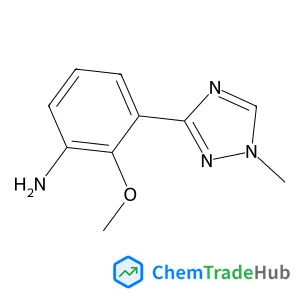
2-Methoxy-3-(1-methyl-1H-1,2,4-triazol-3-yl)aniline
CAS Number:
1609394-10-6
Molecular Formula:
C10H12N4O

Recommended Suppliers




Disclaimer
This page provides academic journal information for reference and research purposes only. We are not affiliated with any journal publishers and do not handle publication submissions. For publication-related inquiries, please contact the respective journal publishers directly.
If you notice any inaccuracies in the information displayed, please contact us at support@chemtradehub.com. We will promptly review and address your concerns.