












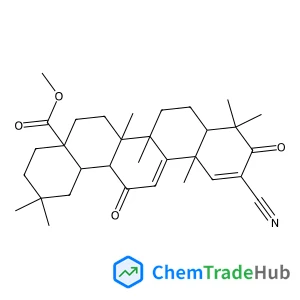
Methyl 2-cyano-3,12-dioxooleana-1,9(11)-dien-28-oate
CAS Number:
218600-53-4
Molecular Formula:
C32H43NO4
Boyapati M. Choudary, Chinta Reddy V. Reddy, Billakanti V. Prakash, Mannepalli L. Kantam, B. Sreedhar
Osmate-exchanged Mg–Al layered double hydroxides catalysed the delivery of two oxygen atoms simultaneously via a 3 + 1 cycloaddition to sulfide to form sulfone directly for the first time, reminiscent of 3 + 2 cycloaddition in asymmetric dihydroxylation reactions.
Zhenli Luo, Xiaoyan Wang
DOI: 10.1039/C2CP40077D
David C. Apperley, A. Fraser Markwell, Ilya Frantsuzov, Andrew J. Ilott, Robin K. Harris, Paul Hodgkinson
DOI: 10.1039/C3CP50180A
Wilbee D. Sasikala, Arnab Mukherjee
DOI: 10.1039/C3CP50501D
Ferdinand Lipps, Seth Levy, A. G. Markelz
DOI: 10.1039/C2CP23760A
Bor Kae Chang, Nicholas C Bristowe, Paul D Bristowe, Anthony K Cheetham
DOI: 10.1039/C2CP23530G
Chi Chen, Ling Miao, Kui Xu, Jie Yao, Chenyang Li, Jianjun Jiang
DOI: 10.1039/C3CP50474C
Zhiwei Lin, Brad Bendiak, Igor V. Rubtsov
DOI: 10.1039/C2CP23245F
Robert J. Salter, Mark A. Blitz, Dwayne E. Heard, Michael J. Pilling, Paul W. Seakins
DOI: 10.1039/C3CP43596B
When handling 4-(2-Furylmethyl)thiomorpholine 1,1-dioxide (CAS: 79206-94-3), it ...
When handling 4-Chloro-N-[2-(4-morpholinyl)ethyl]benzamide (CAS: 71320-77-9), it...
Waste containing this compound (CAS: 62921-74-8) should be handled according to ...
Waste containing (S)-Methyl 2-amino-3-cyclohexylpropanoate should be collected i...
This compound can be synthesized using a multi-step process involving the conjug...
There are several alternatives to (2E)-3-(3,4-Dichlorophenyl)acrylic acid in syn...
Ethyl 6-(2-nitrophenyl)imidazo[2,1-b][1,3]thiazole-3-carboxylate (CAS: 925437-84...
Waste containing 2-(1,3-Thiazol-2-yl)ethanamine (CAS: 18453-07-1) should be coll...
Methyl 5-iodo-2-methylbenzoate can be synthesized through the iodination of meth...
5-Chloro[1,2,4]triazolo[1,5-a]pyridine is commonly synthesized via the condensat...

ChemComm publishes urgent research which is of outstanding significance and interest to experts in the field, while also appealing to the journal’s broad chemistry readership. Our communication format is ideally suited to short, urgent studies that are of such importance that they require accelerated publication. Our scope covers all topics in chemistry, and research at the interface of chemistry and other disciplines (such as materials science, nanoscience, physics, engineering and biology) where there is a significant novelty in the chemistry aspects. Major topic areas covered include: Analytical Chemistry Catalysis Chemical Biology and medicinal chemistry Computational Chemistry and Machine Learning Energy and sustainable chemistry Environmental Chemistry Green Chemistry Inorganic Chemistry Materials Chemistry Nanoscience Organic Chemistry Physical Chemistry Polymer Chemistry Supramolecular Chemistry
![1,2-Diphenyl-4-[2-(phenylsulfinyl)ethyl]-3,5-pyrazolidinedione structure](https://static.chemtradehub.com/structs/57-/57-96-5-efcc.webp "1,2-Diphenyl-4-[2-(phenylsulfinyl)ethyl]-3,5-pyrazolidinedione structure")



