












Carbon dioxide induced separation of ionic liquids and water
Literature Information
Publication Date
2003-01-29
DOI
10.1039/B211376G
Impact Factor
6.222
Authors
Aaron M. Scurto, Sudhir N. V. K. Aki, Joan F. Brennecke
View Original
Abstract
Both hydrophobic and hydrophilic room-temperature ionic liquids can be separated from aqueous solutions with relatively low-pressure gaseous carbon dioxide.
Recommended Journals
Related Literature
A biomimetic approach towards phorone sesterterpenoids
Harry J. Shirley, Christopher D. Bray
2019-07-10
Communication
DOI: 10.1039/C9OB00745H
Solvent-free ruthenium-catalysed triflate coupling as a convenient method for selective azole-o-C–H monoarylation
Taoufik Boubaker, Julien Roger
2019-05-22
Communication
DOI: 10.1039/C9OB00806C
Correction: Enantiomeric NMR discrimination of carboxylic acids using actinomycin D as a chiral solvating agent
Liwen Bai, Pian Chen, Jiangxia Xiang, Jiarui Sun, Xinxiang Lei
2019-03-28
Correction
DOI: 10.1039/C9OB90055A
Decarboxylative acylation of N-free indoles enabled by a catalytic amount of copper catalyst and liquid-assisted grinding
Jingbo Yu, Chao Zhang, Xinjie Yang, Weike Su
2019-04-06
Communication
DOI: 10.1039/C9OB00622B
Selective binding of nucleosides to gapped DNA duplex revealed by orientation and distance dependence of FRET
Hiromu Kashida, Yuta Kokubo, Koki Makino, Hiroyuki Asanuma
2019-05-16
Paper
DOI: 10.1039/C9OB00946A
Synthesis of macrocyclic peptidomimetics via the Ugi-click-strategy
Elena A. Zakharova, Olga I. Shmatova, Irina V. Kutovaya, Valentine G. Nenajdenko
2019-03-04
Paper
DOI: 10.1039/C9OB00229D
Ring closing metathesis (RCM) approach to the synthesis of conduramine B-2, ent-conduramine F-2, aminocyclopentitol and trihydroxyazepane
Vimal Kant Harit, Namakkal G. Ramesh
2019-05-30
Paper
DOI: 10.1039/C9OB01010F
Selectfluor-promoted regioselective chlorination/bromination of 2-aminopyridines and 2-aminodiazines using LiCl/LiBr
Jiao Hu, Gang Zhou, Yawei Tian, Xiaoming Zhao
2019-05-30
Communication
DOI: 10.1039/C9OB00972H
Organoboron synthesis via ring opening coupling reactions
Riccardo Gava, Elena Fernández
2019-06-03
Review Article
DOI: 10.1039/C9OB00989B
Substituent-controlled racemization of dissymmetric coordination capsules
Kentaro Harada, Ryo Sekiya, Takeshi Maehara, Takeharu Haino
2019-03-28
Paper
DOI: 10.1039/C9OB00388F
You might also like
Compound Q&A
What are the main uses of (3.beta.)-3-Hydroxy-N,N-dimethyl-chol-5-en-24-amide (CAS: 79066-03-8)?
(3.beta.)-3-Hydroxy-N,N-dimethyl-chol-5-en-24-amide (CAS: 79066-03-8) is primari...
79066-03-8(3.beta.)-3-Hydroxy-...
Compound Q&A
What regulatory guidelines apply to 5-(aminomethyl)-2-methoxyphenol (CAS: 89702-89-6)?
5-(Aminomethyl)-2-methoxyphenol (CAS: 89702-89-6) is classified under GHS as a s...
89702-89-65-(aminomethyl)-2-me...
Compound Q&A
What is Thieno[2,3-c]pyridin-7(6H)-one (CAS: 28981-13-7)?
Thieno[2,3-c]pyridin-7(6H)-one (CAS: 28981-13-7) is a heterocyclic organic compo...
28981-13-7Thieno[2,3-c]pyridin...
Compound Q&A
Is 1-[(6-Methoxy-3-pyridinyl)methyl]-4-piperidinamine dihydrochloride (CAS: 1185311-28-7) safe?
1-[(6-Methoxy-3-pyridinyl)methyl]-4-piperidinamine dihydrochloride is generally ...
1185311-28-71-[(6-Methoxy-3-pyri...
Compound Q&A
What regulatory guidelines apply to [(2E)-3-Phenyl-2-propen-1-yl]phosphonic acid (CAS: 146404-58-2)?
[(2E)-3-Phenyl-2-propen-1-yl]phosphonic acid (CAS: 146404-58-2) is regulated und...
146404-58-2[(2E)-3-Phenyl-2-pro...
Compound Q&A
What regulatory guidelines apply to 6-Bromo-7-methoxyquinoline (CAS: 1620515-86-7)?
6-Bromo-7-methoxyquinoline (CAS: 1620515-86-7) falls under the scope of the Glob...
1620515-86-76-Bromo-7-methoxyqui...
Compound Q&A
What industries use (2R)-1-(1-Benzofuran-2-yl)-N-propyl-2-pentanamine (CAS: 260550-89-8)?
This compound is primarily used in the pharmaceutical industry for the developme...
260550-89-8(2R)-1-(1-Benzofuran...
Compound Q&A
What are the main uses of 1-Ethyl-7-[2-methyl-6-(4H-1,2,4-triazol-3-yl)-3-pyridinyl]-3,5-dihydropyrazino[2,3-b]pyrazin-2(1H)-one (CAS: 1228013-15-7)?
1-Ethyl-7-[2-methyl-6-(4H-1,2,4-triazol-3-yl)-3-pyridinyl]-3,5-dihydropyrazino[2...
1228013-15-71-Ethyl-7-[2-methyl-...
Compound Q&A
Are there alternatives to {5-(Acryloylamino)-2-[(dimethylamino)methyl]phenyl}boronic acid (CAS: 1217500-78-1) in synthesis?
Alternative reagents such as 2-[(dimethylamino)methyl]phenylboronic acid or rela...
1217500-78-1{5-(Acryloylamino)-2...
Compound Q&A
What is 3-(Piperidin-4-yloxy)pyridine (CAS: 310881-48-2)?
3-(Piperidin-4-yloxy)pyridine (CAS: 310881-48-2) is an organic compound with the...
310881-48-23-(Piperidin-4-yloxy...
Source Journal
Chemical Communications

CiteScore:
8.6
Self-citation Rate:
4.7%
Articles per Year:
2458
ChemComm publishes urgent research which is of outstanding significance and interest to experts in the field, while also appealing to the journal’s broad chemistry readership. Our communication format is ideally suited to short, urgent studies that are of such importance that they require accelerated publication. Our scope covers all topics in chemistry, and research at the interface of chemistry and other disciplines (such as materials science, nanoscience, physics, engineering and biology) where there is a significant novelty in the chemistry aspects. Major topic areas covered include: Analytical Chemistry Catalysis Chemical Biology and medicinal chemistry Computational Chemistry and Machine Learning Energy and sustainable chemistry Environmental Chemistry Green Chemistry Inorganic Chemistry Materials Chemistry Nanoscience Organic Chemistry Physical Chemistry Polymer Chemistry Supramolecular Chemistry
Recommended Compounds
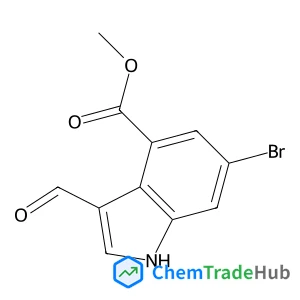
methyl 6-bromo-3-formyl-1H-indole-4-carboxylate
CAS Number:
1353636-63-1
Molecular Formula:
C11H8BrNO3
Recommended Suppliers





Disclaimer
This page provides academic journal information for reference and research purposes only. We are not affiliated with any journal publishers and do not handle publication submissions. For publication-related inquiries, please contact the respective journal publishers directly.
If you notice any inaccuracies in the information displayed, please contact us at support@chemtradehub.com. We will promptly review and address your concerns.