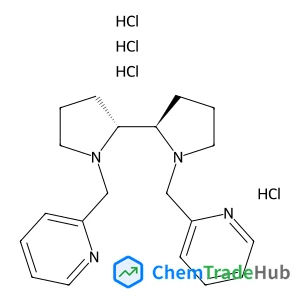
(2R,2'R)-1,1'-Bis(2-pyridinylmethyl)-2,2'-bipyrrolidine tetrahydrochloride
CAS Number:
1228077-88-0
Molecular Formula:
C20H30Cl4N4
Hironao Sajiki, Takashi Ikawa, Kazuyuki Hattori, Kosaku Hirota
Selective hydrogenation conditions of olefin, benzyl ether and acetylene functionalities in the presence of TBDMS or TES ether have been developed.
Mikinori Ando, Mika Sakai, Naoki Ando, Masato Hirai
DOI: 10.1039/C9OB00934E
Radhey M. Singh
DOI: 10.1039/C9OB00841A
DOI: 10.1039/C9OB00338J
Yi He, Danjun Wu, Zhenghua Li, Koen Robeyns, Luc Van Meervelt
DOI: 10.1039/C9OB01299K
Chun-Lan Xie, Jin-Mei Xia, Cui-Ping Xing, Zhu-Hua Luo, Zongze Shao, Xiao-Jun Yan, Shan He, Xian-Wen Yang
DOI: 10.1039/C9OB01159E
Marc A. Little
DOI: 10.1039/C9OB00123A
Kun Huang, Fabio Parmeggiani, Helene Ledru, Kristian Hollingsworth, Jordi Mas Pons, Andrea Marchesi, Peter Both, Ashley P. Mattey, Edward Pallister, Gregory S. Bulmer, Jolanda M. van Munster, W. Bruce Turnbull, M. Carmen Galan, Sabine L. Flitsch
DOI: 10.1039/C9OB01089K
Julien Malassis, Jean-Baptiste Vendeville, Qui-Hien Nguyen, Marie Boujon, Quentin Gaignard-Gaillard, Mark Light, Bruno Linclau
DOI: 10.1039/C9OB00707E
Alexander M. Genaev, Vyacheslav G. Shubin, Henry S. Rzepa
DOI: 10.1039/C9OB00607A
(3.beta.)-3-Hydroxy-N,N-dimethyl-chol-5-en-24-amide (CAS: 79066-03-8) is primari...
5-(Aminomethyl)-2-methoxyphenol (CAS: 89702-89-6) is classified under GHS as a s...
Thieno[2,3-c]pyridin-7(6H)-one (CAS: 28981-13-7) is a heterocyclic organic compo...
1-[(6-Methoxy-3-pyridinyl)methyl]-4-piperidinamine dihydrochloride is generally ...
[(2E)-3-Phenyl-2-propen-1-yl]phosphonic acid (CAS: 146404-58-2) is regulated und...
6-Bromo-7-methoxyquinoline (CAS: 1620515-86-7) falls under the scope of the Glob...
This compound is primarily used in the pharmaceutical industry for the developme...
1-Ethyl-7-[2-methyl-6-(4H-1,2,4-triazol-3-yl)-3-pyridinyl]-3,5-dihydropyrazino[2...
Alternative reagents such as 2-[(dimethylamino)methyl]phenylboronic acid or rela...
3-(Piperidin-4-yloxy)pyridine (CAS: 310881-48-2) is an organic compound with the...

ChemComm publishes urgent research which is of outstanding significance and interest to experts in the field, while also appealing to the journal’s broad chemistry readership. Our communication format is ideally suited to short, urgent studies that are of such importance that they require accelerated publication. Our scope covers all topics in chemistry, and research at the interface of chemistry and other disciplines (such as materials science, nanoscience, physics, engineering and biology) where there is a significant novelty in the chemistry aspects. Major topic areas covered include: Analytical Chemistry Catalysis Chemical Biology and medicinal chemistry Computational Chemistry and Machine Learning Energy and sustainable chemistry Environmental Chemistry Green Chemistry Inorganic Chemistry Materials Chemistry Nanoscience Organic Chemistry Physical Chemistry Polymer Chemistry Supramolecular Chemistry
![N-[4-(Cyanoethynyl)phenyl]-16-oxo-4,7,10,13-tetraoxa-17-azahenicos-1-yn-21-amide structure](https://static.chemtradehub.com/structs/218/2183440-36-8-68cb.webp "N-[4-(Cyanoethynyl)phenyl]-16-oxo-4,7,10,13-tetraoxa-17-azahenicos-1-yn-21-amide structure")