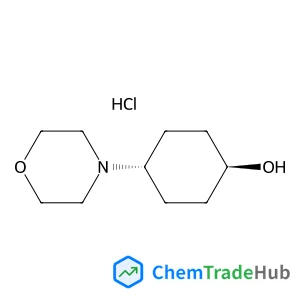
trans-4-(4-Morpholinyl)cyclohexanol hydrochloride (1:1)
CAS Number:
1588441-09-1
Molecular Formula:
C10H20ClNO2
Marc A. Little
The design, synthesis and structural characterization of non-natural oligomers that adopt well-defined conformations, so called foldamers, is a key objective in developing biomimetic 3D functional architectures. For the aromatic oligoamide foldamer family, use of interactions between side-chains to control conformation is underexplored. The current manuscript addresses this objective through the design, synthesis and conformational analyses of model dimers derived from 3-O-alkylated para-aminobenzoic acid monomers. The O-alkyl groups on these foldamers are capable of adopting syn- or anti-conformers through rotation around the Ar–CO/NH axes. In the syn-conformation this allows the foldamer to act as a topographical mimic of the α-helix whereby the O-alkyl groups mimic the spatial orientation of the i and i + 4 side-chains from the α-helix. Using molecular modelling and 2D NMR analyses, this work illustrates that covalent links and hydrogen-bonding interactions between side-chains can bias the conformation in favour of the α-helix mimicking syn-conformer, offering insight that may be more widely applied to control secondary structure in foldamers.
Jing Chen, Hanyu Zhang, Xianhu Liu, Chengqian Yuan, Meiye Jia, Zhixun Luo, Jiannian Yao
DOI: 10.1039/C5CP06892D
Bo Wu, Xiaoqin Liu, Ping Li, Shuangju Zhang, Bai Sun, Ankun Zhou
DOI: 10.1039/C5CP07650A
Gordon J. Kearley, Yun Liu, Dehong Yu, Richard A. Mole, Chris D. Ling, Ray L. Withers
DOI: 10.1039/C5CP01723H
Weiwang Chen, Xiaomeng Zhou, Yajun Han
DOI: 10.1039/C5CP01457C
DOI: 10.1039/C6CP00602G
Ian Streeter
DOI: 10.1039/C5CP02630J
Phuong D. Dau, P. B. Armentrout, Maria C. Michelini, John K. Gibson
DOI: 10.1039/C6CP00494F
Hiroshi C. Watanabe, Misa Banno, Minoru Sakurai
DOI: 10.1039/C5CP07136D
DOI: 10.1039/C4CP05082G
M. Khairy, Mohamed Mokhtar Mohamed
DOI: 10.1039/C5CP02066B
1-(2,4,6-Trifluorophenyl)ethanol is an organic compound with the CAS number 1250...
1-(2,4-Dimethoxybenzyl)-4-(hydroxymethyl)-2-pyrrolidinone (CAS: 919111-34-5) is ...
(7S,15R)-6β,15-Diacetoxy-7α,20-epoxy-7-hydroxykaura-2,16-dien-1-one is a crystal...
The compound rac-ethyl (1r,4r)-4-hydroxycyclohexane-1-carboxylate, trans (CAS: 3...
The market for 2-(2,4-Difluorophenoxy)-3-nitropyridine (CAS: 175135-62-3) is cur...
The main uses of 6-Diazo-5-oxo-L-norleucine (CAS: 157-03-9) include research in ...
When handling 2-Aminoethyl-mono-amide-DOTA-tris(tBu ester) (CAS: 173308-19-5), i...
5-Methylimidazo[1,2-a]pyridine-3-carbaldehyde (CAS: 178488-37-4) can be synthesi...
There are alternative reagents that can be used in the synthesis of 2,4,6-Trihyd...
(2Z)-3-(5-Fluoro-1H-indol-3-yl)-2-sulfanylacrylic acid is a chemical compound wi...

Organic & Biomolecular Chemistry (OBC) publishes original and high impact research and reviews in organic chemistry. We welcome research that shows new or significantly improved protocols or methodologies in total synthesis, synthetic methodology or physical and theoretical organic chemistry as well as research that shows a significant advance in the organic chemistry or molecular design aspects of chemical biology, catalysis, supramolecular and macromolecular chemistry, theoretical chemistry, mechanism-oriented physical organic chemistry, medicinal chemistry or natural products. Articles published in the journal should report new work which makes a highly-significant impact in the field. Routine and incremental work is generally not suitable for publication in the journal. More details about key areas of our scope are below. In all cases authors should include in their article clear rationale for why their research has been carried out.
![Sodium 6-amino-3-[(E)-{4-[(E)-(4-aminophenyl)diazenyl]-2-methoxy-5-methylphenyl}diazenyl]-4-hydroxy-2-naphthalenesulfonate structure](https://static.chemtradehub.com/structs/294/2945-96-2-092f.webp "Sodium 6-amino-3-[(E)-{4-[(E)-(4-aminophenyl)diazenyl]-2-methoxy-5-methylphenyl}diazenyl]-4-hydroxy-2-naphthalenesulfonate structure")