











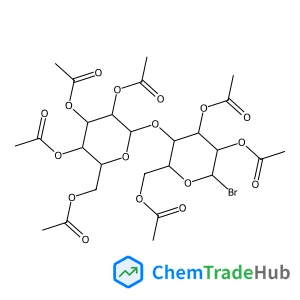
2,3,6-Tri-O-acetyl-4-O-(2,3,4,6-tetra-O-acetyl-beta-D-galactopyranosyl)-alpha-D-glucopyranosyl bromide
CAS Number:
4753-07-5
Molecular Formula:
C26H35BrO17
Noriyoshi Kon, Nobuhiko Iki, Sotaro Miyano
Inclusion abilities of thiacalix- and calix[4]arenetetrasulfonate (3 and 4) towards mono-substituted benzenes were investigated in neutral aqueous solution. In general, the hosts regioselectively encapsulated the guests from the aromatic moiety except the complexation of toluene by 4, in which the guest penetrated from either the aromatic or the methyl group. Stabilities of the inclusion complexes increased with the electron-withdrawing ability of the substituent on the guest, suggesting π–π electronic interaction between the host and guest. In spite of the lower electron density of the aromatic ring, thiacalix[4]arene 3 showed higher inclusion ability than calix[4]arene 4, suggesting that the size rather than the electron density of the calix framework is a more important factor in determining the inclusion ability.
Rongchang Luo, Xiantai Zhou, Wuying Zhang, Zhongxiu Liang, Jun Jiang, Hongbing Ji
DOI: 10.1039/C4GC00671B
S. Gupta, T. Kobayashi
DOI: 10.1039/C4GC00998C
Lin Wang, Zhi-Gang Ma, Xiao-Jing Wei, Qing-Yuan Meng, Deng-Tao Yang, Shao-Fu Du, Zi-Fei Chen, Li-Zhu Wu, Qiang Liu
DOI: 10.1039/C4GC00337C
Ana R. C. Morais, Ana C. Mata, Rafal Bogel-Lukasik
DOI: 10.1039/C4GC01093K
Peter A. Bayliss, Eduardo Pérez, Sihai Yang, Chiu C. Tang, Martyn Poliakoff, Martin Schröder
DOI: 10.1039/C4GC00313F
Denis Prat, John Hayler, Andy Wells
DOI: 10.1039/C4GC01149J
Estevão F. Mai, Marta A. Machado, Thomas E. Davies, Jose A. Lopez-Sanchez, Victor Teixeira da Silva
DOI: 10.1039/C4GC00920G
Yves Schellekens, Bert Van Trimpont, Pieter-Jan Goelen, Koen Binnemans, Mario Smet, Marie-Anne Persoons, Dirk De Vos
DOI: 10.1039/C4GC00873A
Yuchao Lu, Peng Wei, Yuxin Pei, Hengfu Xu, Xiaoting Xin
DOI: 10.1039/C4GC00770K
2-Methylbenzene-1,4-diamine dihydrochloride (CAS: 615-45-2) should be stored in ...
(1S,4S)-2,5-Diazabicyclo[2.2.1]heptane dihydrobromide is generally considered sa...
(6-Chloropyridazin-3-YL)methanamine finds applications in the pharmaceutical ind...
2-Fluoro-3-methylphenol is primarily used in the synthesis of pharmaceuticals, p...
When handling 3-Methoxy-4-nitrobenzonitrile, it is important to wear appropriate...
When handling 1,3-Oxazolo[4,5-b]pyridine-2(3H)-thione (CAS: 211949-57-4), it is ...
4-Ethynylbenzamide (CAS: 90347-86-7) falls under various regulatory guidelines i...
3-(2-Ethylphenyl)-2-thioxo-4-imidazolidinone is primarily used as an intermediat...
(2-Fluoro-6-methoxyphenyl)acetic acid, also known as 4-fluoro-3-methoxybenzoic a...
Market trends for 2-[4-(Hydroxymethyl)phenoxy]ethanol (CAS: 102196-18-9) indicat...

Organic & Biomolecular Chemistry (OBC) publishes original and high impact research and reviews in organic chemistry. We welcome research that shows new or significantly improved protocols or methodologies in total synthesis, synthetic methodology or physical and theoretical organic chemistry as well as research that shows a significant advance in the organic chemistry or molecular design aspects of chemical biology, catalysis, supramolecular and macromolecular chemistry, theoretical chemistry, mechanism-oriented physical organic chemistry, medicinal chemistry or natural products. Articles published in the journal should report new work which makes a highly-significant impact in the field. Routine and incremental work is generally not suitable for publication in the journal. More details about key areas of our scope are below. In all cases authors should include in their article clear rationale for why their research has been carried out.
![Methyl 2-[5-(3-Phenoxyphenyl)-2H-tetrazol-2-yl]acetate structure](https://static.chemtradehub.com/structs/130/1305320-60-8-84b4.webp "Methyl 2-[5-(3-Phenoxyphenyl)-2H-tetrazol-2-yl]acetate structure")



