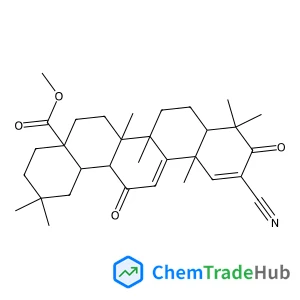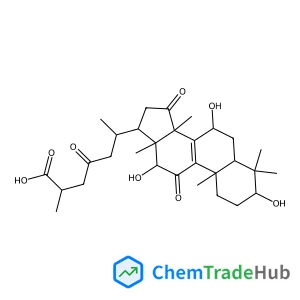
(3beta,7beta,12beta)-3,7,12-Trihydroxy-11,15,23-trioxolanost-8-en-26-oic acid
CAS Number:
98665-22-6
Molecular Formula:
C30H44O8
G. Gescheidt, D. Neshchadin, G. Rist, A. Borer, K. Dietliker, K. Misteli
Two stereoisomeric ketones, endo- and exo-(2-hydroxy-[2.2.2]bicyclo-5-en-1-yl)-phenyl methanone (endo-2 and exo-2) were synthesized via a Lewis acid catalyzed Diels–Alder reaction. Both compounds were tested in terms of their efficiency as photoinitiators for radical polymerization. Whereas the exo isomer serves as a good photoinitiator, the curing efficiency is poor in the case of the endo derivative. CIDNP investigations and product analysis by NMR and GC-MS together with density functional calculations reveal the distinctly different reaction pathways of the two isomers. On one hand, exo-2 undergoes α-cleavage from the triplet excited state forming a radical pair that is able to induce polymerizations. On the other hand, endo-2 cyclizes in a Paternò–Büchi reaction yielding a tetracyclic product 11 and no formation of radicals is observed.
Reece W. Lewis, Richard A. Evans, Nino Malic, Kei Saito
DOI: 10.1039/C7PY00682A
Chao Yu, Pengfei Zhang, Fei Gao, Shaowen Zhang, Xiaofang Li
DOI: 10.1039/C7PY01915G
Ryan L. Jezorek, Mojtaba Enayati, Rauan B. Smail, Jānis Lejnieks, Silvia Grama, Michael J. Monteiro, Virgil Percec
DOI: 10.1039/C7PY00659D
G. Tripodo, G. Marrubini, M. Corti, G. Brusotti, C. Milanese, M. Sorrenti, L. Catenacci, G. Massolini, E. Calleri
DOI: 10.1039/C7PY01626C
Xinwen Yan, Shaowen Zhang, Deqian Peng, Pengfei Zhang, Junge Zhi, Xiaolu Wu, Lin Wang, Yuping Dong, Xiaofang Li
DOI: 10.1039/C8PY00007G
Yan Deng, Wenbin Liu, Yongjun Li, Xiaoyu Huang
DOI: 10.1039/C7PY01932G
Hui Li, Yuyu Zhang, Yibin Liu, Rint P. Sijbesma, Johan P. A. Heuts, Qiuyu Zhang
DOI: 10.1039/C7PY00468K
Zhe Wang, Chao Xu, Yuexiang Lu, Guoyu Wei, Gang Ye, Taoxiang Sun, Jing Chen
DOI: 10.1039/C7PY00805H
Bo Pang, Jingzhe Zhang, Minglei Pang, Peijian Zhao, Zhen Yang, Shengyu Feng, Jie Zhang
DOI: 10.1039/C7PY01525A
Karol Erfurt, Anna Chrobok, Andrzej Zięba, Rafał Bielas
DOI: 10.1039/C7PY01726J
When handling 4-(2-Furylmethyl)thiomorpholine 1,1-dioxide (CAS: 79206-94-3), it ...
When handling 4-Chloro-N-[2-(4-morpholinyl)ethyl]benzamide (CAS: 71320-77-9), it...
Waste containing this compound (CAS: 62921-74-8) should be handled according to ...
Waste containing (S)-Methyl 2-amino-3-cyclohexylpropanoate should be collected i...
This compound can be synthesized using a multi-step process involving the conjug...
There are several alternatives to (2E)-3-(3,4-Dichlorophenyl)acrylic acid in syn...
Ethyl 6-(2-nitrophenyl)imidazo[2,1-b][1,3]thiazole-3-carboxylate (CAS: 925437-84...
Waste containing 2-(1,3-Thiazol-2-yl)ethanamine (CAS: 18453-07-1) should be coll...
Methyl 5-iodo-2-methylbenzoate can be synthesized through the iodination of meth...
5-Chloro[1,2,4]triazolo[1,5-a]pyridine is commonly synthesized via the condensat...

Physical Chemistry Chemical Physics (PCCP) is an international journal co-owned by 19 physical chemistry and physics societies from around the world. This journal publishes original, cutting-edge research in physical chemistry, chemical physics and biophysical chemistry. To be suitable for publication in PCCP, articles must include significant innovation and/or insight into physical chemistry; this is the most important criterion that reviewers and Editors will judge against when evaluating submissions. The journal has a broad scope and welcomes contributions spanning experiment, theory, computation and data science. Topical coverage includes spectroscopy, dynamics, kinetics, statistical mechanics, thermodynamics, electrochemistry, catalysis, surface science, quantum mechanics, quantum computing and machine learning. Interdisciplinary research areas such as polymers and soft matter, materials, nanoscience, energy, surfaces/interfaces, and biophysical chemistry are welcomed if they demonstrate significant innovation and/or insight into physical chemistry. Joined experimental/theoretical studies are particularly appreciated when complementary and based on up-to-date approaches.