













Cleavage of macromolecular RAFT chain transfer agents by sodium azide during characterization by aqueous GPC
Literature Information
Publication Date
2017-06-01
DOI
10.1039/C7PY00682A
Impact Factor
5.582
Authors
Reece W. Lewis, Richard A. Evans, Nino Malic, Kei Saito
View Original
Abstract
Accurate and reliable analysis of polymers by GPC is vital in the field of controlled radical polymerisation. Often, water-soluble polymers are analysed by aqueous gel permeation chromatography (GPC) in a solvent containing dilute sodium azide as an anti-microbial agent. Previous reports have shown that sodium azide at high concentration is able to remove terminal CTA groups from polymer chains, producing thiol-terminated polymers. This study demonstrates that GPC sample preparation of RAFT polymers in aqueous solvents containing dilute (200 ppm) sodium azide can cause significant changes in the measured molecular weight distribution. These changes occur within hours of dissolving the polymer sample and are shown to be due to cleavage of the CTA in the polymer chain together with disulfide coupling of the resulting polymeric thiols. The extent to which this occurs is strongly dependent on the CTA attached to the polymer; an almost 10-fold difference in the rate of CTA removal is observed between different RAFT agents. The by-product of the reaction between sodium azide and RAFT polymers is also investigated and shown to be an unstable thiatriazole-functionalised Z group. The thiatriazole then degrades further to form a nitrile-functionalised Z group, N2 and elemental sulfur.
Related Literature
Synthesis and crystallographic structure of a novel photoresponsive azobenzene-containing organosilane
Nanguo Liu, Darren R. Dunphy, Mark A. Rodriguez, Sarany Singer
2003-04-10
Communication
DOI: 10.1039/B301569F
Regiocontrolled Ru-catalyzed addition of carboxylic acids to alkynes: practical protocols for the synthesis of vinyl esters
2003-02-17
Communication
DOI: 10.1039/B211277A
Bond energy M–C/H–C correlations: dual theoretical and experimental approach to the sensitivity of M–C bond strength to substituents
Eric Clot, Maria Besora, Feliu Maseras, Claire Mégret, Odile Eisenstein, Beatriz Oelckers, Robin N. Perutz
2003-01-24
Communication
DOI: 10.1039/B210036N
Optical and electrical properties of the wide gap, n-type semiconductors: ZnBi2O6 and MgBi2O6
Hiroshi Mizoguchi, Nattamai S. P. Bhuvanesh, Patrick M. Woodward
2003-04-07
Communication
DOI: 10.1039/B300635B
A novel bioassay for screening and quantification of taxanes
Sergi Morais, P. C. Pandey, Wilfred Chen, Ashok Mulchandani
2003-04-17
Communication
DOI: 10.1039/B302112B
Pyridine–sugar conjugates as potent inhibitors of enzyme-catalysed glycosidehydrolysis
Peter A. Nkansah, Alan H. Haines, N. Patrick J. Stamford
2003-02-20
Communication
DOI: 10.1039/B211399F
Photochemical isomerization of 1,2,5-trisilabicyclo[3.2.0]hepta-3,6-diene to 1,4,7-trisilabicyclo[2.2.1]hepta-2,5-diene
Tadahiro Matsuno, Masaaki Ichinohe, Akira Sekiguchi
2003-04-22
Communication
DOI: 10.1039/B301536J
New thermally stable cationic η3-allyl(1,4-diphospha-(1,3)-butadiene)nickel complexes for ethylene polymerization
Alex Ionkin, William Marshall
2003-02-17
Communication
DOI: 10.1039/B211252C
Understanding the building-up process of three dimensional open-framework metal phosphates: Acid degradation of the 3D structures to lower dimensional structures
Amitava Choudhury
2003-01-06
Communication
DOI: 10.1039/B210037C
Probing DNA selectivity of ruthenium metallointercalators using ESI mass spectrometry
Jennifer L. Beck, Rajesh Gupta, Thitima Urathamakul, Nyree L. Williamson, Margaret M. Sheil, Janice R. Aldrich-Wright, Stephen F. Ralph
2003-02-10
Communication
DOI: 10.1039/B212132H
You might also like
Compound Q&A
What precautions should be taken when handling 4-(2-Furylmethyl)thiomorpholine 1,1-dioxide (CAS: 79206-94-3)?
When handling 4-(2-Furylmethyl)thiomorpholine 1,1-dioxide (CAS: 79206-94-3), it ...
79206-94-34-(2-Furylmethyl)thi...
Compound Q&A
What precautions should be taken when handling 4-Chloro-N-[2-(4-morpholinyl)ethyl]benzamide (CAS: 71320-77-9)?
When handling 4-Chloro-N-[2-(4-morpholinyl)ethyl]benzamide (CAS: 71320-77-9), it...
71320-77-94-Chloro-N-[2-(4-mor...
Compound Q&A
How should waste containing 2-[2-(2-Methoxyethoxy)ethoxy]ethyl 4-methylbenzenesulfonate (CAS: 62921-74-8) be handled?
Waste containing this compound (CAS: 62921-74-8) should be handled according to ...
62921-74-82-[2-(2-Methoxyethox...
Compound Q&A
How should waste containing (S)-Methyl 2-amino-3-cyclohexylpropanoate be handled?
Waste containing (S)-Methyl 2-amino-3-cyclohexylpropanoate should be collected i...
40056-18-6(S)-Methyl 2-amino-3...
Compound Q&A
How is 5-({4-[(2S,4R)-4-Hydroxy-2-methyltetrahydro-2H-pyran-4-yl]-2-thienyl}sulfanyl)-1-methyl-1,3-dihydro-2H-indol-2-one (CAS: 166882-70-8) typically synthesized?
This compound can be synthesized using a multi-step process involving the conjug...
166882-70-85-({4-[(2S,4R)-4-Hyd...
Compound Q&A
Are there alternatives to (2E)-3-(3,4-Dichlorophenyl)acrylic acid (CAS: 7312-27-8) in synthesis?
There are several alternatives to (2E)-3-(3,4-Dichlorophenyl)acrylic acid in syn...
7312-27-8(2E)-3-(3,4-Dichloro...
Compound Q&A
How should Ethyl 6-(2-nitrophenyl)imidazo[2,1-b][1,3]thiazole-3-carboxylate (CAS: 925437-84-9) be stored?
Ethyl 6-(2-nitrophenyl)imidazo[2,1-b][1,3]thiazole-3-carboxylate (CAS: 925437-84...
925437-84-9Ethyl 6-(2-nitrophen...
Compound Q&A
How should waste containing 2-(1,3-Thiazol-2-yl)ethanamine (CAS: 18453-07-1) be handled?
Waste containing 2-(1,3-Thiazol-2-yl)ethanamine (CAS: 18453-07-1) should be coll...
18453-07-12-(1,3-Thiazol-2-yl)...
Compound Q&A
How is Methyl 5-iodo-2-methylbenzoate (CAS: 103440-54-6) typically synthesized?
Methyl 5-iodo-2-methylbenzoate can be synthesized through the iodination of meth...
103440-54-6Methyl 5-iodo-2-meth...
Compound Q&A
How is 5-Chloro[1,2,4]triazolo[1,5-a]pyridine (CAS: 1427399-34-5) typically synthesized?
5-Chloro[1,2,4]triazolo[1,5-a]pyridine is commonly synthesized via the condensat...
1427399-34-55-Chloro[1,2,4]triaz...
Source Journal
Polymer Chemistry

CiteScore:
8.6
Self-citation Rate:
7.3%
Articles per Year:
457
Polymer Chemistry welcomes submissions in all areas of polymer science that have a strong focus on macromolecular chemistry. Manuscripts may cover a broad range of fields, yet no direct application focus is required.
Recommended Compounds
![5-Acetyl-2,3-dihydrobenzo[b]furan structure](https://static.chemtradehub.com/structs/908/90843-31-5-eea4.webp "5-Acetyl-2,3-dihydrobenzo[b]furan structure")
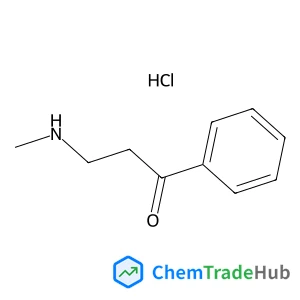
3-(Methylamino)-1-phenyl-1-propanone hydrochloride (1:1)
CAS Number:
2538-50-3
Molecular Formula:
C10H14ClNO


Recommended Suppliers






Disclaimer
This page provides academic journal information for reference and research purposes only. We are not affiliated with any journal publishers and do not handle publication submissions. For publication-related inquiries, please contact the respective journal publishers directly.
If you notice any inaccuracies in the information displayed, please contact us at support@chemtradehub.com. We will promptly review and address your concerns.