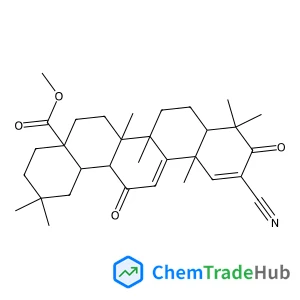
Methyl 2-cyano-3,12-dioxooleana-1,9(11)-dien-28-oate
CAS Number:
218600-53-4
Molecular Formula:
C32H43NO4
Yan Deng, Wenbin Liu, Yongjun Li, Xiaoyu Huang
Graphene is of great significance for applications of fabricating new functional materials, due to its unique physical and chemical structure and properties. Modification of graphene with different polymeric chains has been widely investigated by a range of synthetic methods to extend its application. An efficient way to prepare 2,2,6,6-tetramethylpiperidine-1-oxyl-functionalized graphene sheets (GS-TEMPO), which can be used as grafting sites, has been reported by our group. Herein, Br-terminated poly(2-acryloxyethyl ferrocenecarboxylate) (PAEFC) homopolymers prepared by atom transfer radical polymerization (ATRP) were selected as the grafted brushes to be anchored on the surface of GS-TEMPO via atom transfer nitroxide radical coupling (ATNRC) chemistry for construction of functional electrochemical platforms. The product of the grafting reaction, graphene-PAEFC (GS-PAEFC) nanocomposite, was characterized by 1H-NMR, FT-IR, XPS, TGA, DTG, TEM and AFM. Cyclic voltammetry (CV) measurements show that the redox responsiveness of PAEFC is retained after surface functionalization. Moreover, GS-PAEFC nanohybrids are dispersible and stable in a wider range of organic solvents than the graphene oxide precursor nanosheets, paving the way for the development of smart nanocomposites.

Journal of Physics and Chemistry of Solids

Journal of Organometallic Chemistry

Organic Preparations and Procedures International

Science

Journal of Catalysis

Molecular Pharmacology

Proceedings of the National Academy of Sciences of the United States of America

Kinetics and Catalysis

Pharmacological Reviews

Science Progress
Karen L. Nash, K. Jessica Sully, Andrew B. Horn
DOI: 10.1039/B005531J
DOI: 10.1039/A901847F
DOI: 10.1039/A903458G
Luciano Lepori, Enrico Matteoli, Luca Bernazzani, Norberto Ceccanti, Giovanni Conti, Paolo Gianni, Vincenzo Mollica, Maria R. Tinè
DOI: 10.1039/B005160H
Alison M. De Asha, John T. S. Critchley, A. Elina Siokou, Roger M. Nix
DOI: 10.1039/B005602M
DOI: 10.1039/B002375M
Cristina Alvarez, Joaquim J. Moura-Ramos
DOI: 10.1039/B004133P
When handling 4-(2-Furylmethyl)thiomorpholine 1,1-dioxide (CAS: 79206-94-3), it ...
When handling 4-Chloro-N-[2-(4-morpholinyl)ethyl]benzamide (CAS: 71320-77-9), it...
Waste containing this compound (CAS: 62921-74-8) should be handled according to ...
Waste containing (S)-Methyl 2-amino-3-cyclohexylpropanoate should be collected i...
This compound can be synthesized using a multi-step process involving the conjug...
There are several alternatives to (2E)-3-(3,4-Dichlorophenyl)acrylic acid in syn...
Ethyl 6-(2-nitrophenyl)imidazo[2,1-b][1,3]thiazole-3-carboxylate (CAS: 925437-84...
Waste containing 2-(1,3-Thiazol-2-yl)ethanamine (CAS: 18453-07-1) should be coll...
Methyl 5-iodo-2-methylbenzoate can be synthesized through the iodination of meth...
5-Chloro[1,2,4]triazolo[1,5-a]pyridine is commonly synthesized via the condensat...

Polymer Chemistry welcomes submissions in all areas of polymer science that have a strong focus on macromolecular chemistry. Manuscripts may cover a broad range of fields, yet no direct application focus is required.

![[4-(Heptyloxy)phenyl]boronic acid structure](https://static.chemtradehub.com/structs/136/136370-19-9-ad33.webp "[4-(Heptyloxy)phenyl]boronic acid structure")