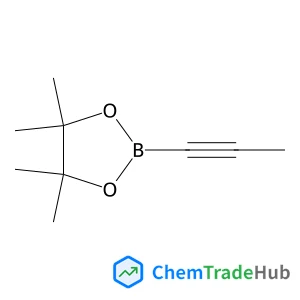
4,4,5,5-Tetramethyl-2-(1-propyn-1-YL)-1,3,2-dioxaborolane
CAS Number:
347389-75-7
Molecular Formula:
C9H15BO2
Adão A. Sabino, Marcos N. Eberlin, Luis Alberto B. Moraes, Kenneth K. Laali
The 2-tert-butyl-3-phenylphosphirenylium ion 13 is formed in abundance in the gas phase from 1-chloro-1H-phosphirene 6 upon 70 eV electron ionization. Collision-induced dissociation (CID) and ion–molecule reactions followed by CID of the product ions were performed via pentaquadrupole mass spectrometry to probe the structure and reactivity of 13 towards representative nucleophiles and dienes. Under CID conditions, 13 produces a variety of fragment ions mainly via dissociation processes that are preceded by isomerizations. In ion–molecule reactions, 13 reacts readily with ethers, sulfides, pyridine and aniline to form hitherto unknown oxonium, sulfonium and azonium ions via nucleophilic attack at phosphorus. With butadiene, isoprene, 1-acetoxybutadiene, and with Danishefsky's diene (1-methoxy-3-silyloxybuta-1,3-diene), 13 undergoes [4 + 2+] cycloaddition at phosphorus to generate novel P-spiro bicyclic phosphonium ions. With butadiene and isoprene, a second [4 + 2] cycloaddition occurs which generates P-spiro tricyclic phosphonium ions. Whereas 13 also reacts readily with 1-acetoxybutadiene via [4 + 2+] cycloaddition, most of the nascent P-spiro cycloadducts are unstable and dissociate by the loss of either a neutral ketene or acetic acid molecule. B3LYP/6-31G(d,p) calculations were performed to gain insight into the structures of the product ions. The present study constitutes the first successful attempt to unravel the chemistry of 13, a unique 2π-Hückel phosphirenylium ion for which no direct solution chemical reactivity data are as yet available. The present findings also create a parallel with the solution reactivity of 1-halo-1H-phosphirenes and 1-triflato-1H-phosphirenes as precursors to phosphirenylium ions.
Peter A. Bayliss, Eduardo Pérez, Sihai Yang, Chiu C. Tang, Martyn Poliakoff, Martin Schröder
DOI: 10.1039/C4GC00313F
P. P. Giovannini, O. Bortolini, A. Cavazzini, R. Greco, G. Fantin, A. Massi
DOI: 10.1039/C4GC00838C
Rongchang Luo, Xiantai Zhou, Wuying Zhang, Zhongxiu Liang, Jun Jiang, Hongbing Ji
DOI: 10.1039/C4GC00671B
Kristian Larsson, Koen Binnemans
DOI: 10.1039/C3GC41930D
Haitao He, Xiaohan Hu, Yuqi Guan, Huanfeng Jiang
DOI: 10.1039/C4GC00522H
Yves Schellekens, Bert Van Trimpont, Pieter-Jan Goelen, Koen Binnemans, Mario Smet, Marie-Anne Persoons, Dirk De Vos
DOI: 10.1039/C4GC00873A
Zhenping Zhu, Yupeng Wu, Tianjian Zhao, Li Li
DOI: 10.1039/C4GC00413B
Do Joong Kim, Kyung Hwan Oh, Jin Kyoon Park
DOI: 10.1039/C4GC00684D
Lin He, Helfried Neumann, Matthias Beller
DOI: 10.1039/C4GC00801D
Tao Li, Xuan Li
DOI: 10.1039/C4GC00565A
2-Methylbenzene-1,4-diamine dihydrochloride (CAS: 615-45-2) should be stored in ...
(1S,4S)-2,5-Diazabicyclo[2.2.1]heptane dihydrobromide is generally considered sa...
(6-Chloropyridazin-3-YL)methanamine finds applications in the pharmaceutical ind...
2-Fluoro-3-methylphenol is primarily used in the synthesis of pharmaceuticals, p...
When handling 3-Methoxy-4-nitrobenzonitrile, it is important to wear appropriate...
When handling 1,3-Oxazolo[4,5-b]pyridine-2(3H)-thione (CAS: 211949-57-4), it is ...
4-Ethynylbenzamide (CAS: 90347-86-7) falls under various regulatory guidelines i...
3-(2-Ethylphenyl)-2-thioxo-4-imidazolidinone is primarily used as an intermediat...
(2-Fluoro-6-methoxyphenyl)acetic acid, also known as 4-fluoro-3-methoxybenzoic a...
Market trends for 2-[4-(Hydroxymethyl)phenoxy]ethanol (CAS: 102196-18-9) indicat...

Organic & Biomolecular Chemistry (OBC) publishes original and high impact research and reviews in organic chemistry. We welcome research that shows new or significantly improved protocols or methodologies in total synthesis, synthetic methodology or physical and theoretical organic chemistry as well as research that shows a significant advance in the organic chemistry or molecular design aspects of chemical biology, catalysis, supramolecular and macromolecular chemistry, theoretical chemistry, mechanism-oriented physical organic chemistry, medicinal chemistry or natural products. Articles published in the journal should report new work which makes a highly-significant impact in the field. Routine and incremental work is generally not suitable for publication in the journal. More details about key areas of our scope are below. In all cases authors should include in their article clear rationale for why their research has been carried out.
![5-Bromo-3-isopropyl-1H-pyrrolo[2,3-b]pyridine structure](https://static.chemtradehub.com/structs/125/1256819-54-1-8620.webp "5-Bromo-3-isopropyl-1H-pyrrolo[2,3-b]pyridine structure")