












A novel nanostructure of nickel nanotubes encapsulated in carbon nanotubes
Literature Information
Publication Date
2002-12-06
DOI
10.1039/B208539A
Impact Factor
6.222
Authors
Keyu Wang, Zheng Xu, Hong Zhang, Zuhong Lu
View Original
Abstract
A novel nanostructure of Ni nanotubes encapsulated in carbon nanotubes has been obtained via the pyrolysis of C2H2 on an array of Ni nanotubes in an alumina membrane support and a possible mechanism has been proposed.
Related Literature
Thermo-osmotic pressure and resistance to mass transport in a vapor-gap membrane
Michael T. Rauter, Sondre K. Schnell, Bjørn Hafskjold, Signe Kjelstrup
2021-06-04
Paper
DOI: 10.1039/D0CP06556K
Resistive switching on individual V2O5 nanoparticles encapsulated in fluorinated graphene films
Artem I. Ivanov, Victor Ya. Prinz, Irina V. Antonova, Anton K. Gutakovskii
2021-08-19
Paper
DOI: 10.1039/D1CP02930D
Self-assembled, optically-active {naphthalene diimide}U{cucurbit[8]uril} ensembles in an aqueous environment
Heather F. Higginbotham, Subashani Maniam, Tina Hsia, Lyle Isaacs, Steven J. Langford, Toby D. M. Bell
2021-06-02
Communication
DOI: 10.1039/D1CP00659B
Effects of molecular shape on alcohol aggregation and water hydrogen bond network behavior in butanol isomer solutions
Seungeui Choi, Saravanan Parameswaran, Jun-Ho Choi
2021-05-18
Paper
DOI: 10.1039/D1CP00634G
Triangular boron carbon nitrides: an unexplored family of chromophores with unique properties for photocatalysis and optoelectronics
Sebastian Pios, Xiang Huang, Andrzej L. Sobolewski, Wolfgang Domcke
2021-05-26
Paper
DOI: 10.1039/D1CP02026A
Imaging intramolecular hydrogen migration with time- and momentum-resolved photoelectron diffraction
Fukiko Ota, Shigeru Abe, Keisuke Hatada, Kiyoshi Ueda
2021-07-30
Paper
DOI: 10.1039/D1CP02055B
Probing reaction processes and reversibility in Earth-abundant Na3FeF6 for Na-ion batteries
Anthony Wong, Gabriel Ménard
2021-07-01
Paper
DOI: 10.1039/D1CP02763H
Gaseous cyclodextrin-closo-dodecaborate complexes χCD·B12X122− (χ = α, β, and γ; X = F, Cl, Br, and I): electronic structures and intramolecular interactions
Yanrong Jiang, Qinqin Yuan, Wenjin Cao, Marc C. Nierstenhöfer, Zhipeng Li, Yan Yang, Cheng Zhong, Carsten Jenne, Xue-Bin Wang
2021-04-26
Paper
DOI: 10.1039/D1CP01131F
The structure of isolated thalidomide as reference for its chirality-dependent biological activity: a laser-ablation rotational study
Susana Blanco, Alberto Macario, Juan Carlos López
2021-06-07
Paper
DOI: 10.1039/D1CP01691A
You might also like
Compound Q&A
What is the market or research trend for N-(4-Methoxybenzyl)-2-pyridinamine (CAS: 52818-63-0)?
N-(4-Methoxybenzyl)-2-pyridinamine (CAS: 52818-63-0) is increasingly being used ...
52818-63-0N-(4-Methoxybenzyl)-...
Compound Q&A
What precautions should be taken when handling Ethyl 4-(2-chlorophenyl)-1,3-thiazole-2-carboxylate (CAS: 1050507-06-6)?
When handling Ethyl 4-(2-chlorophenyl)-1,3-thiazole-2-carboxylate, appropriate p...
1050507-06-6Ethyl 4-(2-chlorophe...
Compound Q&A
What regulatory guidelines apply to diethyldiselane (CAS: 628-39-7)?
Diethyldiselane (CAS: 628-39-7) is classified under the Globally Harmonized Syst...
628-39-7Diethyldiselane
Compound Q&A
What is the market or research trend for oxocopper (CAS: 12053-18-8)?
The market for oxocopper (CAS: 12053-18-8) is primarily driven by its use in cat...
12053-18-8oxocopper; oxo-(oxoc...
Compound Q&A
What is the market or research trend for 5-{[(2-Methyl-2-propanyl)oxy]carbonyl}-5-azaspiro[2.4]heptane-7-carboxylic acid?
The market for 5-{[(2-Methyl-2-propanyl)oxy]carbonyl}-5-azaspiro[2.4]heptane-7-c...
1268519-54-55-{[(2-Methyl-2-prop...
Compound Q&A
What is 2-(1-Pyrrolidinyl)-4-pyridinamine (CAS: 35981-63-6)?
2-(1-Pyrrolidinyl)-4-pyridinamine is a chemical compound with the CAS number 359...
35981-63-62-(1-Pyrrolidinyl)-4...
Compound Q&A
What are the physical and chemical properties of 2-(3-Pyridinyl)-1-azabicyclo[2.2.2]octane (CAS: 91556-75-1)?
2-(3-Pyridinyl)-1-azabicyclo[2.2.2]octane (CAS: 91556-75-1) is a crystalline sol...
91556-75-12-(3-Pyridinyl)-1-az...
Compound Q&A
How is (S)-Alpha-allyl-proline hydrochloride (CAS: 129704-91-2) typically synthesized?
(S)-Alpha-allyl-proline hydrochloride is usually synthesized via a Wittig reacti...
129704-91-2(S)-Alpha-allyl-prol...
Compound Q&A
What is 3-Methyl-1,2-oxazole-5-carboxylic acid (CAS: 4857-42-5)?
3-Methyl-1,2-oxazole-5-carboxylic acid (CAS: 4857-42-5) is an organic compound w...
4857-42-53-Methyl-1,2-oxazole...
Compound Q&A
How is Lys-SMCC-DM1 (CAS: 1281816-04-3) typically synthesized?
Lys-SMCC-DM1 is synthesized via a multi-step process involving the coupling of S...
1281816-04-3Lys-SMCC-DM1
Source Journal
Chemical Communications

CiteScore:
8.6
Self-citation Rate:
4.7%
Articles per Year:
2458
ChemComm publishes urgent research which is of outstanding significance and interest to experts in the field, while also appealing to the journal’s broad chemistry readership. Our communication format is ideally suited to short, urgent studies that are of such importance that they require accelerated publication. Our scope covers all topics in chemistry, and research at the interface of chemistry and other disciplines (such as materials science, nanoscience, physics, engineering and biology) where there is a significant novelty in the chemistry aspects. Major topic areas covered include: Analytical Chemistry Catalysis Chemical Biology and medicinal chemistry Computational Chemistry and Machine Learning Energy and sustainable chemistry Environmental Chemistry Green Chemistry Inorganic Chemistry Materials Chemistry Nanoscience Organic Chemistry Physical Chemistry Polymer Chemistry Supramolecular Chemistry
Recommended Compounds
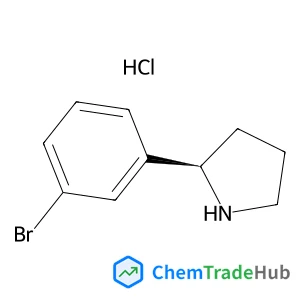
(2R)-2-(3-Bromophenyl)pyrrolidine hydrochloride (1:1)
CAS Number:
1391550-13-2
Molecular Formula:
C10H13BrClN

Recommended Suppliers





Disclaimer
This page provides academic journal information for reference and research purposes only. We are not affiliated with any journal publishers and do not handle publication submissions. For publication-related inquiries, please contact the respective journal publishers directly.
If you notice any inaccuracies in the information displayed, please contact us at support@chemtradehub.com. We will promptly review and address your concerns.