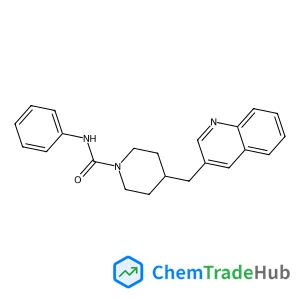
N-phenyl-4-(quinolin-3-ylmethyl)piperidine-1-carboxamide
CAS Number:
959151-50-9
Molecular Formula:
C22H23N3O
Bernd Giese, Don McNaughton
The surface-enhanced Raman scattering (SERS) spectra of guanine and its alkylated derivatives 7-methylguanine (7-MeG) and 9-ethylguanine (9-EtG) adsorbed to a silver colloid and a silver electrode are reported. The influence of the pH and the surface potential are studied. The interaction between the three molecules and the silver surfaces is interpreted on the basis of density functional theoretical (DFT) assignments of the SERS bands, the relative enhancement factors of the vibrational modes, the surface selection rules, the pH dependence of the SERS spectra, and a comparison of the SERS spectra of the different molecules. The wavenumber value and SERS intensity of a normal mode dominated by carbonyl stretching, in particular, is shown to provide valuable information concerning the orientation of the adsorbate on silver surfaces. The pKa values of all studied compounds are lowered substantially in the presence of the SERS substrates, so that acidic conditions have to be employed to obtain SERS spectra of neutral molecules. In their neutral forms, guanine and 7-MeG adsorb to both surface substrates with the H2N–C2–N3–C4–N9 side directed towards the surface, whereas 9-EtG is adsorbed via N7 and the carbonyl group. At alkaline pH, the colloidal surface stabilizes the N9-deprotonated tautomer of guanine, while only the N1-deprotonated tautomer is present on the electrode surface and in aqueous solution.
Christopher D. Entwistle, Andrei S. Batsanov, Judith A. K. Howard, Mark A. Fox, Todd B. Marder
DOI: 10.1039/B316250H
R. Vijayaraghavan, D. R. MacFarlane
DOI: 10.1039/B315100J
Atsushi Nagai, Bungo Ochiai, Takeshi Endo
DOI: 10.1039/B310735C
Woo Jin Bae, Keon Hyeong Kim, Yun Heum Park, Won Ho Jo
DOI: 10.1039/B309346H
Paul D. Beer, David P. Cormode, Jason J. Davis
DOI: 10.1039/B313658B
Judith J. van Gorp, Jef A. J. M. Vekemans, E. W. Meijer
DOI: 10.1039/B312407J
Jun Terao, Andrew Tang, Jasper J. Michels, Alexander Krivokapic, Harry L. Anderson
DOI: 10.1039/B311762F
Ik-Hwan Um, Sang-Eun Jeon, Mi-Hwa Baek, Hye-Ran Park
DOI: 10.1039/B310055C
Hans-Jörg Schneider, Tianjun Liu
DOI: 10.1039/B310939A
Jean-Paul Lellouche, Nurit Perlman, Augustine Joseph, Senthil Govindaraji, Ludmila Buzhansky, Aline Yakir, Ian Bruce
DOI: 10.1039/B309375A
Waste containing 2-Ethyl-4-Methyl-1H-Imidazole-5-Carbaldehyde (CAS: 88634-80-4) ...
Triethoxy(octyl)silane (CAS: 1385031-14-0) is widely used in the pharmaceuticals...
Several alternatives to 3-iodo-7-nitro-1H-indazole (CAS: 864724-64-1) exist in t...
Yes, there are alternatives to Benzene, bis[(trimethoxysilyl)ethyl] (CAS: 266317...
Isothiazole-3-carbonitrile (CAS: 1452-17-1) is generally considered safe when us...
(3-Chlorophenyl)methanol (CAS: 873-63-2) is considered low to moderately toxic. ...
(2S,3S)-2-Hydroxy-3-({[(2-methyl-2-propanyl)oxy]carbonyl}amino)-3-(2-naphthyl)pr...
Proper handling of methyl 2-(bromomethyl)-5-methoxybenzoate requires the use of ...
6,8-Dibromoimidazo[1,2-a]pyridine-2-carboxylic acid (CAS: 904805-36-3) is an aro...
3-Amino-5-bromo-2-pyridinecarbonitrile is considered safe when handled under pro...

Physical Chemistry Chemical Physics (PCCP) is an international journal co-owned by 19 physical chemistry and physics societies from around the world. This journal publishes original, cutting-edge research in physical chemistry, chemical physics and biophysical chemistry. To be suitable for publication in PCCP, articles must include significant innovation and/or insight into physical chemistry; this is the most important criterion that reviewers and Editors will judge against when evaluating submissions. The journal has a broad scope and welcomes contributions spanning experiment, theory, computation and data science. Topical coverage includes spectroscopy, dynamics, kinetics, statistical mechanics, thermodynamics, electrochemistry, catalysis, surface science, quantum mechanics, quantum computing and machine learning. Interdisciplinary research areas such as polymers and soft matter, materials, nanoscience, energy, surfaces/interfaces, and biophysical chemistry are welcomed if they demonstrate significant innovation and/or insight into physical chemistry. Joined experimental/theoretical studies are particularly appreciated when complementary and based on up-to-date approaches.