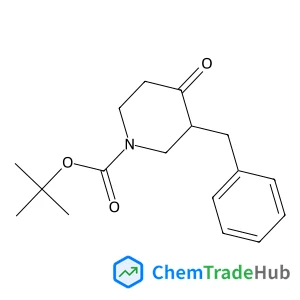
2-Methyl-2-propanyl 3-benzyl-4-oxo-1-piperidinecarboxylate
CAS Number:
193274-82-7
Molecular Formula:
C17H23NO3
R. Vijayaraghavan, D. R. MacFarlane
For the first time, living cationic polymerisation of styrene has been carried out in room temperature ionic liquids under mild reaction conditions and using mild acid catalysts (e.g. organoborate acids) to obtain polymers of narrow polydispersity.
Guijun Yu, Peiyi Wu
DOI: 10.1039/C3PY00878A
Peng Liu, Caixia Yue, Zonghai Sheng, Guanhui Gao, Mingxing Li, Huqiang Yi, Cuifang Zheng, Bi Wang, Lintao Cai
DOI: 10.1039/C3PY01173A
Sachin Laxman Bobade, Thomas Malmgren
DOI: 10.1039/C3PY01002C
Daniel L. Jacobs, Benjamin R. Bunes, Helin Huang, Xiaomei Yang, Ling Zang
DOI: 10.1039/C3PY01026K
Jimy Hadiono So, David Mayevsky, Orawan Winther-Jensen, Bjorn Winther-Jensen
DOI: 10.1039/C3PY01265D
Wolfgang Ensinger
DOI: 10.1039/C3PY01062G
Kung-Chin Chang, Wei-Fu Ji, Mei-Chun Lai, You-Rong Hsiao, Chien-Hua Hsu, Tsao-Li Chuang, Yen Wei, Jui-Ming Yeh, Wei-Ren Liu
DOI: 10.1039/C3PY01178J
Lin Yang, Yaling Lin, Lianshi Wang, Anqiang Zhang
DOI: 10.1039/C3PY01005H
Rong Jin, Chao Lin, Aoneng Cao
DOI: 10.1039/C3PY00864A
Ying-Hsuan Chou, Sanae Takasugi, Raita Goseki, Takashi Ishizone, Wen-Chang Chen
DOI: 10.1039/C3PY01124K
1H-Indazole-6-carbonitrile finds applications in pharmaceuticals, where it serve...
Waste containing Dioctyl (2E)-2-butenedioate (CAS: 2997-85-5) should be collecte...
Sodium [(1,2-benzoxazol-3-ylmethyl)sulfonyl]azanide is primarily used in pharmac...
Dimethyl 4-(4,4,5,5-tetramethyl-1,3,2-dioxaborolan-2-yl)-2,6-pyridinedicarboxyla...
Waste containing 2-Fluoro-6-hydrazinopyridine (CAS: 80714-39-2) should be manage...
6-Formyl-2-pyridinecarboxylic acid is an organic compound with the molecular for...
Research trends for this compound indicate a focus on its potential applications...
9H-Tribenzo[b,d,f]azepine is typically synthesized via a multi-step process invo...
1-Cyclopropyl-7-ethoxy-6-fluoro-8-methoxy-4-oxo-1,4-dihydro-3-quinolinecarboxyli...
Waste containing Methyl 3-oxo-1,2,3,4-tetrahydro-6-quinoxalinecarboxylate (CAS: ...

ChemComm publishes urgent research which is of outstanding significance and interest to experts in the field, while also appealing to the journal’s broad chemistry readership. Our communication format is ideally suited to short, urgent studies that are of such importance that they require accelerated publication. Our scope covers all topics in chemistry, and research at the interface of chemistry and other disciplines (such as materials science, nanoscience, physics, engineering and biology) where there is a significant novelty in the chemistry aspects. Major topic areas covered include: Analytical Chemistry Catalysis Chemical Biology and medicinal chemistry Computational Chemistry and Machine Learning Energy and sustainable chemistry Environmental Chemistry Green Chemistry Inorganic Chemistry Materials Chemistry Nanoscience Organic Chemistry Physical Chemistry Polymer Chemistry Supramolecular Chemistry