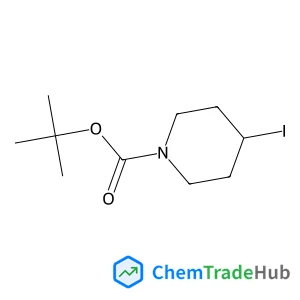
2-Methyl-2-propanyl 4-iodo-1-piperidinecarboxylate
CAS Number:
301673-14-3
Molecular Formula:
C10H18INO2
Davide Ferri, Thomas Bürgi, Alfons Baiker
In situ ATR infrared spectroscopy was used to follow the reaction of CO2 with hydrogen at the solid–liquid interface of a model Pt/Al2O3 catalyst in cyclohexane at 313 K. CO2 adsorbs on Al2O3 to form carbonate-like species, which react with hydrogen to form CO. The observed spectrum exhibits unusually low vibrational frequencies and ratio of linearly to bridged bonded CO. In contrast, CO adsorbed from the solution onto the Pt/Al2O3 model catalyst results in a normal spectrum for CO on Pt. The results suggest that the reaction of CO2 and hydrogen takes place at the boundary sites of the interface between the Pt and the Al2O3 and that the resulting CO selectively probes these sites. The unusual CO spectrum indicates that these sites are characterised by a low ionisation potential of the d-valence orbitals of Pt. It is likely that the unusual property of these Pt sites are caused by a nearby oxygen vacancy of the Al2O3, onto which the CO2 initially adsorbs.
Clara Rettenmaier, Antonia Herzog, Daniele Casari, Martina Rüscher, Hyo Sang Jeon, David Kordus, Mauricio Lopez Luna, Stefanie Kühl, Uta Hejral, Earl M. Davis, See Wee Chee, Janis Timoshenko, Duncan T.L. Alexander, Arno Bergmann, Beatriz Roldan Cuenya
DOI: 10.1039/D3EY00162H
Ronald Sluyter, Konstantin Konstantinov, Jung Ho Kim
DOI: 10.1039/D3EY00239J
Benjamin M. Alameda, Margaret S. Kumler, J. Scott Murphy, Jeffrey S. Aguinaga, Derek L. Patton
DOI: 10.1039/D3LP00095H
William A. Maza, James A. Ridenour, Brian L. Chaloux, Albert Epshteyn, Jeffrey C. Owrutsky
DOI: 10.1039/D3VA00223C
Libin Zeng, Jiali Wang, Can Yang
DOI: 10.1039/D3VA00239J
Deepak Kumar, B. V. Ramarao
DOI: 10.1039/D3SU00126A
Valeria Della Gala, Ditte Hededam Welner
DOI: 10.1039/D3SU00220A
Waste containing (6-Bromo-2-naphthyl)oxy](dimethyl)(2-methyl-2-propanyl)silane (...
7-Fluoro-4-isoquinolinecarboxylic acid can be synthesized via a multi-step proce...
2,3,5,6-Tetrabromothieno[3,2-b]thiophene is a crystalline compound with a high m...
1-[4-(Benzylamino)-7,8-dihydro-5H-pyrano[4,3-d]pyrimidin-2-yl]-2-methyl-1H-indol...
The market for imidazo[5,1-d]-1,2,3,5-tetrazine-8-carboxylic acid, 3,4-dihydro-3...
3-(Triisopropylsilyl)propiolaldehyde is a synthetic organic compound with the CA...
6-Nitro-2H-1,4-benzoxazin-3(4H)-one (CAS: 81721-87-1) is subject to various regu...
Waste containing (3-Fluorophenyl)(4-{[(2-methyl-2-propanyl)oxy]carbonyl}-1-piper...
N,N'-4,4'-Biphenyldiyldiisonicotinamide is a white crystalline solid with a mole...
6-Bromo-8-fluoro-2-quinazolinol is primarily used in the pharmaceutical industry...

Physical Chemistry Chemical Physics (PCCP) is an international journal co-owned by 19 physical chemistry and physics societies from around the world. This journal publishes original, cutting-edge research in physical chemistry, chemical physics and biophysical chemistry. To be suitable for publication in PCCP, articles must include significant innovation and/or insight into physical chemistry; this is the most important criterion that reviewers and Editors will judge against when evaluating submissions. The journal has a broad scope and welcomes contributions spanning experiment, theory, computation and data science. Topical coverage includes spectroscopy, dynamics, kinetics, statistical mechanics, thermodynamics, electrochemistry, catalysis, surface science, quantum mechanics, quantum computing and machine learning. Interdisciplinary research areas such as polymers and soft matter, materials, nanoscience, energy, surfaces/interfaces, and biophysical chemistry are welcomed if they demonstrate significant innovation and/or insight into physical chemistry. Joined experimental/theoretical studies are particularly appreciated when complementary and based on up-to-date approaches.
![5-Bromoimidazo[1,2-a]pyridine structure](https://static.chemtradehub.com/structs/692/69214-09-1-d8e2.webp "5-Bromoimidazo[1,2-a]pyridine structure")