













![2-{[4-(2-Methoxyethyl)phenoxy]methyl}oxirane structure](https://static.chemtradehub.com/structs/567/56718-70-8-f037.webp "2-{[4-(2-Methoxyethyl)phenoxy]methyl}oxirane structure")
Linear perfluoroalkyl carboxylate reduction dynamics with solvated electrons from ferrocyanide and sulfite
Literature Information
Publication Date
2023-10-10
DOI
10.1039/D3VA00223C
Impact Factor
0
Authors
William A. Maza, James A. Ridenour, Brian L. Chaloux, Albert Epshteyn, Jeffrey C. Owrutsky
View Original
Abstract
The initial reduction dynamics of perfluoroalkyl substances (PFASs) by the hydrated electron, eaq−, is a topic of great interest and importance due to the pervasive environmental presence of PFAS in soil and waters and the need to remediate the contamination. Understanding how PFAS behaves in water, including the potential effect of aggregation on the apparent PFAS reduction rate constant (kPFAS) is, therefore, of paramount importance. In this publication we re-examine the proposition that submicellar aggregation decreases the apparent kPFAS for sodium perfluorocarboxylates of varying chain lengths (NaPFxA, x = number of carbons in the PFAS backbone, ranging from 4 to 8) using transient absorption spectroscopy. We compare the dynamics for eaq− quenching by NaPFxA in aqueous solutions of ferrocyanide, Fe(CN)64−, and sulfite, SO32−. The results demonstrate that the apparent rate constant depends on the choice of eaq− precursor. We demonstrate that the ionic strength of the solution and the counterion of the PFxA salt both affect the measured rate constant of PFAS reduction by eaq−. The results presented here help to better understand PFAS degradation by advanced reduction processes.
Related Literature
On the electron-induced isotope fractionation in low temperature 32O2/36O2 ices—ozone as a case study
B. Sivaraman, A. M. Mebel, N. J. Mason, D. Babikov
2010-11-15
Communication
DOI: 10.1039/C0CP00448K
A detailed TPD study of H2O and pre-adsorbed O on the stepped Pt(553) surface
Maria J. T. C. van der Niet, Angela den Dunnen, Ludo B. F. Juurlink, Marc T. M. Koper
2010-12-01
Paper
DOI: 10.1039/C0CP01162B
Predicting the coordination geometry for Mg2+ in the p53 DNA-binding domain: insights from computational studies
Teng Wang, Xueguang Shao, Wensheng Cai, Yonglai Xue, Shuai Wang, Xizeng Feng
2010-11-15
Paper
DOI: 10.1039/C0CP00678E
Low temperature rate coefficients for reactions of the butadiynyl radical, C4H, with various hydrocarbons. Part II: reactions with alkenes (ethylene, propene, 1-butene), dienes (allene, 1,3-butadiene) and alkynes (acetylene, propyne and 1-butyne)
Coralie Berteloite, Sébastien D. Le Picard, Nadia Balucani, André Canosa, Ian R. Sims
2010-03-19
Paper
DOI: 10.1039/B923867K
Measurements of the wavelength dependent extinction of aerosols by cavity ring down spectroscopy
Rachael E. H. Miles, Svemir Rudić, Andrew J. Orr-Ewing, Jonathan P. Reid
2010-02-23
Paper
DOI: 10.1039/B923758E
Negative differential resistance in oxidized zigzag graphene nanoribbons
Min Wang, Chang Ming Li
2010-12-09
Paper
DOI: 10.1039/C0CP00828A
Accurate determination of the dielectric parameters of spherical shells in suspension
Niloofar Asgharian, Zoltan A. Schelly
2010-06-08
Paper
DOI: 10.1039/B922123A
You might also like
Compound Q&A
How should waste containing (6-Bromo-2-naphthyl)oxy](dimethyl)(2-methyl-2-propanyl)silane be handled?
Waste containing (6-Bromo-2-naphthyl)oxy](dimethyl)(2-methyl-2-propanyl)silane (...
100751-65-3[(6-Bromo-2-naphthyl...
Compound Q&A
How is 7-Fluoro-4-isoquinolinecarboxylic acid (CAS: 1841081-40-0) typically synthesized?
7-Fluoro-4-isoquinolinecarboxylic acid can be synthesized via a multi-step proce...
1841081-40-07-Fluoro-4-isoquinol...
Compound Q&A
What are the physical and chemical properties of 2,3,5,6-Tetrabromothieno[3,2-b]thiophene (CAS: 124638-53-5)?
2,3,5,6-Tetrabromothieno[3,2-b]thiophene is a crystalline compound with a high m...
124638-53-52,3,5,6-Tetrabromoth...
Compound Q&A
Is 1-[4-(Benzylamino)-7,8-dihydro-5H-pyrano[4,3-d]pyrimidin-2-yl]-2-methyl-1H-indole-4-carboxamide (CAS: 1542705-92-9) safe?
1-[4-(Benzylamino)-7,8-dihydro-5H-pyrano[4,3-d]pyrimidin-2-yl]-2-methyl-1H-indol...
1542705-92-91-[4-(Benzylamino)-7...
Compound Q&A
What is the market or research trend for imidazo[5,1-d]-1,2,3,5-tetrazine-8-carboxylic acid, 3,4-dihydro-3-methyl-4-oxo- (CAS: 113942-30-6)?
The market for imidazo[5,1-d]-1,2,3,5-tetrazine-8-carboxylic acid, 3,4-dihydro-3...
113942-30-6Imidazo[5,1-d]-1,2,3...
Compound Q&A
What is 3-(Triisopropylsilyl)propiolaldehyde (CAS: 163271-80-5)?
3-(Triisopropylsilyl)propiolaldehyde is a synthetic organic compound with the CA...
163271-80-53-(Triisopropylsilyl...
Compound Q&A
What regulatory guidelines apply to 6-Nitro-2H-1,4-benzoxazin-3(4H)-one (CAS: 81721-87-1)?
6-Nitro-2H-1,4-benzoxazin-3(4H)-one (CAS: 81721-87-1) is subject to various regu...
81721-87-16-Nitro-2H-1,4-benzo...
Compound Q&A
How should waste containing (3-Fluorophenyl)(4-{[(2-methyl-2-propanyl)oxy]carbonyl}-1-piperazinyl)acetic acid (CAS: 885272-91-3) be handled?
Waste containing (3-Fluorophenyl)(4-{[(2-methyl-2-propanyl)oxy]carbonyl}-1-piper...
885272-91-3(3-Fluorophenyl)(4-{...
Compound Q&A
What are the physical and chemical properties of N,N'-4,4'-Biphenyldiyldiisonicotinamide (CAS: 55119-40-9)?
N,N'-4,4'-Biphenyldiyldiisonicotinamide is a white crystalline solid with a mole...
55119-40-9N,N'-4,4'-Biphenyldi...
Compound Q&A
What industries use 6-Bromo-8-fluoro-2-quinazolinol (CAS: 1036756-15-6)?
6-Bromo-8-fluoro-2-quinazolinol is primarily used in the pharmaceutical industry...
1036756-15-66-Bromo-8-fluoro-2-q...
Source Journal
Recommended Compounds
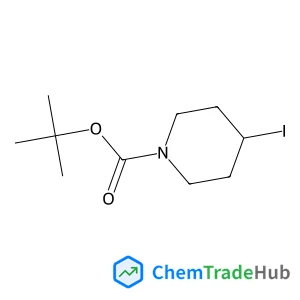
2-Methyl-2-propanyl 4-iodo-1-piperidinecarboxylate
CAS Number:
301673-14-3
Molecular Formula:
C10H18INO2
![N-[(E)-Phenylmethylene]benzenesulfonamide structure](https://static.chemtradehub.com/structs/139/13909-34-7-8167.webp "N-[(E)-Phenylmethylene]benzenesulfonamide structure")
Recommended Suppliers





Disclaimer
This page provides academic journal information for reference and research purposes only. We are not affiliated with any journal publishers and do not handle publication submissions. For publication-related inquiries, please contact the respective journal publishers directly.
If you notice any inaccuracies in the information displayed, please contact us at support@chemtradehub.com. We will promptly review and address your concerns.