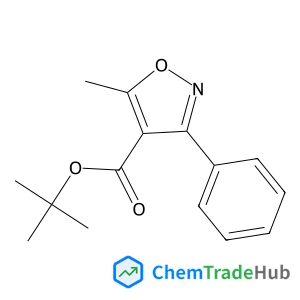
2-Methyl-2-propanyl 5-methyl-3-phenyl-1,2-oxazole-4-carboxylate
CAS Number:
211429-79-7
Molecular Formula:
C15H17NO3
Hiroshi Takahashi, Akira Matsuo, Ichiro Hatta
The effects of various sodium salts on the phase behavior of monoacylglycerol were investigated for fully hydrated monoelaidin systems by means of X-ray diffraction and differential scanning calorimetry. The hydrated monoelaidin systems form lamellar and bicontinuous cubic phases, depending on the temperature. Calorimetric data showed that the sign and magnitude of the phase transition temperature shifts on addition of salts are consistent with the Hofmeister series which is determined according to the efficiency of salting-out of proteins. Kosmotropic salts, having a great ability for the salting-out of proteins, increase the lamellar gel to lamellar liquid crystalline phase transition temperatures and decrease the primitive cubic to body-centered cubic (Im3m to Pn3m) phase transition temperatures. On the other hand, chaotropic salts, having a weak ability for the salting-out of proteins, exhibit the opposite effect. X-ray diffraction data demonstrated that chaotropic salts expand the lattice constants of fully hydrated monoelaidin in the Pn3m cubic phase whereas kosmotropic salts reduce the lattice constants. The above results are discussed in comparison with previous results reported for phospholipids and glycolipids. In addition, the structures of the cubic phases are discussed, based upon the above results.
Carlos Vila, Magnus Rueping
DOI: 10.1039/C3GC40587G
Weijiang Sun, Yan Wang, Xuan Wu, Xiaoquan Yao
DOI: 10.1039/C3GC40980E
Hu Wang, Li Li, Xing-Feng Bai, Wen-Hui Deng, Zhan-Jiang Zheng, Ke-Fang Yang
DOI: 10.1039/C3GC40991K
Joseph P. Adams, Catherine M. Alder, Ian Andrews, Ann M. Bullion, Matthew Campbell-Crawford, Michael G. Darcy, John D. Hayler, Richard K. Henderson, Catriona A. Oare, Israil Pendrak, Anikó M. Redman, Leanna E. Shuster, Helen F. Sneddon, Matthew D. Walker
DOI: 10.1039/C3GC40225H
Antonio Pineda, Leyre Gomez, Alina M. Balu, Victor Sebastian, Manuel Ojeda, Manuel Arruebo, Antonio A. Romero, Jesus Santamaria, Rafael Luque
DOI: 10.1039/C3GC40166A
David Obermayer, Alina M. Balu, Antonio A. Romero, Walter Goessler, Rafael Luque, C. Oliver Kappe
DOI: 10.1039/C3GC40307F
Hamid Salehzadeh, Davood Nematollahi, Hooman Hesari
DOI: 10.1039/C3GC40954F
Ali Pourjavadi, Seyed Hassan Hosseini, Firouz Matloubi Moghaddam, Behzad Koushki Foroushani, Craig Bennett
DOI: 10.1039/C3GC41307A
Qin Wang, Di Zhang, Xiangliang Yang, Huibi Xu, Amy Q. Shen, Yajiang Yang
DOI: 10.1039/C3GC40728D
Zhongtian Du, Hong Ma, Jie Xu
DOI: 10.1039/C3GC40730F
When handling 4-Methyl-6-(trifluoromethyl)quinoline (CAS: 40716-16-3), safety go...
4-(3,5-Difluorophenyl)aniline is an aromatic organic compound with the CAS numbe...
5-{[4-(Trifluoromethyl)phenyl]sulfanyl}-1,2,3-thiadiazole-4-carboxylic acid can ...
The market for 4-Benzylaniline hydrochloride (CAS: 6317-57-3) is steadily growin...
[3-(Diethylsulfamoyl)phenyl]boronic acid is generally considered safe when handl...
3-Bromo-2,5-dimethoxyaniline is mainly used in the pharmaceutical and chemical i...
N-Methyl-1-(5-methyl-1H-indol-3-yl)methanamine (CAS: 915922-67-7) is subject to ...
This compound is primarily used in the pharmaceutical industry for the synthesis...
2-Methyl-2-propanyl [(1S,3R)-3-aminocyclohexyl]carbamate (CAS: 1298101-47-9) sho...
Ethyl 2-bromo-4,4,4-trifluorobutanoate (CAS: 367-33-9) is utilized in the pharma...

Physical Chemistry Chemical Physics (PCCP) is an international journal co-owned by 19 physical chemistry and physics societies from around the world. This journal publishes original, cutting-edge research in physical chemistry, chemical physics and biophysical chemistry. To be suitable for publication in PCCP, articles must include significant innovation and/or insight into physical chemistry; this is the most important criterion that reviewers and Editors will judge against when evaluating submissions. The journal has a broad scope and welcomes contributions spanning experiment, theory, computation and data science. Topical coverage includes spectroscopy, dynamics, kinetics, statistical mechanics, thermodynamics, electrochemistry, catalysis, surface science, quantum mechanics, quantum computing and machine learning. Interdisciplinary research areas such as polymers and soft matter, materials, nanoscience, energy, surfaces/interfaces, and biophysical chemistry are welcomed if they demonstrate significant innovation and/or insight into physical chemistry. Joined experimental/theoretical studies are particularly appreciated when complementary and based on up-to-date approaches.

![Methyl 3-({2'-[(E)-(hydroxyhydrazono)methyl]-4-biphenylyl}methyl)-2-oxo-2,3-dihydro-1H-benzimidazole-4-carboxylate structure](https://static.chemtradehub.com/structs/149/1499167-72-4-034a.webp "Methyl 3-({2'-[(E)-(hydroxyhydrazono)methyl]-4-biphenylyl}methyl)-2-oxo-2,3-dihydro-1H-benzimidazole-4-carboxylate structure")