


Aerobic oxidation of primary aliphatic alcohols over bismuth oxide supported platinum catalysts in water
Literature Information
Publication Date
2013-05-17
DOI
10.1039/C3GC40730F
Impact Factor
10.182
Authors
Zhongtian Du, Hong Ma, Jie Xu
View Original
Abstract
Catalytic oxidation of non-activated aliphatic alcohols with molecular oxygen is rather challenging, especially in an aqueous medium in the absence of an additional base. Bismuth is usually used as a promoter of platinum-based catalysts. In this work, bismuth oxide was explored as a support, and Pt0 nanoparticles supported on bismuth oxide (Pt/Bi2O3) exhibited high activity for aerobic oxidation of n-butanol using water as a solvent in the absence of an additional base under optimized conditions. Besides n-butanol, liquid primary aliphatic alcohols with low solubility in water could also be smoothly oxidized into the corresponding carbonyl compounds with molecular oxygen. Pt/Bi2O3 reduced by H2 at about 200 °C showed the highest activity for aerobic oxidation of n-butanol. At this temperature, platinum oxide was reduced to Pt0 and bismuth oxide could be reduced partially which might change the surface property of bismuth oxide.
Recommended Journals

Biocatalysis and Biotransformation

Bioorganic & Medicinal Chemistry

Journal of Chemical Sciences

Colloid Journal

Polycyclic Aromatic Compounds

Critical Reviews in Solid State and Materials Sciences

Topics in Catalysis

Herald of the Russian Academy of Sciences

Bioorganic & Medicinal Chemistry Letters

Medicinal Chemistry Research
Related Literature
Functionalization of pentacene-5,7,12,14-tetraone with geminal enediyne and 1,3-dithiole groups
Eyad A. Younes, Yuming Zhao
2017-03-21
Research Article
DOI: 10.1039/C7QO00041C
Efficient synthesis of multisubstituted 2-alkenylpyridines via 2,3-rearrangement of O-homoallenylic oximes
Itaru Nakamura, Yoshiharu Oyama, Dong Zhang
2017-02-09
Research Article
DOI: 10.1039/C6QO00703A
Group 9 [Cp*MIII] complex-catalyzed C–H olefination of arenes in water at room temperature: a study on the catalytic activity
Hailong Zhang, Zhongzhen Yang, Jinxing Liu, Xinling Yu, Qiantao Wang, Yong Wu
2019-02-12
Research Article
DOI: 10.1039/C8QO01407H
Planar versus triptycenylene end-capped aroyleneimidazoles as electron acceptors in organic photovoltaics
2017-04-04
Research Article
DOI: 10.1039/C7QO00231A
Effect of Lewis acid bulkiness on the stereoselectivity of Diels–Alder reactions between acyclic dienes and α,β-enals
Israel Fernández
2017-04-17
Research Article
DOI: 10.1039/C7QO00154A
Three-component bis-heterocycliation for synthesis of 2-aminobenzo[4,5]thieno[3,2-d]thiazoles
Huawen Huang, Zhonghua Qu, Xiaochen Ji, Guo-Jun Deng
2019-02-26
Research Article
DOI: 10.1039/C8QO01365A
Pyrene-fused bisphenazinothiadiazoles with red to NIR electroluminescence
Diego Cortizo-Lacalle, Antonio Pertegás, Manuel Melle-Franco, Henk J. Bolink
2017-04-10
Research Article
DOI: 10.1039/C7QO00227K
Visible light enabled γ-trifluoromethylation of Baylis–Hillman acetates: stereoselective synthesis of trisubstituted alkenes
Arvind Kumar Yadav, Anup Kumar Sharma, Krishna Nand Singh
2019-02-14
Research Article
DOI: 10.1039/C9QO00166B
Enynone-enabled migratory insertion and Schmittel cyclization cascade for the synthesis of furan-fused fluorenes
He Zhang, Tongxiang Cao, Hejiang Luo, Lianfen Chen, Shifa Zhu
2019-02-21
Research Article
DOI: 10.1039/C9QO00045C
A new water-soluble cavitand with deeper guest binding properties‡
Faiz-Ur Rahman, Yang Yu
2019-02-25
Research Article
DOI: 10.1039/C9QO00049F
You might also like
Compound Q&A
What precautions should be taken when handling 4-Methyl-6-(trifluoromethyl)quinoline (CAS: 40716-16-3)?
When handling 4-Methyl-6-(trifluoromethyl)quinoline (CAS: 40716-16-3), safety go...
40716-16-34-Methyl-6-(trifluor...
Compound Q&A
What is 4-(3,5-Difluorophenyl)aniline (CAS: 405058-00-6)?
4-(3,5-Difluorophenyl)aniline is an aromatic organic compound with the CAS numbe...
405058-00-64-(3,5-Difluoropheny...
Compound Q&A
How is 5-{[4-(Trifluoromethyl)phenyl]sulfanyl}-1,2,3-thiadiazole-4-carboxylic acid (CAS: 338982-07-3) typically synthesized?
5-{[4-(Trifluoromethyl)phenyl]sulfanyl}-1,2,3-thiadiazole-4-carboxylic acid can ...
338982-07-35-{[4-(Trifluorometh...
Compound Q&A
What is the market or research trend for 4-Benzylaniline hydrochloride (CAS: 6317-57-3)?
The market for 4-Benzylaniline hydrochloride (CAS: 6317-57-3) is steadily growin...
6317-57-34-Benzylaniline hydr...
Compound Q&A
Is [3-(Diethylsulfamoyl)phenyl]boronic acid (CAS: 871329-58-7) safe?
[3-(Diethylsulfamoyl)phenyl]boronic acid is generally considered safe when handl...
871329-58-7[3-(Diethylsulfamoyl...
Compound Q&A
What are the main uses of 3-Bromo-2,5-dimethoxyaniline (CAS: 115929-62-9)?
3-Bromo-2,5-dimethoxyaniline is mainly used in the pharmaceutical and chemical i...
115929-62-93-Bromo-2,5-dimethox...
Compound Q&A
What regulatory guidelines apply to N-Methyl-1-(5-methyl-1H-indol-3-yl)methanamine (CAS: 915922-67-7)?
N-Methyl-1-(5-methyl-1H-indol-3-yl)methanamine (CAS: 915922-67-7) is subject to ...
915922-67-7N-Methyl-1-(5-methyl...
Compound Q&A
What industries use Carbamic acid, N-[(5S)-5,6-diamino-6-oxohexyl]-, 1,1-dimethylethyl ester (CAS: 24828-96-4)?
This compound is primarily used in the pharmaceutical industry for the synthesis...
24828-96-4Carbamic acid, N-[(5...
Compound Q&A
How should 2-Methyl-2-propanyl [(1S,3R)-3-aminocyclohexyl]carbamate (CAS: 1298101-47-9) be stored?
2-Methyl-2-propanyl [(1S,3R)-3-aminocyclohexyl]carbamate (CAS: 1298101-47-9) sho...
1298101-47-92-Methyl-2-propanyl ...
Compound Q&A
What industries use Ethyl 2-bromo-4,4,4-trifluorobutanoate (CAS: 367-33-9)?
Ethyl 2-bromo-4,4,4-trifluorobutanoate (CAS: 367-33-9) is utilized in the pharma...
367-33-9Ethyl 2-bromo-4,4,4-...
Source Journal
Green Chemistry

CiteScore:
16.1
Self-citation Rate:
7.5%
Articles per Year:
944
Green Chemistry provides a unique forum for the publication of innovative research on the development of alternative green and sustainable technologies. The scope of Green Chemistry is based on, but not limited to, the definition proposed by Anastas and Warner (Green Chemistry: Theory and Practice, P T Anastas and J C Warner, Oxford University Press, Oxford, 1998). Green chemistry is the utilisation of a set of principles that reduces or eliminates the use or generation of hazardous substances in the design, manufacture and application of chemical products. Green Chemistry is at the frontiers of this continuously-evolving interdisciplinary science and publishes research that attempts to reduce the environmental impact of the chemical enterprise by developing a technology base that is inherently non-toxic to living things and the environment. Submissions on all aspects of research relating to the endeavour are welcome. The journal publishes original and significant cutting-edge research that is likely to be of wide general appeal. To be published, work must present a significant advance in green chemistry. Papers must contain a comparison with existing methods and demonstrate advantages over those methods before publication can be considered. For more information please see this Editorial. Coverage includes the following, but is not limited to: Design (e.g. biomimicry, design for degradation/recycling/reduced toxicity…) Reagents & Feedstocks (e.g. renewables, CO2, solvents, auxiliary agents, waste utilization…) Synthesis (e.g. organic, inorganic, synthetic biology…) Catalysis (e.g. homogeneous, heterogeneous, enzyme, whole cell…) Process (e.g. process design, intensification, separations, recycling, efficiency…) Energy (e.g. renewable energy, fuels, photovoltaics, fuel cells, energy storage, energy carriers…) Applications (e.g. electronics, dyes, consumer products, coatings, pharmaceuticals, preservatives, building materials, chemicals for industry/agriculture/mining…) Impact (e.g. safety, metrics, LCA, sustainability, (eco)toxicology…) Green chemistry is, by definition, a continuously-evolving frontier. Therefore, the inclusion of a particular material or technology does not, of itself, guarantee that a paper is suitable for the journal. To be suitable, the novel advance should have the potential for reduced environmental impact relative to the state of the art. Green Chemistry does not normally deal with research associated with 'end-of-pipe' or remediation issues.
Recommended Compounds
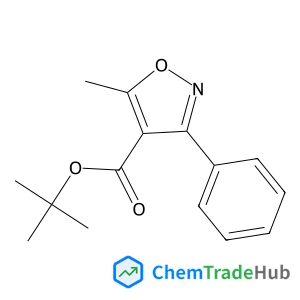
2-Methyl-2-propanyl 5-methyl-3-phenyl-1,2-oxazole-4-carboxylate
CAS Number:
211429-79-7
Molecular Formula:
C15H17NO3
Recommended Suppliers




Disclaimer
This page provides academic journal information for reference and research purposes only. We are not affiliated with any journal publishers and do not handle publication submissions. For publication-related inquiries, please contact the respective journal publishers directly.
If you notice any inaccuracies in the information displayed, please contact us at support@chemtradehub.com. We will promptly review and address your concerns.