












Laser-driven heterogeneous catalysis: efficient amide formation catalysed by Au/SiO2 systems
Literature Information
Publication Date
2013-05-22
DOI
10.1039/C3GC40166A
Impact Factor
10.182
Authors
Antonio Pineda, Leyre Gomez, Alina M. Balu, Victor Sebastian, Manuel Ojeda, Manuel Arruebo, Antonio A. Romero, Jesus Santamaria, Rafael Luque
View Original
Abstract
A proof of concept of laser-assisted heterogeneously catalysed processes at room temperature using silica supported gold nanoparticles is reported. Au/SiO2 nanoparticles were laser-irradiated at 532 nm (SPR maximum absorbance) to catalyse the selected reaction, namely the production of 4-benzoylmorpholine from benzaldehyde and morpholine via amide formation, for which quantitative yields to the target amide were obtained after 3–5 h of reaction. The protocol could also be extended to a tandem oxidation/amidation process which shows the potential of the proposed approach for the promotion of liquid-phase organic reactions at room temperature.
Recommended Journals
Related Literature
Functionalization of pentacene-5,7,12,14-tetraone with geminal enediyne and 1,3-dithiole groups
Eyad A. Younes, Yuming Zhao
2017-03-21
Research Article
DOI: 10.1039/C7QO00041C
From tetrabenzoheptafulvalene to sp2 carbon nano-rings
Kwan Yin Cheung, Shuaijun Yang, Qian Miao
2017-01-13
Research Article
DOI: 10.1039/C6QO00828C
Silver-catalyzed geminal aminofluorination of diazoketones with anilines and N-fluorobenzenesulphonimide
Jun Huang, Linyong Li, Haoguo Chen, Tiebo Xiao, Yuwei He, Lei Zhou
2017-01-12
Research Article
DOI: 10.1039/C6QO00813E
Asymmetric organocatalytic conjugated addition of pyrazolin-5-ones to ortho-quinomethanes: construction of vicinal tertiary and all-carbon quaternary stereocenters
Ming-Ming Chu, Suo-Suo Qi, Wan-Zhen Ju, Yi-Feng Wang, Xue-Yang Chen, Dan-Qian Xu, Zhen-Yuan Xu
2019-02-27
Research Article
DOI: 10.1039/C9QO00011A
The direct decarboxylative allylation of N-arylglycine derivatives by photoredox catalysis
Yingqian Duan, Muliang Zhang, Rehanguli Ruzi, Zhongkai Wu
2016-12-26
Research Article
DOI: 10.1039/C6QO00711B
Additive-free regio- and diastereoselective construction of fully-substituted isoxazolidines employing diazo compounds
Ekta Gupta, Mohd Khalid Zaheer, Ruchir Kant
2019-02-21
Research Article
DOI: 10.1039/C8QO01421C
A copper-catalyzed arylation/nucleophilic addition/fragmentation/C–S bond formation cascade: synthesis of bis(arylthio)imines
Wei-Si Guo, Yuan-Chao Wang, Qian Dou, Li-Rong Wen, Ming Li
2017-01-03
Research Article
DOI: 10.1039/C6QO00739B
Reactivity of epoxy-ynamides with metal halides: nucleophile (Br/Cl/OH)-assisted tandem intramolecular 5-exo-dig or 6-endo-dig cyclisation and AgF2-promoted oxidation
Mandala Anitha, Mallepalli Shankar, K. C. Kumara Swamy
2019-02-21
Research Article
DOI: 10.1039/C9QO00027E
Synthesis of homoazafullerene [C59N(CH2)]R and azahomoazafullerene [C59N(NH)]R
Dan Xu, Yanbang Li, Ning Lou
2017-02-16
Research Article
DOI: 10.1039/C7QO00098G
Copper nitrate-mediated chemo- and regioselective annulation from two different alkynes: a direct route to isoxazoles
Yingying Li, Mingchun Gao, Bingxin Liu
2016-12-20
Research Article
DOI: 10.1039/C6QO00704J
You might also like
Compound Q&A
What precautions should be taken when handling 4-Methyl-6-(trifluoromethyl)quinoline (CAS: 40716-16-3)?
When handling 4-Methyl-6-(trifluoromethyl)quinoline (CAS: 40716-16-3), safety go...
40716-16-34-Methyl-6-(trifluor...
Compound Q&A
What is 4-(3,5-Difluorophenyl)aniline (CAS: 405058-00-6)?
4-(3,5-Difluorophenyl)aniline is an aromatic organic compound with the CAS numbe...
405058-00-64-(3,5-Difluoropheny...
Compound Q&A
How is 5-{[4-(Trifluoromethyl)phenyl]sulfanyl}-1,2,3-thiadiazole-4-carboxylic acid (CAS: 338982-07-3) typically synthesized?
5-{[4-(Trifluoromethyl)phenyl]sulfanyl}-1,2,3-thiadiazole-4-carboxylic acid can ...
338982-07-35-{[4-(Trifluorometh...
Compound Q&A
What is the market or research trend for 4-Benzylaniline hydrochloride (CAS: 6317-57-3)?
The market for 4-Benzylaniline hydrochloride (CAS: 6317-57-3) is steadily growin...
6317-57-34-Benzylaniline hydr...
Compound Q&A
Is [3-(Diethylsulfamoyl)phenyl]boronic acid (CAS: 871329-58-7) safe?
[3-(Diethylsulfamoyl)phenyl]boronic acid is generally considered safe when handl...
871329-58-7[3-(Diethylsulfamoyl...
Compound Q&A
What are the main uses of 3-Bromo-2,5-dimethoxyaniline (CAS: 115929-62-9)?
3-Bromo-2,5-dimethoxyaniline is mainly used in the pharmaceutical and chemical i...
115929-62-93-Bromo-2,5-dimethox...
Compound Q&A
What regulatory guidelines apply to N-Methyl-1-(5-methyl-1H-indol-3-yl)methanamine (CAS: 915922-67-7)?
N-Methyl-1-(5-methyl-1H-indol-3-yl)methanamine (CAS: 915922-67-7) is subject to ...
915922-67-7N-Methyl-1-(5-methyl...
Compound Q&A
What industries use Carbamic acid, N-[(5S)-5,6-diamino-6-oxohexyl]-, 1,1-dimethylethyl ester (CAS: 24828-96-4)?
This compound is primarily used in the pharmaceutical industry for the synthesis...
24828-96-4Carbamic acid, N-[(5...
Compound Q&A
How should 2-Methyl-2-propanyl [(1S,3R)-3-aminocyclohexyl]carbamate (CAS: 1298101-47-9) be stored?
2-Methyl-2-propanyl [(1S,3R)-3-aminocyclohexyl]carbamate (CAS: 1298101-47-9) sho...
1298101-47-92-Methyl-2-propanyl ...
Compound Q&A
What industries use Ethyl 2-bromo-4,4,4-trifluorobutanoate (CAS: 367-33-9)?
Ethyl 2-bromo-4,4,4-trifluorobutanoate (CAS: 367-33-9) is utilized in the pharma...
367-33-9Ethyl 2-bromo-4,4,4-...
Source Journal
Green Chemistry

CiteScore:
16.1
Self-citation Rate:
7.5%
Articles per Year:
944
Green Chemistry provides a unique forum for the publication of innovative research on the development of alternative green and sustainable technologies. The scope of Green Chemistry is based on, but not limited to, the definition proposed by Anastas and Warner (Green Chemistry: Theory and Practice, P T Anastas and J C Warner, Oxford University Press, Oxford, 1998). Green chemistry is the utilisation of a set of principles that reduces or eliminates the use or generation of hazardous substances in the design, manufacture and application of chemical products. Green Chemistry is at the frontiers of this continuously-evolving interdisciplinary science and publishes research that attempts to reduce the environmental impact of the chemical enterprise by developing a technology base that is inherently non-toxic to living things and the environment. Submissions on all aspects of research relating to the endeavour are welcome. The journal publishes original and significant cutting-edge research that is likely to be of wide general appeal. To be published, work must present a significant advance in green chemistry. Papers must contain a comparison with existing methods and demonstrate advantages over those methods before publication can be considered. For more information please see this Editorial. Coverage includes the following, but is not limited to: Design (e.g. biomimicry, design for degradation/recycling/reduced toxicity…) Reagents & Feedstocks (e.g. renewables, CO2, solvents, auxiliary agents, waste utilization…) Synthesis (e.g. organic, inorganic, synthetic biology…) Catalysis (e.g. homogeneous, heterogeneous, enzyme, whole cell…) Process (e.g. process design, intensification, separations, recycling, efficiency…) Energy (e.g. renewable energy, fuels, photovoltaics, fuel cells, energy storage, energy carriers…) Applications (e.g. electronics, dyes, consumer products, coatings, pharmaceuticals, preservatives, building materials, chemicals for industry/agriculture/mining…) Impact (e.g. safety, metrics, LCA, sustainability, (eco)toxicology…) Green chemistry is, by definition, a continuously-evolving frontier. Therefore, the inclusion of a particular material or technology does not, of itself, guarantee that a paper is suitable for the journal. To be suitable, the novel advance should have the potential for reduced environmental impact relative to the state of the art. Green Chemistry does not normally deal with research associated with 'end-of-pipe' or remediation issues.
Recommended Compounds
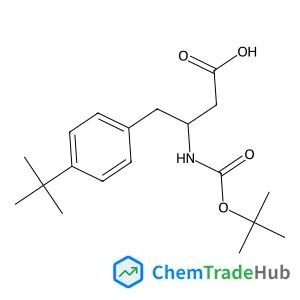
(S)-3-((tert-Butoxycarbonyl)amino)-4-(4-(tert-butyl)phenyl)butanoic acid
CAS Number:
403661-85-8
Molecular Formula:
C19H29NO4
Recommended Suppliers






Disclaimer
This page provides academic journal information for reference and research purposes only. We are not affiliated with any journal publishers and do not handle publication submissions. For publication-related inquiries, please contact the respective journal publishers directly.
If you notice any inaccuracies in the information displayed, please contact us at support@chemtradehub.com. We will promptly review and address your concerns.