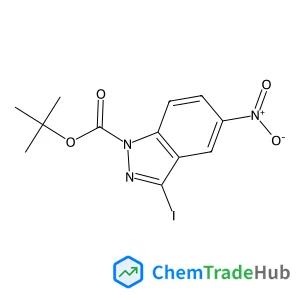
Tert-butyl 3-iodo-5-nitro-1H-indazole-1-carboxylate
CAS Number:
459133-69-8
Molecular Formula:
C12H12IN3O4
David Obermayer, Alina M. Balu, Antonio A. Romero, Walter Goessler, Rafael Luque, C. Oliver Kappe
Investigations on heterogeneous iron catalysis in the selective aerobic oxidation of a primary alcohol are presented. Continuous flow technology was used in combination with an iron oxide nanoparticle catalyst stabilized in a mesoporous aluminosilicate support (“flow nanocatalysis”) as a process intensification tool to maximize catalyst efficiency. Using 5 mol% 2,2,6,6-tetramethylpiperidine-1-oxyl (TEMPO) as a co-catalyst, up to 42% benzyl alcohol as a simple model substrate was selectively converted to benzaldehyde in a single pass of the reactor. Full conversion was achieved by continuous recirculation, simulating an extension of the catalyst bed. ICPMS analysis indicated that the catalyst is highly stable and does not leach under the investigated conditions, providing solid evidence for the participation of a heterogeneous iron species in the catalytic cycle.
Mandala Anitha, Mallepalli Shankar, K. C. Kumara Swamy
DOI: 10.1039/C9QO00027E
Marcus Richter, Karl Sebastian Schellhammer, Peter Machata, Gianaurelio Cuniberti, Alexey Popov, Frank Ortmann, Reinhard Berger, Klaus Müllen, Xinliang Feng
DOI: 10.1039/C7QO00180K
Lu-Ping Shao, Chang-Mei Si, Zhuo-Ya Mao, Wen Zhou, Tadeusz F. Molinski, Bang-Guo Wei, Guo-Qiang Lin
DOI: 10.1039/C7QO00052A
Dong Pan, Yin Wei
DOI: 10.1039/C9QO00050J
He Zhang, Tongxiang Cao, Hejiang Luo, Lianfen Chen, Shifa Zhu
DOI: 10.1039/C9QO00045C
Yin Wei, Xu-Bo Hu, Kai Chen
DOI: 10.1039/C6QO00713A
Zhuang Xiong, Dongdong Liang, Shuang Luo
DOI: 10.1039/C7QO00049A
Mingyang Wang, Zhen Wu
DOI: 10.1039/C6QO00744A
Huawen Huang, Zhonghua Qu, Xiaochen Ji, Guo-Jun Deng
DOI: 10.1039/C8QO01365A
When handling 4-Methyl-6-(trifluoromethyl)quinoline (CAS: 40716-16-3), safety go...
4-(3,5-Difluorophenyl)aniline is an aromatic organic compound with the CAS numbe...
5-{[4-(Trifluoromethyl)phenyl]sulfanyl}-1,2,3-thiadiazole-4-carboxylic acid can ...
The market for 4-Benzylaniline hydrochloride (CAS: 6317-57-3) is steadily growin...
[3-(Diethylsulfamoyl)phenyl]boronic acid is generally considered safe when handl...
3-Bromo-2,5-dimethoxyaniline is mainly used in the pharmaceutical and chemical i...
N-Methyl-1-(5-methyl-1H-indol-3-yl)methanamine (CAS: 915922-67-7) is subject to ...
This compound is primarily used in the pharmaceutical industry for the synthesis...
2-Methyl-2-propanyl [(1S,3R)-3-aminocyclohexyl]carbamate (CAS: 1298101-47-9) sho...
Ethyl 2-bromo-4,4,4-trifluorobutanoate (CAS: 367-33-9) is utilized in the pharma...

Green Chemistry provides a unique forum for the publication of innovative research on the development of alternative green and sustainable technologies. The scope of Green Chemistry is based on, but not limited to, the definition proposed by Anastas and Warner (Green Chemistry: Theory and Practice, P T Anastas and J C Warner, Oxford University Press, Oxford, 1998). Green chemistry is the utilisation of a set of principles that reduces or eliminates the use or generation of hazardous substances in the design, manufacture and application of chemical products. Green Chemistry is at the frontiers of this continuously-evolving interdisciplinary science and publishes research that attempts to reduce the environmental impact of the chemical enterprise by developing a technology base that is inherently non-toxic to living things and the environment. Submissions on all aspects of research relating to the endeavour are welcome. The journal publishes original and significant cutting-edge research that is likely to be of wide general appeal. To be published, work must present a significant advance in green chemistry. Papers must contain a comparison with existing methods and demonstrate advantages over those methods before publication can be considered. For more information please see this Editorial. Coverage includes the following, but is not limited to: Design (e.g. biomimicry, design for degradation/recycling/reduced toxicity…) Reagents & Feedstocks (e.g. renewables, CO2, solvents, auxiliary agents, waste utilization…) Synthesis (e.g. organic, inorganic, synthetic biology…) Catalysis (e.g. homogeneous, heterogeneous, enzyme, whole cell…) Process (e.g. process design, intensification, separations, recycling, efficiency…) Energy (e.g. renewable energy, fuels, photovoltaics, fuel cells, energy storage, energy carriers…) Applications (e.g. electronics, dyes, consumer products, coatings, pharmaceuticals, preservatives, building materials, chemicals for industry/agriculture/mining…) Impact (e.g. safety, metrics, LCA, sustainability, (eco)toxicology…) Green chemistry is, by definition, a continuously-evolving frontier. Therefore, the inclusion of a particular material or technology does not, of itself, guarantee that a paper is suitable for the journal. To be suitable, the novel advance should have the potential for reduced environmental impact relative to the state of the art. Green Chemistry does not normally deal with research associated with 'end-of-pipe' or remediation issues.
![2,4-Dichloro-6-isopropyl-5H-pyrrolo[3,4-d]pyrimidin-7(6H)-one structure](https://static.chemtradehub.com/structs/107/1079649-94-7-ad4a.webp "2,4-Dichloro-6-isopropyl-5H-pyrrolo[3,4-d]pyrimidin-7(6H)-one structure")
![(4aR,5S,6R,8aS)-5-[2-(3-Furyl)ethyl]-8a-(hydroxymethyl)-5,6-dimethyl-3,4,4a,5,6,7,8,8a-octahydro-1-naphthalenecarboxylic acid structure](https://static.chemtradehub.com/structs/184/18411-75-1-d4cd.webp "(4aR,5S,6R,8aS)-5-[2-(3-Furyl)ethyl]-8a-(hydroxymethyl)-5,6-dimethyl-3,4,4a,5,6,7,8,8a-octahydro-1-naphthalenecarboxylic acid structure")