


Development of GSK's reagent guides – embedding sustainability into reagent selection
Literature Information
Publication Date
2013-04-22
DOI
10.1039/C3GC40225H
Impact Factor
10.182
Authors
Joseph P. Adams, Catherine M. Alder, Ian Andrews, Ann M. Bullion, Matthew Campbell-Crawford, Michael G. Darcy, John D. Hayler, Richard K. Henderson, Catriona A. Oare, Israil Pendrak, Anikó M. Redman, Leanna E. Shuster, Helen F. Sneddon, Matthew D. Walker
View Original
Abstract
Reagent guides ranking commonly used reagents for 15 transformations have been developed to reduce the environmental impact of drug discovery and development. Reagents have been scored by a combination of health, safety and environmental risk phrases, life cycle analysis (where possible) and an assessment of the chemistry including considerations of atom efficiency, stoichiometry, work-up and other issues. Guides covering alkene reduction, amide formation, C–H bromination, C–H chlorination, deoxychlorination, epoxidation, ester formation, ether formation, fluorination, iodination, ketone reduction, nitro reduction, oxidation of alcohols to aldehydes and ketones, reductive amination and sulfur oxidation are shared, with an explanation of the methodology behind their generation.
Recommended Journals

Heteroatom Chemistry

Acta Metallurgica Sinica-English Letters

Polycyclic Aromatic Compounds

Medicinal Chemistry Research

Main Group Chemistry

Bioorganic & Medicinal Chemistry Letters

Biocatalysis and Biotransformation

Atomization and Sprays

Journal of the Indian Institute of Science

Bioorganic & Medicinal Chemistry
Related Literature
An efficient approach to generate aryl carbenes: gold-catalyzed sequential activation of 1,6-diynes
Tongxiang Cao, Kai Chen
2016-12-21
Research Article
DOI: 10.1039/C6QO00769D
Chiral phosphoric acid-catalyzed asymmetric C(sp3)–H functionalization of biomass-derived 2,5-dimethylfuran via two sequential Cope-type rearrangements
Lubin Xu, Haohua Chen, Jian Liu, Lan Zhou, Qing Liu
2019-02-26
Research Article
DOI: 10.1039/C8QO01375F
Spirocyclic cladosporicin A and cladosporiumins I and J from a Hydractinia-associated Cladosporium sphaerospermum SW67
Maja Rischer, Seoung Rak Lee, Hee Jeong Eom, Hyun Bong Park, John Vollmers, Anne-Kristin Kaster, Yern-Hyerk Shin, Dong-Chan Oh, Ki Hyun Kim, Christine Beemelmanns
2018-11-27
Research Article
DOI: 10.1039/C8QO01104D
One-pot synthesis of N-heterocycles and enimino carbocycles by tandem dehydrative coupling–reductive cyclization of halo-sec-amides and dehydrative cyclization of olefinic sec-amides‡
Pei-Qiang Huang, Ying-Hong Huang, Shu-Ren Wang
2016-12-16
Research Article
DOI: 10.1039/C6QO00720A
Expedient synthesis of a symmetric cycloheptyne-Co2(CO)6 complex for orthogonal Huisgen cycloadditions
Morgan Cormier, Eric Fouquet, Philippe Hermange
2019-02-28
Research Article
DOI: 10.1039/C9QO00086K
Iron-catalyzed boration of cinnamyl carbonates: a highly stereoselective approach to cyclopropylboronates
Yang Liu, Yuhan Zhou, Dong Li, Han Chen, Jinfeng Zhao, Jingping Qu
2019-02-20
Research Article
DOI: 10.1039/C8QO01163J
Oxidative annulations triggered by a simple Lewis acid: facile synthesis of benzofurans
Chinnabattigalla Sreenivasulu, A. Gopi Krishna Reddy, G. Satyanarayana
2017-02-08
Research Article
DOI: 10.1039/C6QO00531D
The impact of interplay between electronic and steric effects on the synthesis and the linear and non-linear optical properties of diketopyrrolopyrrole bearing benzofuran moieties
Anna Purc, Beata Koszarna, Irina Iachina, Daniel H. Friese, Mariusz Tasior, Krzysztof Sobczyk, Tomasz Pędziński, Jonathan Brewer, Daniel T. Gryko
2017-02-07
Research Article
DOI: 10.1039/C6QO00869K
Ir-Catalyzed ring-opening of oxa(aza)benzonorbornadienes with water or alcohols
Xin Yang, Wen Yang, Yongqi Yao, Yingying Deng, Dingqiao Yang
2019-03-06
Research Article
DOI: 10.1039/C8QO01403E
Synthesis of largely π-extended naphthalenediimides via C–H activation towards highly soluble and narrow band-gap organic optoelectronic materials
Wenting Wu, Zheng Zhao, Xiaodi Yang, Xike Gao
2017-03-22
Research Article
DOI: 10.1039/C7QO00061H
You might also like
Compound Q&A
What precautions should be taken when handling 4-Methyl-6-(trifluoromethyl)quinoline (CAS: 40716-16-3)?
When handling 4-Methyl-6-(trifluoromethyl)quinoline (CAS: 40716-16-3), safety go...
40716-16-34-Methyl-6-(trifluor...
Compound Q&A
What is 4-(3,5-Difluorophenyl)aniline (CAS: 405058-00-6)?
4-(3,5-Difluorophenyl)aniline is an aromatic organic compound with the CAS numbe...
405058-00-64-(3,5-Difluoropheny...
Compound Q&A
How is 5-{[4-(Trifluoromethyl)phenyl]sulfanyl}-1,2,3-thiadiazole-4-carboxylic acid (CAS: 338982-07-3) typically synthesized?
5-{[4-(Trifluoromethyl)phenyl]sulfanyl}-1,2,3-thiadiazole-4-carboxylic acid can ...
338982-07-35-{[4-(Trifluorometh...
Compound Q&A
What is the market or research trend for 4-Benzylaniline hydrochloride (CAS: 6317-57-3)?
The market for 4-Benzylaniline hydrochloride (CAS: 6317-57-3) is steadily growin...
6317-57-34-Benzylaniline hydr...
Compound Q&A
Is [3-(Diethylsulfamoyl)phenyl]boronic acid (CAS: 871329-58-7) safe?
[3-(Diethylsulfamoyl)phenyl]boronic acid is generally considered safe when handl...
871329-58-7[3-(Diethylsulfamoyl...
Compound Q&A
What are the main uses of 3-Bromo-2,5-dimethoxyaniline (CAS: 115929-62-9)?
3-Bromo-2,5-dimethoxyaniline is mainly used in the pharmaceutical and chemical i...
115929-62-93-Bromo-2,5-dimethox...
Compound Q&A
What regulatory guidelines apply to N-Methyl-1-(5-methyl-1H-indol-3-yl)methanamine (CAS: 915922-67-7)?
N-Methyl-1-(5-methyl-1H-indol-3-yl)methanamine (CAS: 915922-67-7) is subject to ...
915922-67-7N-Methyl-1-(5-methyl...
Compound Q&A
What industries use Carbamic acid, N-[(5S)-5,6-diamino-6-oxohexyl]-, 1,1-dimethylethyl ester (CAS: 24828-96-4)?
This compound is primarily used in the pharmaceutical industry for the synthesis...
24828-96-4Carbamic acid, N-[(5...
Compound Q&A
How should 2-Methyl-2-propanyl [(1S,3R)-3-aminocyclohexyl]carbamate (CAS: 1298101-47-9) be stored?
2-Methyl-2-propanyl [(1S,3R)-3-aminocyclohexyl]carbamate (CAS: 1298101-47-9) sho...
1298101-47-92-Methyl-2-propanyl ...
Compound Q&A
What industries use Ethyl 2-bromo-4,4,4-trifluorobutanoate (CAS: 367-33-9)?
Ethyl 2-bromo-4,4,4-trifluorobutanoate (CAS: 367-33-9) is utilized in the pharma...
367-33-9Ethyl 2-bromo-4,4,4-...
Source Journal
Green Chemistry

CiteScore:
16.1
Self-citation Rate:
7.5%
Articles per Year:
944
Green Chemistry provides a unique forum for the publication of innovative research on the development of alternative green and sustainable technologies. The scope of Green Chemistry is based on, but not limited to, the definition proposed by Anastas and Warner (Green Chemistry: Theory and Practice, P T Anastas and J C Warner, Oxford University Press, Oxford, 1998). Green chemistry is the utilisation of a set of principles that reduces or eliminates the use or generation of hazardous substances in the design, manufacture and application of chemical products. Green Chemistry is at the frontiers of this continuously-evolving interdisciplinary science and publishes research that attempts to reduce the environmental impact of the chemical enterprise by developing a technology base that is inherently non-toxic to living things and the environment. Submissions on all aspects of research relating to the endeavour are welcome. The journal publishes original and significant cutting-edge research that is likely to be of wide general appeal. To be published, work must present a significant advance in green chemistry. Papers must contain a comparison with existing methods and demonstrate advantages over those methods before publication can be considered. For more information please see this Editorial. Coverage includes the following, but is not limited to: Design (e.g. biomimicry, design for degradation/recycling/reduced toxicity…) Reagents & Feedstocks (e.g. renewables, CO2, solvents, auxiliary agents, waste utilization…) Synthesis (e.g. organic, inorganic, synthetic biology…) Catalysis (e.g. homogeneous, heterogeneous, enzyme, whole cell…) Process (e.g. process design, intensification, separations, recycling, efficiency…) Energy (e.g. renewable energy, fuels, photovoltaics, fuel cells, energy storage, energy carriers…) Applications (e.g. electronics, dyes, consumer products, coatings, pharmaceuticals, preservatives, building materials, chemicals for industry/agriculture/mining…) Impact (e.g. safety, metrics, LCA, sustainability, (eco)toxicology…) Green chemistry is, by definition, a continuously-evolving frontier. Therefore, the inclusion of a particular material or technology does not, of itself, guarantee that a paper is suitable for the journal. To be suitable, the novel advance should have the potential for reduced environmental impact relative to the state of the art. Green Chemistry does not normally deal with research associated with 'end-of-pipe' or remediation issues.
Recommended Compounds
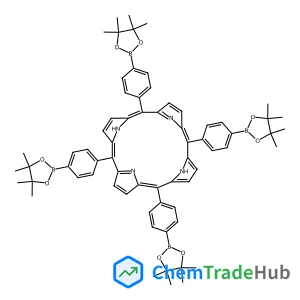
5,10,15,20-tetrakis(4-boronic acid pinacol ester phenyl) porphyrin
CAS Number:
1332748-00-1
Molecular Formula:
C68H74B4N4O8
![Methyl 3-({2'-[(E)-(hydroxyhydrazono)methyl]-4-biphenylyl}methyl)-2-oxo-2,3-dihydro-1H-benzimidazole-4-carboxylate structure](https://static.chemtradehub.com/structs/149/1499167-72-4-034a.webp "Methyl 3-({2'-[(E)-(hydroxyhydrazono)methyl]-4-biphenylyl}methyl)-2-oxo-2,3-dihydro-1H-benzimidazole-4-carboxylate structure")
Methyl 3-({2'-[(E)-(hydroxyhydrazono)methyl]-4-biphenylyl}methyl)-2-oxo-2,3-dihydro-1H-benzimidazole-4-carboxylate
CAS Number:
1499167-72-4
Molecular Formula:
C23H20N4O4
Recommended Suppliers




Disclaimer
This page provides academic journal information for reference and research purposes only. We are not affiliated with any journal publishers and do not handle publication submissions. For publication-related inquiries, please contact the respective journal publishers directly.
If you notice any inaccuracies in the information displayed, please contact us at support@chemtradehub.com. We will promptly review and address your concerns.