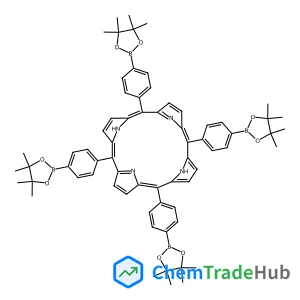
5,10,15,20-tetrakis(4-boronic acid pinacol ester phenyl) porphyrin
CAS Number:
1332748-00-1
Molecular Formula:
C68H74B4N4O8
J. Melsheimer, J. Kröhnert, R. Ahmad, S. Klokishner, F. C. Jentoft, G. Mestl, R. Schlögl
In order to understand the transformations of the Keggin-type H4−xCsxPV–Mo11O40 (x = 0, 2) compounds with rising temperature over a long time in a stream of different gas atmospheres, in situ UV/Vis/near-IR spectroscopic studies were carried out. Diffuse reflectance spectra were recorded using an improved spectrometer and a suitable microreactor. Visible and near-IR peak intensities, peak positions and the band gap energies were determined from apparent absorption spectra. Propene, isopropanol, water and the oxidation products were analyzed by GC. The experimentally observed blue shift of the visible absorption band in the region of crystal water loss and the increase in the near-IR absorption were explained on the basis of quantum-mechanical calculations of the shapes and positions of the charge transfer and d–d bands arising from Mo5+–Mo6+ and V4+–Mo6+ pairs in intact and ill-defined fragments of the Keggin structure. It was concluded that with removal of crystal water during the action of He, He/H2O, propene, O2/propene and increasing temperature, reduced species with protons located at the bridging oxygens promote a blue shift of the visible band, while a large number of ill-defined species form the near-IR part of the spectra in the temperature range 326–600 K.
Hicham Ait Rass, Nadine Essayem, Michèle Besson
DOI: 10.1039/C3GC40727F
Abdoulaye Gassama, Cédric Ernenwein, Ali Youssef, Mickaël Agach, Emmanuel Riguet, Siniša Marinković, Boris Estrine, Norbert Hoffmann
DOI: 10.1039/C3GC00062A
Antonio J. F. Carvalho
DOI: 10.1039/C3GC40358K
Lu Li, Kejing Quan, Junming Xu, Fusheng Liu, Shiwei Liu, Shitao Yu, Congxia Xie, Baoquan Zhang, Xiaoping Ge
DOI: 10.1039/C3GC40796A
Haixin Guo, Youfen Lian, Lulu Yan, Xinhua Qi, Richard Lee Smith, Jr.
DOI: 10.1039/C3GC40433A
Hu Wang, Li Li, Xing-Feng Bai, Wen-Hui Deng, Zhan-Jiang Zheng, Ke-Fang Yang
DOI: 10.1039/C3GC40991K
Hong Wu, Chunyong Tian, Xiaokai Song, Chuang Liu, Dong Yang, Zhongyi Jiang
DOI: 10.1039/C3GC37129H
Andrey Chernykh, Samim Alam, Anurad Jayasooriya, James Bahr
DOI: 10.1039/C3GC40605A
Cristina Mottillo, Yuneng Lu, Minh-Hao Pham, Matthew J. Cliffe, Trong-On Do, Tomislav Friščić
DOI: 10.1039/C3GC40520F
Hamid Salehzadeh, Davood Nematollahi, Hooman Hesari
DOI: 10.1039/C3GC40954F
When handling 4-Methyl-6-(trifluoromethyl)quinoline (CAS: 40716-16-3), safety go...
4-(3,5-Difluorophenyl)aniline is an aromatic organic compound with the CAS numbe...
5-{[4-(Trifluoromethyl)phenyl]sulfanyl}-1,2,3-thiadiazole-4-carboxylic acid can ...
The market for 4-Benzylaniline hydrochloride (CAS: 6317-57-3) is steadily growin...
[3-(Diethylsulfamoyl)phenyl]boronic acid is generally considered safe when handl...
3-Bromo-2,5-dimethoxyaniline is mainly used in the pharmaceutical and chemical i...
N-Methyl-1-(5-methyl-1H-indol-3-yl)methanamine (CAS: 915922-67-7) is subject to ...
This compound is primarily used in the pharmaceutical industry for the synthesis...
2-Methyl-2-propanyl [(1S,3R)-3-aminocyclohexyl]carbamate (CAS: 1298101-47-9) sho...
Ethyl 2-bromo-4,4,4-trifluorobutanoate (CAS: 367-33-9) is utilized in the pharma...

Physical Chemistry Chemical Physics (PCCP) is an international journal co-owned by 19 physical chemistry and physics societies from around the world. This journal publishes original, cutting-edge research in physical chemistry, chemical physics and biophysical chemistry. To be suitable for publication in PCCP, articles must include significant innovation and/or insight into physical chemistry; this is the most important criterion that reviewers and Editors will judge against when evaluating submissions. The journal has a broad scope and welcomes contributions spanning experiment, theory, computation and data science. Topical coverage includes spectroscopy, dynamics, kinetics, statistical mechanics, thermodynamics, electrochemistry, catalysis, surface science, quantum mechanics, quantum computing and machine learning. Interdisciplinary research areas such as polymers and soft matter, materials, nanoscience, energy, surfaces/interfaces, and biophysical chemistry are welcomed if they demonstrate significant innovation and/or insight into physical chemistry. Joined experimental/theoretical studies are particularly appreciated when complementary and based on up-to-date approaches.
![N-{3-[Benzyl(methyl)amino]propyl}-9-chloro-5,6,7,8-tetrahydro-2-acridinecarboxamide structure](https://static.chemtradehub.com/structs/142/1426944-49-1-1e4c.webp "N-{3-[Benzyl(methyl)amino]propyl}-9-chloro-5,6,7,8-tetrahydro-2-acridinecarboxamide structure")