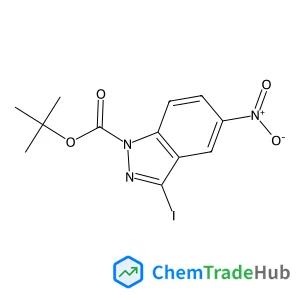
Tert-butyl 3-iodo-5-nitro-1H-indazole-1-carboxylate
CAS Number:
459133-69-8
Molecular Formula:
C12H12IN3O4
Hicham Ait Rass, Nadine Essayem, Michèle Besson
5-Hydroxymethylfurfural (HMF) was quantitatively oxidized to 2,5-furandicarboxylic acid (FDCA) at 100 °C under 40 bar air in moderately basic aqueous solution in the presence of active carbon supported platinum and bismuth–platinum catalysts. The transformation of HMF into FDCA proceeded via the 5-hydroxymethyl-2-furancarboxylic acid (HMFCA) and 2,5-diformylfuran (DFF) intermediates; both of these were very reactive and rapidly oxidized to 5-formylfurancarboxylic acid (FFCA), the subsequent oxidation of which was found to be the rate-limiting step. The preparation method of the platinum catalysts influenced the particle size of metallic platinum and modified the surface of the support, therefore determining the activity. The addition of a carbonate base (Na2CO3/HMF molar ratio = 2) led to faster overall conversion than bicarbonate (NaHCO3/HMF = 4) by maintaining an appropriate pH for the oxidation reaction. The ex situ or in situ addition of a bismuth promoter still accelerated the reaction; the highest activity was observed for a Bi/Pt molar ratio of ca. 0.2. Furthermore, the promoter helped to prevent some deactivation of the Pt catalyst upon recycling experiments. Quantitative conversion of HMF (0.1 M) and >99% yield of FDCA were achieved using a molar ratio of HMF to Pt of 100 and Na2CO3 as the homogeneous base in less than 2 h.
Mingyang Wang, Zhen Wu
DOI: 10.1039/C6QO00744A
Chinnabattigalla Sreenivasulu, A. Gopi Krishna Reddy, G. Satyanarayana
DOI: 10.1039/C6QO00531D
Maja Rischer, Seoung Rak Lee, Hee Jeong Eom, Hyun Bong Park, John Vollmers, Anne-Kristin Kaster, Yern-Hyerk Shin, Dong-Chan Oh, Ki Hyun Kim, Christine Beemelmanns
DOI: 10.1039/C8QO01104D
Qiaoning Ma, Xiaodi Yang, Xinsheng Lei
DOI: 10.1039/C8QO01166D
Kai Cheng, Guofang Wang, Mengting Meng, Chenze Qi
DOI: 10.1039/C6QO00634E
Dong Li
DOI: 10.1039/C6QO00730A
Yin Wei, Xu-Bo Hu, Kai Chen
DOI: 10.1039/C6QO00713A
Xin Yang, Wen Yang, Yongqi Yao, Yingying Deng, Dingqiao Yang
DOI: 10.1039/C8QO01403E
Tongxiang Cao, Kai Chen
DOI: 10.1039/C6QO00769D
When handling 4-Methyl-6-(trifluoromethyl)quinoline (CAS: 40716-16-3), safety go...
4-(3,5-Difluorophenyl)aniline is an aromatic organic compound with the CAS numbe...
5-{[4-(Trifluoromethyl)phenyl]sulfanyl}-1,2,3-thiadiazole-4-carboxylic acid can ...
The market for 4-Benzylaniline hydrochloride (CAS: 6317-57-3) is steadily growin...
[3-(Diethylsulfamoyl)phenyl]boronic acid is generally considered safe when handl...
3-Bromo-2,5-dimethoxyaniline is mainly used in the pharmaceutical and chemical i...
N-Methyl-1-(5-methyl-1H-indol-3-yl)methanamine (CAS: 915922-67-7) is subject to ...
This compound is primarily used in the pharmaceutical industry for the synthesis...
2-Methyl-2-propanyl [(1S,3R)-3-aminocyclohexyl]carbamate (CAS: 1298101-47-9) sho...
Ethyl 2-bromo-4,4,4-trifluorobutanoate (CAS: 367-33-9) is utilized in the pharma...

Green Chemistry provides a unique forum for the publication of innovative research on the development of alternative green and sustainable technologies. The scope of Green Chemistry is based on, but not limited to, the definition proposed by Anastas and Warner (Green Chemistry: Theory and Practice, P T Anastas and J C Warner, Oxford University Press, Oxford, 1998). Green chemistry is the utilisation of a set of principles that reduces or eliminates the use or generation of hazardous substances in the design, manufacture and application of chemical products. Green Chemistry is at the frontiers of this continuously-evolving interdisciplinary science and publishes research that attempts to reduce the environmental impact of the chemical enterprise by developing a technology base that is inherently non-toxic to living things and the environment. Submissions on all aspects of research relating to the endeavour are welcome. The journal publishes original and significant cutting-edge research that is likely to be of wide general appeal. To be published, work must present a significant advance in green chemistry. Papers must contain a comparison with existing methods and demonstrate advantages over those methods before publication can be considered. For more information please see this Editorial. Coverage includes the following, but is not limited to: Design (e.g. biomimicry, design for degradation/recycling/reduced toxicity…) Reagents & Feedstocks (e.g. renewables, CO2, solvents, auxiliary agents, waste utilization…) Synthesis (e.g. organic, inorganic, synthetic biology…) Catalysis (e.g. homogeneous, heterogeneous, enzyme, whole cell…) Process (e.g. process design, intensification, separations, recycling, efficiency…) Energy (e.g. renewable energy, fuels, photovoltaics, fuel cells, energy storage, energy carriers…) Applications (e.g. electronics, dyes, consumer products, coatings, pharmaceuticals, preservatives, building materials, chemicals for industry/agriculture/mining…) Impact (e.g. safety, metrics, LCA, sustainability, (eco)toxicology…) Green chemistry is, by definition, a continuously-evolving frontier. Therefore, the inclusion of a particular material or technology does not, of itself, guarantee that a paper is suitable for the journal. To be suitable, the novel advance should have the potential for reduced environmental impact relative to the state of the art. Green Chemistry does not normally deal with research associated with 'end-of-pipe' or remediation issues.
![2,4-Dichloro-6-isopropyl-5H-pyrrolo[3,4-d]pyrimidin-7(6H)-one structure](https://static.chemtradehub.com/structs/107/1079649-94-7-ad4a.webp "2,4-Dichloro-6-isopropyl-5H-pyrrolo[3,4-d]pyrimidin-7(6H)-one structure")