













Nearside-farside analysis of differential cross sections: The reaction I + HI → IH + I
Literature Information
Publication Date
2001-08-31
DOI
10.1039/B104099P
Impact Factor
3.676
Authors
C. Noli, J. N. L. Connor, N. Rougeau, C. Kubach
View Original
Abstract
We have carried out quantum calculations of differential cross sections for the state selected reaction, I + HI(i, ji) → IH(f, jf) + I, where i, ji and f, jf are initial and final vibrational and rotational quantum numbers respectively. The extended London–Eyring–Polanyi–Sato potential energy surface A of Manz and Römelt (J. Manz and J. Römelt, Chem. Phys. Lett., 1981, 81, 179) was employed. The scattering matrix elements were computed by a quantum method which applies a Born–Oppenheimer type separation to the motion of the light and heavy atoms; a centrifugal-sudden approximation was also made. The scattering calculations were performed for three values of the total energy. Eighteen differential cross sections are reported, which display forward, sideward and backward scattering. Structure in the angular distributions is analysed using a semiclassical optical model. In addition, a nearside-farside (NF) decomposition is applied to the Legendre partial wave series representation of the scattering amplitude. The semiclassical optical model supplies a physical interpretation of the backward scattering in terms of simple classical concepts, but fails to interpret the sideward and forward scattering. In contrast, NF theory nearly always provides a physically clear explanation of the forward, sideward and backward scattering.
Related Literature
Preparation of a colloidal array of NaTaO3nanoparticlesvia a confined space synthesis route and its photocatalytic application
Toshiyuki Yokoi, Junya Sakuma, Kazuhiko Maeda, Kazunari Domen, Takashi Tatsumi, Junko N. Kondo
2011-01-11
Paper
DOI: 10.1039/C0CP02141E
The role of hydrogen bonding in water–metal interactions
Adrien Poissier, Sriram Ganeshan, M. V. Fernández-Serra
2010-12-22
Paper
DOI: 10.1039/C0CP00994F
Electrochemical activation of molecular nitrogen at the Ir/YSZ interface
Ilia Valov, Bjoern Luerssen, Eva Mutoro, Luca Gregoratti, Roger A. De Souza, Thomas Bredow, Sebastian Günther, Alexei Barinov, Pavel Dudin, Manfred Martin, Jürgen Janek
2011-01-11
Paper
DOI: 10.1039/C0CP01024C
Effect of substituents on redox, spectroscopic and structural properties of conjugated diaryltetrazines—a combined experimental and theoretical study
Ewa Kurach, David Djurado, Jan Rimarčik, Aleksandra Kornet, Marek Wlostowski, Vladimir Lukeš, Jacques Pécaut, Malgorzata Zagorska, Adam Pron
2010-12-09
Paper
DOI: 10.1039/C0CP01553A
Hydrogen bond strength and network structure effects on hydration of non-polar molecules
R. M. Lynden-Bell, N. Giovambattista, P. G. Debenedetti, T. Head-Gordon, P. J. Rossky
2010-12-10
Paper
DOI: 10.1039/C0CP01701A
One-pot generation of mesoporous carbon supported nanocrystalline calcium oxides capable of efficient CO2 capture over a wide range of temperatures
Na Hao, Gongkui Xiao, Liying Liu, Paul Webley
2010-12-06
Paper
DOI: 10.1039/C0CP01807D
Enhanced photocatalytic activity of mesoporous TiO2 aggregates by embedding carbon nanotubes as electron-transfer channel
Jiaguo Yu, Tingting Ma, Shengwei Liu
2010-12-21
Paper
DOI: 10.1039/C0CP01139H
The role of calcium in membrane condensation and spontaneous curvature variations in model lipidic systems
Anan Yaghmur, Barbara Sartori, Michael Rappolt
2010-11-03
Paper
DOI: 10.1039/C0CP01036G
Structure and binding of the H4 histone tail and the effects of lysine 16 acetylation
Darren Yang, Gaurav Arya
2010-12-15
Paper
DOI: 10.1039/C0CP01487G
Basicity, complexation ability and interfacial behavior of BTBPs: a simulation study
G. Benay, R. Schurhammer, G. Wipff
2010-12-16
Paper
DOI: 10.1039/C0CP01975E
You might also like
Compound Q&A
What are the main uses of 1H-Indazole-6-carbonitrile (CAS: 141290-59-7)?
1H-Indazole-6-carbonitrile finds applications in pharmaceuticals, where it serve...
141290-59-71H-Indazole-6-carbon...
Compound Q&A
How should waste containing Dioctyl (2E)-2-butenedioate (CAS: 2997-85-5) be handled?
Waste containing Dioctyl (2E)-2-butenedioate (CAS: 2997-85-5) should be collecte...
2997-85-5Dioctyl (2E)-2-buten...
Compound Q&A
What industries use Sodium [(1,2-benzoxazol-3-ylmethyl)sulfonyl]azanide (CAS: 68291-98-5)?
Sodium [(1,2-benzoxazol-3-ylmethyl)sulfonyl]azanide is primarily used in pharmac...
68291-98-5Sodium [(1,2-benzoxa...
Compound Q&A
Are there alternatives to Dimethyl 4-(4,4,5,5-tetramethyl-1,3,2-dioxaborolan-2-yl)-2,6-pyridinedicarboxylate (CAS: 741709-66-0) in synthesis?
Dimethyl 4-(4,4,5,5-tetramethyl-1,3,2-dioxaborolan-2-yl)-2,6-pyridinedicarboxyla...
741709-66-0Dimethyl 4-(4,4,5,5-...
Compound Q&A
How should waste containing 2-Fluoro-6-hydrazinopyridine (CAS: 80714-39-2) be handled?
Waste containing 2-Fluoro-6-hydrazinopyridine (CAS: 80714-39-2) should be manage...
80714-39-22-Fluoro-6-hydrazino...
Compound Q&A
What is 6-Formyl-2-pyridinecarboxylic acid (CAS: 499214-11-8)?
6-Formyl-2-pyridinecarboxylic acid is an organic compound with the molecular for...
499214-11-86-Formyl-2-pyridinec...
Compound Q&A
What is the market or research trend for 3-(3,4-dimethoxyphenyl)-2,5-dimethyl-N-(2-morpholin-4-ylethyl)pyrazolo[1,5-a]pyrimidin-7-amine (CAS: 900874-91-1)?
Research trends for this compound indicate a focus on its potential applications...
900874-91-13-(3,4-dimethoxyphen...
Compound Q&A
How is 9H-Tribenzo[b,d,f]azepine (CAS: 29875-73-8) typically synthesized?
9H-Tribenzo[b,d,f]azepine is typically synthesized via a multi-step process invo...
29875-73-89H-Tribenzo[b,d,f]az...
Compound Q&A
How is 1-Cyclopropyl-7-ethoxy-6-fluoro-8-methoxy-4-oxo-1,4-dihydro-3-quinolinecarboxylic acid (CAS: 1797982-51-4) typically synthesized?
1-Cyclopropyl-7-ethoxy-6-fluoro-8-methoxy-4-oxo-1,4-dihydro-3-quinolinecarboxyli...
1797982-51-41-Cyclopropyl-7-etho...
Compound Q&A
How should waste containing Methyl 3-oxo-1,2,3,4-tetrahydro-6-quinoxalinecarboxylate (CAS: 671820-52-3) be handled?
Waste containing Methyl 3-oxo-1,2,3,4-tetrahydro-6-quinoxalinecarboxylate (CAS: ...
671820-52-3Methyl 3-oxo-1,2,3,4...
Source Journal
Physical Chemistry Chemical Physics

CiteScore:
5.5
Self-citation Rate:
10.3%
Articles per Year:
3036
Physical Chemistry Chemical Physics (PCCP) is an international journal co-owned by 19 physical chemistry and physics societies from around the world. This journal publishes original, cutting-edge research in physical chemistry, chemical physics and biophysical chemistry. To be suitable for publication in PCCP, articles must include significant innovation and/or insight into physical chemistry; this is the most important criterion that reviewers and Editors will judge against when evaluating submissions. The journal has a broad scope and welcomes contributions spanning experiment, theory, computation and data science. Topical coverage includes spectroscopy, dynamics, kinetics, statistical mechanics, thermodynamics, electrochemistry, catalysis, surface science, quantum mechanics, quantum computing and machine learning. Interdisciplinary research areas such as polymers and soft matter, materials, nanoscience, energy, surfaces/interfaces, and biophysical chemistry are welcomed if they demonstrate significant innovation and/or insight into physical chemistry. Joined experimental/theoretical studies are particularly appreciated when complementary and based on up-to-date approaches.
Recommended Compounds


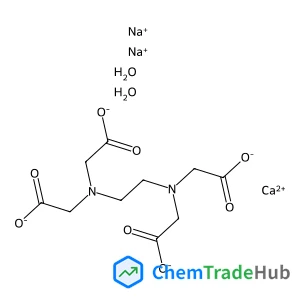
EthylenediaminetetraaceticacidcalciumDisodiumsalthydrate
CAS Number:
23411-34-9
Molecular Formula:
C10H16CaN2Na2O10
Recommended Suppliers



Disclaimer
This page provides academic journal information for reference and research purposes only. We are not affiliated with any journal publishers and do not handle publication submissions. For publication-related inquiries, please contact the respective journal publishers directly.
If you notice any inaccuracies in the information displayed, please contact us at support@chemtradehub.com. We will promptly review and address your concerns.