












![N-[(9H-Fluoren-9-ylmethoxy)carbonyl]serine structure](https://static.chemtradehub.com/structs/737/73724-45-5-b0dc.webp "N-[(9H-Fluoren-9-ylmethoxy)carbonyl]serine structure")
A microwave study of the open-shell complex Kr–NO2
Literature Information
Publication Date
2001-08-21
DOI
10.1039/B102712N
Impact Factor
3.676
Authors
View Original
Abstract
Microwave spectra of the open-shell complex Kr–NO2 have been recorded. Each rotational transition showed significant hyperfine structure due to fine, magnetic hyperfine and electric quadrupole interactions. The spectra could be fitted to a semi-rigid molecule Hamiltonian, but the spectra show significant evidence of large internal motion, in particular a tunnelling motion between the two equivalent non-planar structures of the complex. The spectroscopic parameters were analysed in terms of those of the monomer NO2 to obtain a detailed structure. In particular the anisotropic hyperfine interactions provide information on the orientation of NO2 within the complex and on electronic changes caused by distortion of the electronic wavefunction on complex formation. The Fermi contact interaction indicates little electron rearrangement at the nitrogen nucleus. However the spin–rotation constants indicate that there could be a significant rearrangement of the more diffuse electrons, rather larger than that in Ar–NO2.
Related Literature
Hydrogen bond strength and network structure effects on hydration of non-polar molecules
R. M. Lynden-Bell, N. Giovambattista, P. G. Debenedetti, T. Head-Gordon, P. J. Rossky
2010-12-10
Paper
DOI: 10.1039/C0CP01701A
Translation-rotation energy levels of one H2 molecule inside the small, medium and large cages of the structure H clathrate hydrate
Álvaro Valdés, Geert-Jan Kroes
2010-12-16
Paper
DOI: 10.1039/C0CP01804J
Ultra-slow water diffusion in aqueous sucrose glasses
Vacharaporn Soonsin, Bei P. Luo, Ulrich K. Krieger, Claudia Marcolli, Thomas Peter, Thomas Koop
2011-01-13
Paper
DOI: 10.1039/C0CP01273D
Long distance energy transfer in a polymer matrix doped with a perylenedye
Franziska Fennel, Stefan Lochbrunner
2011-01-06
Paper
DOI: 10.1039/C0CP01211D
Capture and dissociation in the complex-forming CH+H2 → CH2+H, CH+H2 reactions
Miguel González, Amaia Saracibar, Ernesto Garcia
2011-01-06
Paper
DOI: 10.1039/C0CP01188F
Ammonia IRMS-TPD measurements on Brønsted acidity of proton-formed SAPO-34
Katsuki Suzuki, Takuma Nishio, Naonobu Katada, German Sastre, Miki Niwa
2010-12-20
Paper
DOI: 10.1039/C0CP00961J
MRCI investigation of different isomers of Ni2O2H2+‡
Olaf Hübner, Hans-Jörg Himmel
2010-12-08
Paper
DOI: 10.1039/C0CP01170C
Unfolding and refolding details of lysozyme in the presence of β-casein micelles
Fu-Gen Wu, Jun-Jie Luo, Zhi-Wu Yu
2011-01-24
Paper
DOI: 10.1039/C0CP01184C
Conversion of methanol over 10-ring zeolites with differing volumes at channel intersections: comparison of TNU-9, IM-5, ZSM-11 and ZSM-5
Francesca Bleken, Wegard Skistad, Katia Barbera, Marina Kustova, Silvia Bordiga, Pablo Beato, Karl Petter Lillerud, Stian Svelle, Unni Olsbye
2010-12-10
Paper
DOI: 10.1039/C0CP01982H
One-pot generation of mesoporous carbon supported nanocrystalline calcium oxides capable of efficient CO2 capture over a wide range of temperatures
Na Hao, Gongkui Xiao, Liying Liu, Paul Webley
2010-12-06
Paper
DOI: 10.1039/C0CP01807D
You might also like
Compound Q&A
What are the main uses of 1H-Indazole-6-carbonitrile (CAS: 141290-59-7)?
1H-Indazole-6-carbonitrile finds applications in pharmaceuticals, where it serve...
141290-59-71H-Indazole-6-carbon...
Compound Q&A
How should waste containing Dioctyl (2E)-2-butenedioate (CAS: 2997-85-5) be handled?
Waste containing Dioctyl (2E)-2-butenedioate (CAS: 2997-85-5) should be collecte...
2997-85-5Dioctyl (2E)-2-buten...
Compound Q&A
What industries use Sodium [(1,2-benzoxazol-3-ylmethyl)sulfonyl]azanide (CAS: 68291-98-5)?
Sodium [(1,2-benzoxazol-3-ylmethyl)sulfonyl]azanide is primarily used in pharmac...
68291-98-5Sodium [(1,2-benzoxa...
Compound Q&A
Are there alternatives to Dimethyl 4-(4,4,5,5-tetramethyl-1,3,2-dioxaborolan-2-yl)-2,6-pyridinedicarboxylate (CAS: 741709-66-0) in synthesis?
Dimethyl 4-(4,4,5,5-tetramethyl-1,3,2-dioxaborolan-2-yl)-2,6-pyridinedicarboxyla...
741709-66-0Dimethyl 4-(4,4,5,5-...
Compound Q&A
How should waste containing 2-Fluoro-6-hydrazinopyridine (CAS: 80714-39-2) be handled?
Waste containing 2-Fluoro-6-hydrazinopyridine (CAS: 80714-39-2) should be manage...
80714-39-22-Fluoro-6-hydrazino...
Compound Q&A
What is 6-Formyl-2-pyridinecarboxylic acid (CAS: 499214-11-8)?
6-Formyl-2-pyridinecarboxylic acid is an organic compound with the molecular for...
499214-11-86-Formyl-2-pyridinec...
Compound Q&A
What is the market or research trend for 3-(3,4-dimethoxyphenyl)-2,5-dimethyl-N-(2-morpholin-4-ylethyl)pyrazolo[1,5-a]pyrimidin-7-amine (CAS: 900874-91-1)?
Research trends for this compound indicate a focus on its potential applications...
900874-91-13-(3,4-dimethoxyphen...
Compound Q&A
How is 9H-Tribenzo[b,d,f]azepine (CAS: 29875-73-8) typically synthesized?
9H-Tribenzo[b,d,f]azepine is typically synthesized via a multi-step process invo...
29875-73-89H-Tribenzo[b,d,f]az...
Compound Q&A
How is 1-Cyclopropyl-7-ethoxy-6-fluoro-8-methoxy-4-oxo-1,4-dihydro-3-quinolinecarboxylic acid (CAS: 1797982-51-4) typically synthesized?
1-Cyclopropyl-7-ethoxy-6-fluoro-8-methoxy-4-oxo-1,4-dihydro-3-quinolinecarboxyli...
1797982-51-41-Cyclopropyl-7-etho...
Compound Q&A
How should waste containing Methyl 3-oxo-1,2,3,4-tetrahydro-6-quinoxalinecarboxylate (CAS: 671820-52-3) be handled?
Waste containing Methyl 3-oxo-1,2,3,4-tetrahydro-6-quinoxalinecarboxylate (CAS: ...
671820-52-3Methyl 3-oxo-1,2,3,4...
Source Journal
Physical Chemistry Chemical Physics

CiteScore:
5.5
Self-citation Rate:
10.3%
Articles per Year:
3036
Physical Chemistry Chemical Physics (PCCP) is an international journal co-owned by 19 physical chemistry and physics societies from around the world. This journal publishes original, cutting-edge research in physical chemistry, chemical physics and biophysical chemistry. To be suitable for publication in PCCP, articles must include significant innovation and/or insight into physical chemistry; this is the most important criterion that reviewers and Editors will judge against when evaluating submissions. The journal has a broad scope and welcomes contributions spanning experiment, theory, computation and data science. Topical coverage includes spectroscopy, dynamics, kinetics, statistical mechanics, thermodynamics, electrochemistry, catalysis, surface science, quantum mechanics, quantum computing and machine learning. Interdisciplinary research areas such as polymers and soft matter, materials, nanoscience, energy, surfaces/interfaces, and biophysical chemistry are welcomed if they demonstrate significant innovation and/or insight into physical chemistry. Joined experimental/theoretical studies are particularly appreciated when complementary and based on up-to-date approaches.
Recommended Compounds
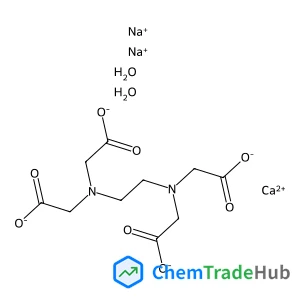
EthylenediaminetetraaceticacidcalciumDisodiumsalthydrate
CAS Number:
23411-34-9
Molecular Formula:
C10H16CaN2Na2O10
![(1S)-1,5-Anhydro-1-[3-(1-benzothiophen-2-ylmethyl)-4-fluorophenyl]-D-glucitol structure](https://static.chemtradehub.com/structs/761/761423-87-4-dbeb.webp "(1S)-1,5-Anhydro-1-[3-(1-benzothiophen-2-ylmethyl)-4-fluorophenyl]-D-glucitol structure")
(1S)-1,5-Anhydro-1-[3-(1-benzothiophen-2-ylmethyl)-4-fluorophenyl]-D-glucitol
CAS Number:
761423-87-4
Molecular Formula:
C21H21FO5S
Recommended Suppliers




Disclaimer
This page provides academic journal information for reference and research purposes only. We are not affiliated with any journal publishers and do not handle publication submissions. For publication-related inquiries, please contact the respective journal publishers directly.
If you notice any inaccuracies in the information displayed, please contact us at support@chemtradehub.com. We will promptly review and address your concerns.