












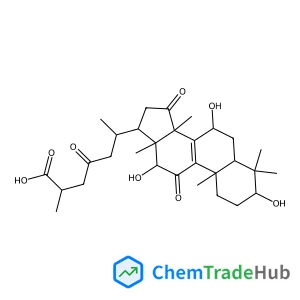
(3beta,7beta,12beta)-3,7,12-Trihydroxy-11,15,23-trioxolanost-8-en-26-oic acid
CAS Number:
98665-22-6
Molecular Formula:
C30H44O8
The gel phase of 1,2-di-13-cyclohexyltridecanoyl-sn-glycero-3-phosphocholine (13cyPC) and 1,2-di-14-cyclohexyltetradecanoyl-sn-glycero-3-phosphocholine (14cyPC) was investigated by atomic force microscopy. 13cyPC forms a gel phase with a very high degree of chain order resembling the subgel phase of PCs with saturated linear chains. For 13cyPC, flat surfaces, ripple structures, and singular ripple lines at domain borders were observed. Ripples developed only in multilamellar stacks (5 or more lamellae) on the top surface of the stack. The ripple periodicity was 33 nm and the ripple amplitude only 0.3 nm. 14cyPC shows a gel phase with much higher degree of disorder. For 14cyPC, ripples were observed on all layers, the ripples having much larger amplitudes (3 nm) but a similar periodicity of 37 nm. In addition, irregular bilayer deformations appearing almost like honeycomb structures were observed. The apparent periodicity of the holes in this structure was 30 nm and thus similar to the ripple period. The hole depth was 2 nm or larger. These deformations were only very pronounced for every second layer. For 14cyPC, the higher disorder in the gel phase seen by spectroscopic techniques enables larger amplitudes for the deformation of the lamellae. These deformations may be related to the convex–concave bilayer deformations seen by freeze fracture electron microscopy in other systems (H. W. Meyer, K. Semmler, W. Rettig, W. Pohle, A. S. Ulrich, S. Grage, C. Selle and P. J. Quinn, Chem. Phys. Lipids, 2000, 105, 149).
Stefano Milione, Cosimo Montefusco, Tomas Cuenca, Alfonso Grassi
DOI: 10.1039/B301997G
Graeme Cooke, Vladimir Sindelar, Vincent M. Rotello
DOI: 10.1039/B211370H
Yongzhong Bian, Rongming Wang, Jianzhuang Jiang, Chi-Hang Lee, Jinzhi Wang, Dennis K. P. Ng
DOI: 10.1039/B301139A
Tomoko Matsuda, Kazunori Watanabe, Takashi Kamitanaka, Tadao Harada, Kaoru Nakamura
DOI: 10.1039/B301452E
Sang Wook Kang, Jong Hak Kim, Jongok Won, Kookheon Char, Yong Soo Kang
DOI: 10.1039/B211933A
Masakatsu Matsumoto, Toshiyuki Mizuno, Nobuko Watanabe
DOI: 10.1039/B210857G
DOI: 10.1039/B301634J
Junpei Yuasa, Tomoyoshi Suenobu, Kei Ohkubo, Shunichi Fukuzumi
DOI: 10.1039/B300543G
Rémi Métivier, Isabelle Leray, Bernard Valeur
DOI: 10.1039/B301323E
Casey A. Kernag, Dominic V. McGrath
DOI: 10.1039/B301157G
When handling 4-(2-Furylmethyl)thiomorpholine 1,1-dioxide (CAS: 79206-94-3), it ...
When handling 4-Chloro-N-[2-(4-morpholinyl)ethyl]benzamide (CAS: 71320-77-9), it...
Waste containing this compound (CAS: 62921-74-8) should be handled according to ...
Waste containing (S)-Methyl 2-amino-3-cyclohexylpropanoate should be collected i...
This compound can be synthesized using a multi-step process involving the conjug...
There are several alternatives to (2E)-3-(3,4-Dichlorophenyl)acrylic acid in syn...
Ethyl 6-(2-nitrophenyl)imidazo[2,1-b][1,3]thiazole-3-carboxylate (CAS: 925437-84...
Waste containing 2-(1,3-Thiazol-2-yl)ethanamine (CAS: 18453-07-1) should be coll...
Methyl 5-iodo-2-methylbenzoate can be synthesized through the iodination of meth...
5-Chloro[1,2,4]triazolo[1,5-a]pyridine is commonly synthesized via the condensat...

Physical Chemistry Chemical Physics (PCCP) is an international journal co-owned by 19 physical chemistry and physics societies from around the world. This journal publishes original, cutting-edge research in physical chemistry, chemical physics and biophysical chemistry. To be suitable for publication in PCCP, articles must include significant innovation and/or insight into physical chemistry; this is the most important criterion that reviewers and Editors will judge against when evaluating submissions. The journal has a broad scope and welcomes contributions spanning experiment, theory, computation and data science. Topical coverage includes spectroscopy, dynamics, kinetics, statistical mechanics, thermodynamics, electrochemistry, catalysis, surface science, quantum mechanics, quantum computing and machine learning. Interdisciplinary research areas such as polymers and soft matter, materials, nanoscience, energy, surfaces/interfaces, and biophysical chemistry are welcomed if they demonstrate significant innovation and/or insight into physical chemistry. Joined experimental/theoretical studies are particularly appreciated when complementary and based on up-to-date approaches.

![1,2-Diphenyl-4-[2-(phenylsulfinyl)ethyl]-3,5-pyrazolidinedione structure](https://static.chemtradehub.com/structs/57-/57-96-5-efcc.webp "1,2-Diphenyl-4-[2-(phenylsulfinyl)ethyl]-3,5-pyrazolidinedione structure")




