












Electrochemically tuneable hydrogen bonding interactions between a phenyl-urea terminated dendrimer and phenanthrenequinone
Literature Information
Publication Date
2003-02-20
DOI
10.1039/B211370H
Impact Factor
6.222
Authors
Graeme Cooke, Vladimir Sindelar, Vincent M. Rotello
View Original
Abstract
Electrochemically tuneable hydrogen bonding interactions are described between a phenyl-urea terminated dendrimer and phenanthrenequinone.
Related Literature
Ionic liquid-derived polyelectrolyte promoting the biphasic condensation of immiscible reactants at moderate temperature
Yuki Kohno, Takashi Makino
2021-08-27
Communication
DOI: 10.1039/D1RE00304F
Synthesis of well-defined primary amine-based homopolymers and block copolymers and their Michael addition reactions with acrylates and acrylamides
Elizabeth S. Read, Kate L. Thompson, Steven P. Armes
2010-01-08
Paper
DOI: 10.1039/B9PY00320G
Colloidal sulphur production by electrochemical oxidation of sulphide in a swirling flow reactor
Camila C. Contigiani, Juan P. Fornés, Omar González Pérez, José M. Bisang
2021-10-26
Paper
DOI: 10.1039/D1RE00395J
A superamplification effect in the detection of explosives by a fluorescent hyperbranched poly(silylenephenylene) with aggregation-enhanced emission characteristics
Yongchun Zhong, Kam Sing Wong
2010-03-11
Communication
DOI: 10.1039/C0PY00046A
High yield and greener C–H difluoromethylation reactions using copper iodide nanoparticles/boron nitride nanosheets as a versatile and recyclable heterogeneous catalyst
Gowsika Jaikumar, Fushen Lu
2021-07-29
Paper
DOI: 10.1039/D1RE00196E
A CFD study on the performance of CO2 methanation in a water-permeable membrane reactor system
Zhewei Liu, Zhoufeng Bian, Zhigang Wang, Bo Jiang
2021-11-24
Paper
DOI: 10.1039/D1RE00401H
Electrostatically excited liquid marble as a micromixer
Nhat-Khuong Nguyen, Pradip Singha, Hongjie An, Hoang-Phuong Phan, Nam-Trung Nguyen, Chin Hong Ooi
2021-06-03
Paper
DOI: 10.1039/D1RE00121C
Grafting of polymer brushes from nanopore surface via atom transfer radical polymerization with activators regenerated by electron transfer
Liang Cao, Michal Kruk
2009-12-22
Paper
DOI: 10.1039/B9PY00282K
You might also like
Compound Q&A
What precautions should be taken when handling 4-(2-Furylmethyl)thiomorpholine 1,1-dioxide (CAS: 79206-94-3)?
When handling 4-(2-Furylmethyl)thiomorpholine 1,1-dioxide (CAS: 79206-94-3), it ...
79206-94-34-(2-Furylmethyl)thi...
Compound Q&A
What precautions should be taken when handling 4-Chloro-N-[2-(4-morpholinyl)ethyl]benzamide (CAS: 71320-77-9)?
When handling 4-Chloro-N-[2-(4-morpholinyl)ethyl]benzamide (CAS: 71320-77-9), it...
71320-77-94-Chloro-N-[2-(4-mor...
Compound Q&A
How should waste containing 2-[2-(2-Methoxyethoxy)ethoxy]ethyl 4-methylbenzenesulfonate (CAS: 62921-74-8) be handled?
Waste containing this compound (CAS: 62921-74-8) should be handled according to ...
62921-74-82-[2-(2-Methoxyethox...
Compound Q&A
How should waste containing (S)-Methyl 2-amino-3-cyclohexylpropanoate be handled?
Waste containing (S)-Methyl 2-amino-3-cyclohexylpropanoate should be collected i...
40056-18-6(S)-Methyl 2-amino-3...
Compound Q&A
How is 5-({4-[(2S,4R)-4-Hydroxy-2-methyltetrahydro-2H-pyran-4-yl]-2-thienyl}sulfanyl)-1-methyl-1,3-dihydro-2H-indol-2-one (CAS: 166882-70-8) typically synthesized?
This compound can be synthesized using a multi-step process involving the conjug...
166882-70-85-({4-[(2S,4R)-4-Hyd...
Compound Q&A
Are there alternatives to (2E)-3-(3,4-Dichlorophenyl)acrylic acid (CAS: 7312-27-8) in synthesis?
There are several alternatives to (2E)-3-(3,4-Dichlorophenyl)acrylic acid in syn...
7312-27-8(2E)-3-(3,4-Dichloro...
Compound Q&A
How should Ethyl 6-(2-nitrophenyl)imidazo[2,1-b][1,3]thiazole-3-carboxylate (CAS: 925437-84-9) be stored?
Ethyl 6-(2-nitrophenyl)imidazo[2,1-b][1,3]thiazole-3-carboxylate (CAS: 925437-84...
925437-84-9Ethyl 6-(2-nitrophen...
Compound Q&A
How should waste containing 2-(1,3-Thiazol-2-yl)ethanamine (CAS: 18453-07-1) be handled?
Waste containing 2-(1,3-Thiazol-2-yl)ethanamine (CAS: 18453-07-1) should be coll...
18453-07-12-(1,3-Thiazol-2-yl)...
Compound Q&A
How is Methyl 5-iodo-2-methylbenzoate (CAS: 103440-54-6) typically synthesized?
Methyl 5-iodo-2-methylbenzoate can be synthesized through the iodination of meth...
103440-54-6Methyl 5-iodo-2-meth...
Compound Q&A
How is 5-Chloro[1,2,4]triazolo[1,5-a]pyridine (CAS: 1427399-34-5) typically synthesized?
5-Chloro[1,2,4]triazolo[1,5-a]pyridine is commonly synthesized via the condensat...
1427399-34-55-Chloro[1,2,4]triaz...
Source Journal
Chemical Communications

CiteScore:
8.6
Self-citation Rate:
4.7%
Articles per Year:
2458
ChemComm publishes urgent research which is of outstanding significance and interest to experts in the field, while also appealing to the journal’s broad chemistry readership. Our communication format is ideally suited to short, urgent studies that are of such importance that they require accelerated publication. Our scope covers all topics in chemistry, and research at the interface of chemistry and other disciplines (such as materials science, nanoscience, physics, engineering and biology) where there is a significant novelty in the chemistry aspects. Major topic areas covered include: Analytical Chemistry Catalysis Chemical Biology and medicinal chemistry Computational Chemistry and Machine Learning Energy and sustainable chemistry Environmental Chemistry Green Chemistry Inorganic Chemistry Materials Chemistry Nanoscience Organic Chemistry Physical Chemistry Polymer Chemistry Supramolecular Chemistry
Recommended Compounds
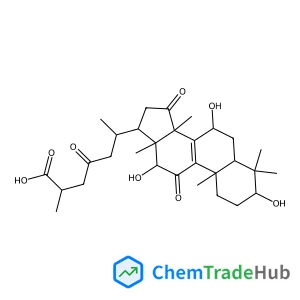
(3beta,7beta,12beta)-3,7,12-Trihydroxy-11,15,23-trioxolanost-8-en-26-oic acid
CAS Number:
98665-22-6
Molecular Formula:
C30H44O8


Recommended Suppliers





Disclaimer
This page provides academic journal information for reference and research purposes only. We are not affiliated with any journal publishers and do not handle publication submissions. For publication-related inquiries, please contact the respective journal publishers directly.
If you notice any inaccuracies in the information displayed, please contact us at support@chemtradehub.com. We will promptly review and address your concerns.