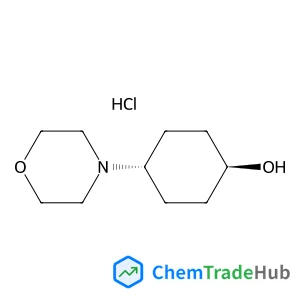
trans-4-(4-Morpholinyl)cyclohexanol hydrochloride (1:1)
CAS Number:
1588441-09-1
Molecular Formula:
C10H20ClNO2
Kengo Suzuki, Attila Demeter, Wolfgang Kühnle, Erich Tauer, Klaas A. Zachariasse, Seiji Tobita, Haruo Shizuka
The thermally activated internal conversion (IC) taking place in 4-substituted 1-(dimethylamino)naphthalenes (14DMX) and 1-aminonaphthalenes (14ANX) with X=CN, Cl, H, CH3 and OCH3 was investigated in three solvents spanning the polarity scale, hexane, diethyl ether and acetonitrile. In both series 14DMX and 14ANX, the efficiency of the IC reaction decreases substantially when X changes from CN to OCH3, the order in which the electron donor character of the 4-substituent increases. Considerably larger IC reaction rate constants are obtained for the first group of compounds. This difference is connected with the ground state structure of the amino group, which is more strongly twisted for 14DMX (ca. 60°) than for 14ANX (ca. 20°), whereas both sets of 1-naphthylamines are planarised in the S1 excited state. The IC process slows down with increasing solvent polarity for each of the 14DMX and 14ANX molecules. The substituent X and the solvent polarity mainly affect the IC activation energy EIC. With 14DMX in hexane, EIC increases from 10 kJ mol−1 for X=CN to 34 kJ mol−1 for X=OCH3, whereas with, e.g., 14DMCL a solvent polarity dependent increase of EIC from 16 kJ mol−1 in hexane to 28 kJ mol−1 in acetonitrile is observed. The height of the barrier EIC is governed by the energy gap ΔE(S1,S2) between the two lowest excited singlet states. The influence of ΔE(S1,S2) on EIC is attributed to vibronic coupling caused by the proximity of the S1 and S2 states, which flattens the S1 potential energy surface and thereby lowers the IC barrier when ΔE(S1,S2) becomes smaller. It is assumed that the IC reaction of the 1-naphthylamines passes through a conical intersection, which exists as a consequence of the relative displacement of the S1 and S0 surfaces caused by the different amino twist angles in the two states.
Hongzhen Lin, Ivan G. Scheblykin
DOI: 10.1039/C0CP02764B
Roberto Senesi, Carla Andreani, Piero Sozzani, Angiolina Comotti, Silvia Bracco, Mario Beretta, Paul E. Sokol, George Reiter
DOI: 10.1039/C0CP02479A
Zhiying Ma, Weihua Wang, Rui Song, Yazhou Zhai, Siwei Bi, Haitao Sun, Yuxiang Bu
DOI: 10.1039/C0CP02298E
Iván Mora-Seró, Sixto Giménez, Francisco Fabregat-Santiago, Eneko Azaceta, Ramón Tena-Zaera, Juan Bisquert
DOI: 10.1039/C1CP20352E
Andreas Maiser, Christian Steinhauer, Lothar Schermelleh
DOI: 10.1039/C0CP01919D
Sun Min Lee, Shigeru Ikeda, Tetsuro Yagi, Takashi Harada, Ahmed Ennaoui, Michio Matsumura
DOI: 10.1039/C0CP02204G
DOI: 10.1039/C0CP01588A
Matthieu Emond, Jing Sun, Jean Grégoire, Sylvie Maurin, Christophe Tribet, Ludovic Jullien
DOI: 10.1039/C0CP02464C
Christoph Erk, Lukas Hammerschmidt, Dirk Andrae, Beate Paulus, Sabine Schlecht
DOI: 10.1039/C0CP01758B
Ethyl 4-chlorothieno[2,3-b]pyridine-5-carboxylate (CAS: 59713-58-5) can be synth...
5-Methyl-1H-indole-3-carbaldehyde (CAS: 52562-50-2) is subject to various regula...
(1,3-Dimethyl-2,4-dioxo-1,2,3,4-tetrahydro-5-pyrimidinyl)boronic acid is a white...
Waste containing Sulfocostunolide A (CAS: 1016983-51-9) should be handled with c...
When handling Murraxocin (CAS: 88478-44-8), ensure proper personal protective eq...
Formvar (CAS: 63148-64-1) is an alkyd resin characterized by a high molecular we...
(S)-4-benzyl-2-((benzyloxy)methyl)morpholine is generally safe when handled with...
Methyl 1-(5-bromo-2-pyrimidinyl)cyclopropanecarboxylate (CAS: 1447607-69-3) is p...
2-Methyl-1-phenyl-1-propanamine hydrochloride (CAS: 24290-47-9) is generally con...
3-(4-Bromophenyl)-2-methylpropanoic acid is synthesized through a multi-step pro...

Physical Chemistry Chemical Physics (PCCP) is an international journal co-owned by 19 physical chemistry and physics societies from around the world. This journal publishes original, cutting-edge research in physical chemistry, chemical physics and biophysical chemistry. To be suitable for publication in PCCP, articles must include significant innovation and/or insight into physical chemistry; this is the most important criterion that reviewers and Editors will judge against when evaluating submissions. The journal has a broad scope and welcomes contributions spanning experiment, theory, computation and data science. Topical coverage includes spectroscopy, dynamics, kinetics, statistical mechanics, thermodynamics, electrochemistry, catalysis, surface science, quantum mechanics, quantum computing and machine learning. Interdisciplinary research areas such as polymers and soft matter, materials, nanoscience, energy, surfaces/interfaces, and biophysical chemistry are welcomed if they demonstrate significant innovation and/or insight into physical chemistry. Joined experimental/theoretical studies are particularly appreciated when complementary and based on up-to-date approaches.
![Sodium 6-amino-3-[(E)-{4-[(E)-(4-aminophenyl)diazenyl]-2-methoxy-5-methylphenyl}diazenyl]-4-hydroxy-2-naphthalenesulfonate structure](https://static.chemtradehub.com/structs/294/2945-96-2-092f.webp "Sodium 6-amino-3-[(E)-{4-[(E)-(4-aminophenyl)diazenyl]-2-methoxy-5-methylphenyl}diazenyl]-4-hydroxy-2-naphthalenesulfonate structure")