












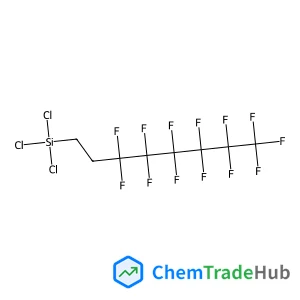
Trichloro(3,3,4,4,5,5,6,6,7,7,8,8,8-tridecafluorooctyl)silane
CAS Number:
78560-45-9
Molecular Formula:
C8H4Cl3F13Si
It is suggested that overlap repulsion between vicinal C–H bonds should be explicitly invoked in empirical calculations of the enthalpies of formation of simple organic gaseous substances. The extent of such repulsion is deemed to be proportional to the sum (over all bonds Ci–Cj) of the products aiaj where ai and aj are the numbers of hydrogen atoms bonded to carbon atoms i and j. With this proportionality constant c, and the bond energy terms E(C–C) and E(C–H), the enthalpies of formation of alkanes CnH2n+2 (n=2–7) can be reproduced within the limits of experimental uncertainty; steric corrections are necessary only where there are at least two contiguous, sterically active C–C bonds. Equally good results are obtained for alkyl radicals and alkenes, although the large experimental uncertainties for many haloalkanes preclude the satisfactory determination of all required parameters. These results may open the way to more elaborate quantum mechanical calculations of overlap repulsion which could prove to be more economical than standard abinitio or density functional methods.
Albert F. Carley, David J. Morgan, Nianxue Song, M. Wyn Roberts, Stuart H. Taylor, Jonathan K. Bartley, David J. Willock, Kara L. Howard, Graham J. Hutchings
DOI: 10.1039/C0CP01852J
D. B. Qian, X. Ma, Z. Chen, X. L. Zhu, H. P. Liu
DOI: 10.1039/C0CP00773K
Aihua Zhang, Shouli Sun, Zachary J. A. Komon, Neil Osterwalder, Sagar Gadewar, Peter Stoimenov, Daniel J. Auerbach, Galen D. Stucky, Eric W. McFarland
DOI: 10.1039/C0CP01985B
Maria Hahlin, Michael Odelius, Martin Magnuson, Erik M. J. Johansson, Stefan Plogmaker, Daniel P. Hagberg, Licheng Sun, Hans Siegbahn, Håkan Rensmo
DOI: 10.1039/C0CP01491E
Antonio Stocco, Jérôme Crassous, Anniina Salonen, Arnaud Saint-Jalmes, Dominique Langevin
DOI: 10.1039/C0CP01152E
Mercedes Boronat, Cristina Martínez, Avelino Corma
DOI: 10.1039/C0CP01996H
Sheng-Gui He, Xun-Lei Ding
DOI: 10.1039/C0CP01171A
Anan Yaghmur, Barbara Sartori, Michael Rappolt
DOI: 10.1039/C0CP01036G
Darren Yang, Gaurav Arya
DOI: 10.1039/C0CP01487G
1H-Indazole-6-carbonitrile finds applications in pharmaceuticals, where it serve...
Waste containing Dioctyl (2E)-2-butenedioate (CAS: 2997-85-5) should be collecte...
Sodium [(1,2-benzoxazol-3-ylmethyl)sulfonyl]azanide is primarily used in pharmac...
Dimethyl 4-(4,4,5,5-tetramethyl-1,3,2-dioxaborolan-2-yl)-2,6-pyridinedicarboxyla...
Waste containing 2-Fluoro-6-hydrazinopyridine (CAS: 80714-39-2) should be manage...
6-Formyl-2-pyridinecarboxylic acid is an organic compound with the molecular for...
Research trends for this compound indicate a focus on its potential applications...
9H-Tribenzo[b,d,f]azepine is typically synthesized via a multi-step process invo...
1-Cyclopropyl-7-ethoxy-6-fluoro-8-methoxy-4-oxo-1,4-dihydro-3-quinolinecarboxyli...
Waste containing Methyl 3-oxo-1,2,3,4-tetrahydro-6-quinoxalinecarboxylate (CAS: ...

Physical Chemistry Chemical Physics (PCCP) is an international journal co-owned by 19 physical chemistry and physics societies from around the world. This journal publishes original, cutting-edge research in physical chemistry, chemical physics and biophysical chemistry. To be suitable for publication in PCCP, articles must include significant innovation and/or insight into physical chemistry; this is the most important criterion that reviewers and Editors will judge against when evaluating submissions. The journal has a broad scope and welcomes contributions spanning experiment, theory, computation and data science. Topical coverage includes spectroscopy, dynamics, kinetics, statistical mechanics, thermodynamics, electrochemistry, catalysis, surface science, quantum mechanics, quantum computing and machine learning. Interdisciplinary research areas such as polymers and soft matter, materials, nanoscience, energy, surfaces/interfaces, and biophysical chemistry are welcomed if they demonstrate significant innovation and/or insight into physical chemistry. Joined experimental/theoretical studies are particularly appreciated when complementary and based on up-to-date approaches.

![N-[(9H-Fluoren-9-ylmethoxy)carbonyl]serine structure](https://static.chemtradehub.com/structs/737/73724-45-5-b0dc.webp "N-[(9H-Fluoren-9-ylmethoxy)carbonyl]serine structure")
![Sodium (2Z)-7-{[(2R)-2-amino-2-carboxyethyl]sulfanyl}-2-({[(1S)-2,2-dimethylcyclopropyl]carbonyl}amino)-2-heptenoate structure](https://static.chemtradehub.com/structs/811/81129-83-1-441c.webp "Sodium (2Z)-7-{[(2R)-2-amino-2-carboxyethyl]sulfanyl}-2-({[(1S)-2,2-dimethylcyclopropyl]carbonyl}amino)-2-heptenoate structure")




