












![3-[(4-Nitrobenzyl)oxy]-3-oxopropanoic Acid structure](https://static.chemtradehub.com/structs/773/77359-11-6-0d04.webp "3-[(4-Nitrobenzyl)oxy]-3-oxopropanoic Acid structure")
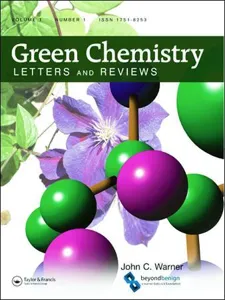
Green Chemistry Letters and Reviews
Basic Information
Brief Name:
GREEN CHEM LETT REV
Impact Factor:
5.8
ISSN:
1751-8253
Research Field:
CHEMICAL
h-index:
27
Self-citation Rate:
1.7%
Articles per Year:
50
SCI Index Status:
Science Citation Index Expanded
Journal Website:
https://www.tandfonline.com/journals/tgcl20
Journal Introduction:
Green Chemistry Letters and Reviews (GCLR) is an international, cross-disciplinary, fully open access journal focused on the contribution of chemistry to sustainable development. GCLR’s scope aims to build upon the definition of Green Chemistry as first defined by its Founding Editor John Warner, together with Paul Anastas, in Green Chemistry: Theory and Practice, Oxford University Press, Oxford, 1998. GCLR is dedicated to bringing together academic, teaching, and industry professionals, including environmental scientists and law and policy makers, who constitute the green chemistry community. We welcome original research letters and articles, review articles, perspective and feature articles, reports on recent innovations, as well as educational resources from those working in related disciplines across chemistry, chemical engineering, political science, jurisprudence, and economics. GCLR accepts the following article types: Research Article, Research Letter, Review Article, Methods, and Brief Reports. All contributions should clearly demonstrate impact to advancing the field by reference to the 12 Principles of Green Chemistry and the Sustainable Development Goals agreed by the United Nations in 2015. Such topics include, but are not limited to: Green synthesis and catalysis Green manufacturing and engineering Green product design Green chemistry education Critical raw materials and sustainable resources Energy harvest, storage, and savings Circular economy Environmental chemistry and green metrics Ethics, legislation, and economics We encourage authors to deposit their manuscripts as a pre-print to speed up the dissemination of research, which allows for feedback before formal peer review. Deposition of your manuscript in a pre-print server will have no bearing on the peer review process and final decision made on your manuscript. Authors who believe their manuscript would benefit from English editing prior to submission should seek a professional editing service or native English speaker. Details of editing services available from Taylor & Francis are available here. Peer Review Statement Green Chemistry Letters and Reviews is an international, peer-reviewed journal publishing high quality, original research contributions in the pursuit of scientific knowledge. All manuscript submissions are subject to initial appraisal by the Editor, and, if found suitable for further consideration, to single anonymized peer review by independent, anonymous expert referees. Publishing Ethics Statement Green Chemistry Letters and Reviews adheres to the highest standards of publishing ethics, with rigorous processes in place to ensure this is achieved. Taylor & Francis is a member of Committee of Publication Ethics (COPE) and utilizes Similarity Check via CrossRef for all journals. More information on our ethical standards and policies can be found here The Journal has an appeals and complaints policy which can be viewed here
CiteScore
CiteScore
9.1
SJR
1.138
SNIP
1.474
| Subject | Rank | Percentile |
|---|---|---|
ChemistryGeneral Chemistry |
62 / 408 | 84% |
Journal Statistics
Issues/Year
59 days avg. from submission to first decision
74 days avg. from submission to first post-review decision
13 days avg. from acceptance to online publication
Review Cycle
USD1680; GBP1344
Article Processing Fee
Submission Information
Submission Website:
https://rp.tandfonline.com/submission/create?journalCode=TGCLRecommended Journals
Related Articles
2-Phenylpyrimidine skeleton-based electron-transport materials for extremely efficient green organic light-emitting devices
Hisahiro Sasabe, Takayuki Chiba, Shi-Jian Su, Yong-Jin Pu, Ken-ichi Nakayama, Junji Kido
2008-10-03
Communication
DOI: 10.1039/B812270A
A cavitand with a fluorous rim acts as an amine receptor
Richard J. Hooley, Per Restorp, Julius Rebek Jr
2008-11-06
Communication
DOI: 10.1039/B814069C
A snapshot of a coordination polymerself-assembly process: the crystallization of a metastable 3D network followed by the spontaneous transformation in water to a 2D pseudopolymorphic phase
Thierry Bataille, Ferdinando Costantino, Andrea Ienco, Annalisa Guerri, Fabio Marmottini, Stefano Midollini
2008-11-04
Communication
DOI: 10.1039/B813222D
Facile synthesis of continuous Pt island networks and their electrochemical properties for methanol electrooxidation
Jitendra N. Tiwari, Fu-Ming Pan, Rajanish N . Tiwari, S.K . Nandi
2008-11-06
Communication
DOI: 10.1039/B813935K
Dynamic kinetic resolution of β-keto sulfonesvia asymmetric transfer hydrogenation
Zhenhua Ding, Jin Yang, Ting Wang, Zongxuan Shen, Yawen Zhang
2008-12-19
Communication
DOI: 10.1039/B818257D
Formation of dodecaphenylporphodimethenevia facile protonation of saddle-distorted dodecaphenylporphyrin
Takahiko Kojima, Kakeru Hanabusa, Kei Ohkubo, Motoo Shiro, Shunichi Fukuzumi
2008-11-05
Communication
DOI: 10.1039/B816063E
Multiradiate calcium phosphate patterns derived from a gradating polysaccharide-acidic protein system‡
Yi Shi, Yahong Zhang, Wuli Yang, Yi Tang
2008-11-19
Communication
DOI: 10.1039/B814095B
Amplified fluorescence determination of microRNAs in homogeneous solution with cationic conjugated polymers
Zhengping Li, Yongqiang Cheng
2008-11-13
Communication
DOI: 10.1039/B816614E
Versatile one-step introduction of multiple hydrogen-bonding sites onto extended π-conjugated systems
Fu-Chuan Fang, Cheng-Che Chu, Chih-Hao Huang, Guillaume Raffy, André Del Guerzo, Ken-Tsung Wong, Dario M. Bassani
2008-11-06
Communication
DOI: 10.1039/B813704H
Phase transition and conductive acceleration of phosphonium-cation-based room-temperature ionic liquid
Shiro Seki, Yasuhiro Umebayashi, Seiji Tsuzuki, Kikuko Hayamizu, Yo Kobayashi, Yasutaka Ohno, Takeshi Kobayashi, Yuichi Mita, Hajime Miyashiro, Nobuyuki Terada, Shin-ichi Ishiguro
2008-09-23
Communication
DOI: 10.1039/B809309A
You might also like
Compound Q&A
What is Ethyl 3-cyclohexylpropanoate (CAS: 10094-36-7)?
Ethyl 3-cyclohexylpropanoate is a clear, colorless to light yellow liquid with a...
10094-36-7Ethyl 3-cyclohexylpr...
Compound Q&A
How should waste containing 2-(Hydroxymethyl)-5-(methoxycarbonyl)-6-methyl-4-(2-nitrophenyl)nicotinic acid (CAS: 34783-31-8) be handled?
Waste containing 2-(Hydroxymethyl)-5-(methoxycarbonyl)-6-methyl-4-(2-nitrophenyl...
34783-31-82-(Hydroxymethyl)-5-...
Compound Q&A
How should waste containing 2,4,6-Tris(pentafluoroethyl)-1,3,5-triazine (CAS: 858-46-8) be handled?
Waste containing 2,4,6-Tris(pentafluoroethyl)-1,3,5-triazine (CAS: 858-46-8) sho...
858-46-82,4,6-Tris(pentafluo...
Compound Q&A
What precautions should be taken when handling Chloroac-nle-oh (CAS: 56787-36-1)?
When handling Chloroac-nle-oh (CAS: 56787-36-1), it is essential to wear appropr...
56787-36-1Chloroac-nle-oh
Compound Q&A
What industries use Ethyl 6-phenylimidazo[2,1-b][1,3]thiazole-3-carboxylate (CAS: 752244-05-6)?
Ethyl 6-phenylimidazo[2,1-b][1,3]thiazole-3-carboxylate is primarily used in the...
752244-05-6Ethyl 6-phenylimidaz...
Compound Q&A
Are there alternatives to alpha-(2-Bromophenyl)benzylamine (CAS: 55095-15-3) in synthesis?
Alternatives to alpha-(2-Bromophenyl)benzylamine (CAS: 55095-15-3) in synthesis ...
55095-15-3alpha-(2-Bromophenyl...
Compound Q&A
How should waste containing 2-Chloro-5-methoxypyridine (CAS: 139585-48-1) be handled?
Waste containing 2-Chloro-5-methoxypyridine (CAS: 139585-48-1) should be managed...
139585-48-12-Chloro-5-methoxypy...
Compound Q&A
What industries use 1-(4-Methoxyphenyl)-2,5-dimethyl-1H-pyrrole (CAS: 5044-27-9)?
1-(4-Methoxyphenyl)-2,5-dimethyl-1H-pyrrole (CAS: 5044-27-9) is used in various ...
5044-27-91-(4-Methoxyphenyl)-...
Compound Q&A
Are there alternatives to 3-Bromo-5-(N-Boc)aminomethylisoxazole (CAS: 903131-45-3) in synthesis?
There are alternative reagents and compounds that can be used in the synthesis o...
903131-45-33-Bromo-5-(N-Boc)ami...
Compound Q&A
What is Tungsten(IV) oxide (CAS: 12036-22-5)?
Tungsten(IV) oxide, also known as tungsten dioxide, is a chemical compound with ...
12036-22-5Tungsten(IV) oxide
Recommended Compounds





Tris(2-ethylhexyl) 4,4',4''-(1,3,5-triazine-2,4,6-triyltriimino)tribenzoate
CAS Number:
88122-99-0
Molecular Formula:
C48H66N6O6


Recommended Suppliers






Disclaimer
This page provides academic journal information for reference and research purposes only. We are not affiliated with any journal publishers and do not handle publication submissions. For publication-related inquiries, please contact the respective journal publishers directly.
If you notice any inaccuracies in the information displayed, please contact us at support@chemtradehub.com. We will promptly review and address your concerns.