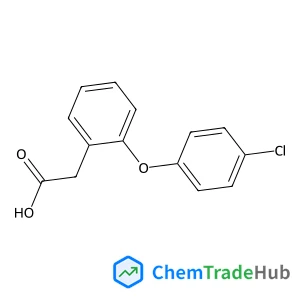
[2-(4-Chlorophenoxy)phenyl]acetic acid | CAS No. 25563-04-6

[2-(4-Chlorophenoxy)phenyl]acetic acid

Basic Information

CAS Number

25563-04-6

Molecular Formula

C14H11ClO3

Molecular Weight

262.69 g/mol

AD

Basic Physical Properties

Melting Point

120-122 ºC

OC(=O)Cc1ccccc1Oc1ccc(cc1)Cl

InChI

InChI=1S/C14H11ClO3/c15-11-5-7-12(8-6-11)18-13-4-2-1-3-10(13)9-14(16)17/h1-8H,9H2,(H,16,17)

InChIKey

ALMJMOPIBISVHZ-UHFFFAOYSA-N

LogP

3.759400000000002

Topological Polar Surface Area

46.53 Ų

Hydrogen Bond Donor/Acceptor

1 / 3

Complexity

274

Synonyms & References

English

  • 2-(2-(4-Chlorophenoxy)phenyl)acetic acid
  • 2-(4-chlorophenoxy)Benzeneacetic acid
  • 2-[2-(4-chlorophenoxy)phenyl]acetic acid
  • 2-(4-chlorophenoxy)phenylacetic acid
  • ALMJMOPIBISVHZ-UHFFFAOYSA-N
  • BCP10074
  • 2096AB
  • [2-(4-chlorophenoxy)phenyl]acetic acid
  • 2-(4-chlorophenoxy)-benzene acetic acid
  • 2-(2-(4-chlorophenoxy)phenyl)

MDL Number

MFCD15528958

FAQ

What regulatory guidelines apply to [2-(4-Chlorophenoxy)phenyl]acetic acid (CAS: 25563-04-6)?

Regulatory guidelines for [2-(4-Chlorophenoxy)phenyl]acetic acid (CAS: 25563-04-6) include GHS classification, REACH regulations, and FDA/EPA requirements. Manufacturers and distributors must ensure compliance with these guidelines to handle, label, and transport the compound safely. GHS classifies the compound as a hazardous substance due to its corrosive and toxic properties. REACH regulations require suppliers to provide safety data sheets (SDS) and register the substance if the annual tonnage exceeds 1 ton. FDA and EPA regulations govern its use in food and environmental safety, respectively.

Are there alternatives to [2-(4-Chlorophenoxy)phenyl]acetic acid (CAS: 25563-04-6) in synthesis?

Yes, there are alternatives to [2-(4-Chlorophenoxy)phenyl]acetic acid (CAS: 25563-04-6) in synthesis. Common alternatives include 2-(4-hydroxyphenyl)phenylacetic acid and 2-(4-isopropylphenyl)phenylacetic acid. These compounds can serve similar functions in certain applications. For substitute reagents, consider 2-(4-chloro-3-methylphenyl)acetic acid or 2-(4-bromo-2-methylphenyl)acetic acid. These alternatives offer similar chemical properties while providing flexibility in synthesizing different end products.

What is the market or research trend for [2-(4-Chlorophenoxy)phenyl]acetic acid (CAS: 25563-04-6)?

The market for [2-(4-Chlorophenoxy)phenyl]acetic acid (CAS: 25563-04-6) is closely tied to its applications in agriculture and pharmaceuticals. Research trends indicate a stable demand, driven by its use as a herbicide and insecticide precursor. Recent studies focus on developing more efficient synthesis methods and exploring its potential in new therapeutic areas. Market trends show a slight increase in prices due to growing global demand and stricter environmental regulations. Emerging research fields include its role in pest control and as a potential bioactive compound.

How should waste containing [2-(4-Chlorophenoxy)phenyl]acetic acid (CAS: 25563-04-6) be handled?

Waste containing [2-(4-Chlorophenoxy)phenyl]acetic acid (CAS: 25563-04-6) should be managed according to local and international waste disposal regulations. Collect waste in appropriate containers and label them as hazardous. Incineration is a common disposal method, but professional waste disposal services are recommended for large quantities. Ensure environmental protection by following safety precautions during handling and disposal. Always consult the latest waste management guidelines and safety data sheets (SDS) for detailed instructions on waste collection, storage, and disposal. Proper disposal is crucial to prevent environmental contamination and ensure compliance with regulatory requirements.

You might also like

Compound Q&A

What is 6-Methyl-7-oxabicyclo[4.1.0]heptan-2-one (CAS: 21889-89-4)?

6-Methyl-7-oxabicyclo[4.1.0]heptan-2-one is a cyclic ketone with a molecular for...

21889-89-46-Methyl-7-oxabicycl...
Compound Q&A

What is 4-[(6-Methyl-2-pyrazinyl)oxy]benzoic acid (CAS: 906353-00-2)?

4-[(6-Methyl-2-pyrazinyl)oxy]benzoic acid is a chemical compound with the CAS nu...

906353-00-24-[(6-Methyl-2-pyraz...
Compound Q&A

What is 2-(2-Pyridinyl)-1,3-propanediol (CAS: 49745-42-8)?

2-(2-Pyridinyl)-1,3-propanediol (CAS: 49745-42-8) is a colorless to slightly yel...

49745-42-82-(2-Pyridinyl)-1,3-...
Compound Q&A

What is 2-(6-Chloro-2-pyridinyl)-2-phenylacetonitrile (CAS: 24783-42-4)?

2-(6-Chloro-2-pyridinyl)-2-phenylacetonitrile is an organic compound with the CA...

24783-42-42-(6-Chloro-2-pyridi...
Compound Q&A

What is 2-Oxopropanamide (CAS: 631-66-3)?

2-Oxopropanamide, also known as 2-aminoacrylic acid, is a chemical compound with...

631-66-32-Oxopropanamide
Compound Q&A

What is 2-Methyl-2-propanyl 4-(5-bromo-6-methyl-2-pyridinyl)-1-piperazinecarboxylate (CAS: 1289040-88-5)?

2-Methyl-2-propanyl 4-(5-bromo-6-methyl-2-pyridinyl)-1-piperazinecarboxylate (CA...

1289040-88-52-Methyl-2-propanyl ...
Compound Q&A

What is NAMPT inhibitor-linker 1 (CAS: 2241019-57-6)?

NAMPT inhibitor-linker 1 (CAS: 2241019-57-6) is a chemical compound designed as ...

2241019-57-6NAMPT inhibitor-link...
Compound Q&A

What is (2-(2,2,2-Trifluoroacetyl)pyridin-4-yl)boronic acid (CAS: 1310404-58-0)?

It is a chemical compound with the structure (2-(2,2,2-Trifluoroacetyl)pyridin-4...

1310404-58-0(2-(2,2,2-Trifluoroa...
Compound Q&A

What is 1-(2-Chlorophenyl)-6-(3,3,3-trifluoro-2-methylpropyl)-1,5-dihydro-4H-pyrazolo[3,4-d]pyrimidin-4-one (CAS: 794568-90-4)?

1-(2-Chlorophenyl)-6-(3,3,3-trifluoro-2-methylpropyl)-1,5-dihydro-4H-pyrazolo[3,...

794568-90-41-(2-Chlorophenyl)-6...
Compound Q&A

What is Vinyl(chloromethyl)dimethoxysilane (CAS: 1314981-48-0)?

Vinyl(chloromethyl)dimethoxysilane is an organosilicon compound with the molecul...

1314981-48-0Vinyl(chloromethyl)d...