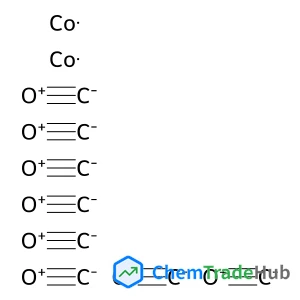
Cobalt Carbonyl (Stabilized with 1-5% Hexane) | CAS No. 10210-68-1

Cobalt Carbonyl (Stabilized with 1-5% Hexane)

Basic Information

CAS Number

10210-68-1

Molecular Formula

C8Co2O8

Molecular Weight

129.88 g/mol

EINECS

233-514-0

AD

Basic Physical Properties

Melting Point

51-52 °C

Boiling Point

52°C

Density

1.81

Water Solubility

Insoluble in water. Soluble in alcohol, ether and carbon disulfideSoluble in ether, naphtha and carbon disulfide. Slightly soluble in alcohol. Insoluble in water.

Flash Point

-13 °C

Vapor Pressure

9.333-200Pa at 15-25℃

[Co].[Co].[C-]#[O+].[C-]#[O+].[C-]#[O+].[C-]#[O+].[C-]#[O+].[C-]#[O+].[C-]#[O+].[C-]#[O+]

InChI

InChI=1S/C.2Co/q-1;;

InChIKey

MPOBUBPPDAIBAP-UHFFFAOYSA-N

LogP

0.07629

Topological Polar Surface Area

0.0 Ų

Hydrogen Bond Donor/Acceptor

0 / 0

Complexity

21.5

Safety Information

View Safety Information

Hazard Statement

H302 Harmful if swallowed
Acute toxicity, oral
H315 Causes skin irritation
Skin corrosion/irritation
H317 May cause an allergic skin reaction
Sensitization, Skin
H319 Causes serious eye irritation
Serious eye damage/eye irritation
H330 Fatal if inhaled
Acute toxicity, inhalation
H335 May cause respiratory irritation
Specific target organ toxicity, single exposure; Respiratory tract irritation
H351 Suspected of causing cancer
Carcinogenicity
H361 Suspected of damaging fertility or the unborn child
Reproductive toxicity
H372 Causes damage to organs through prolonged or repeated exposure
Specific target organ toxicity, repeated exposure
H412 Harmful to aquatic life with long lasting effects
Hazardous to the aquatic environment, long-term hazard

Hazard Class

Class 4.1 Class 4.1

Stability

air sensitive

Hydrolysis Sensitivity

7: reacts slowly with moisture/water

Sensitiveness

Air Sensitive

Toxicity

LD50 in mice, rats (mg/kg): 377.7, 753.8 by gavage (Spiridonova, Shabalina)

Synonyms & References

English

  • OCTACARBONYLDICOBALT
  • carbonyl,tetra-cobal
  • Co2(CO)8
  • Cobalt carbonyl (Co2(CO)8)
  • Cobalt tetracarbonyl dimer
  • Cobalt, di-mu-carbonylhexacarbonyldi-
  • Cobalt, di-mu-carbonylhexacarbonyldi-, (Co-Co)
  • Cobalt,di-μ-carbonylhexacarbonyldi-,(Co-Co)
  • octacarbonyldicobalt
  • Cobalt Carbonyl
  • Cobalt tetracarbonyl dime
  • Dicobalt Octacarbonyl
  • Dicobalt octacarbonyl,stabilized
  • Di-μ-carbonylhexacarbonyldicobal
  • cobaltcarbonyle
  • dicobaltcarbonyl
  • cobaltoctacarbonyl
  • cobaltcarbonyl(asco)
  • COBALT TETRACARBONYL
  • Cobalt Carbonyl (stabilized with 1-5% Hexane)
  • Octacarbonyldicobalt (stabilized with 1-5% Hexane)
  • Cobalt tetracarbonyl

MDL Number

MFCD32664934

EC Number

233-514-0

Customs Code

29319090

FAQ

What regulatory guidelines apply to Cobalt Carbonyl (Stabilized with 1-5% Hexane) (CAS: 10210-68-1)?

Cobalt Carbonyl (Stabilized with 1-5% Hexane) (CAS: 10210-68-1) is regulated under various guidelines including the Globally Harmonized System of Classification and Labeling of Chemicals (GHS), REACH regulations, and FDA/EPA requirements for handling and disposal. It is classified as a flammable gas and requires proper labeling and storage to avoid hazards.

Are there alternatives to Cobalt Carbonyl (Stabilized with 1-5% Hexane) (CAS: 10210-68-1) in synthesis?

Alternatives to Cobalt Carbonyl include other transition metal carbonyls such as nickel carbonyl and iron carbonyl. Additionally, cobalt complexes and other organometallic compounds can serve as effective alternatives in certain synthetic processes. Hexane stabilization helps in handling and storage, but other stabilizers can also be considered based on specific application needs.

What is the market or research trend for Cobalt Carbonyl (Stabilized with 1-5% Hexane) (CAS: 10210-68-1)?

The market for Cobalt Carbonyl (Stabilized with 1-5% Hexane) (CAS: 10210-68-1) remains steady, with increasing research focusing on its use in catalytic processes and as a precursor in the preparation of metal carbonyl complexes. Recent trends highlight its potential in sustainable and green chemistry applications, alongside advancements in safer handling and disposal methods.

How should waste containing Cobalt Carbonyl (Stabilized with 1-5% Hexane) (CAS: 10210-68-1) be handled?

Waste containing Cobalt Carbonyl (Stabilized with 1-5% Hexane) (CAS: 10210-68-1) should be collected in appropriate containers and disposed of by incineration or professional waste disposal services. Environmental precautions include ensuring proper ventilation and minimizing exposure to air and moisture to prevent decomposition and potential hazards. Compliance with local regulations is essential for safe disposal.

You might also like

Compound Q&A

What is 6-Methyl-7-oxabicyclo[4.1.0]heptan-2-one (CAS: 21889-89-4)?

6-Methyl-7-oxabicyclo[4.1.0]heptan-2-one is a cyclic ketone with a molecular for...

21889-89-46-Methyl-7-oxabicycl...
Compound Q&A

What is 4-[(6-Methyl-2-pyrazinyl)oxy]benzoic acid (CAS: 906353-00-2)?

4-[(6-Methyl-2-pyrazinyl)oxy]benzoic acid is a chemical compound with the CAS nu...

906353-00-24-[(6-Methyl-2-pyraz...
Compound Q&A

What is 2-(2-Pyridinyl)-1,3-propanediol (CAS: 49745-42-8)?

2-(2-Pyridinyl)-1,3-propanediol (CAS: 49745-42-8) is a colorless to slightly yel...

49745-42-82-(2-Pyridinyl)-1,3-...
Compound Q&A

What is 2-(6-Chloro-2-pyridinyl)-2-phenylacetonitrile (CAS: 24783-42-4)?

2-(6-Chloro-2-pyridinyl)-2-phenylacetonitrile is an organic compound with the CA...

24783-42-42-(6-Chloro-2-pyridi...
Compound Q&A

What is 2-Oxopropanamide (CAS: 631-66-3)?

2-Oxopropanamide, also known as 2-aminoacrylic acid, is a chemical compound with...

631-66-32-Oxopropanamide
Compound Q&A

What is 2-Methyl-2-propanyl 4-(5-bromo-6-methyl-2-pyridinyl)-1-piperazinecarboxylate (CAS: 1289040-88-5)?

2-Methyl-2-propanyl 4-(5-bromo-6-methyl-2-pyridinyl)-1-piperazinecarboxylate (CA...

1289040-88-52-Methyl-2-propanyl ...
Compound Q&A

What is NAMPT inhibitor-linker 1 (CAS: 2241019-57-6)?

NAMPT inhibitor-linker 1 (CAS: 2241019-57-6) is a chemical compound designed as ...

2241019-57-6NAMPT inhibitor-link...
Compound Q&A

What is (2-(2,2,2-Trifluoroacetyl)pyridin-4-yl)boronic acid (CAS: 1310404-58-0)?

It is a chemical compound with the structure (2-(2,2,2-Trifluoroacetyl)pyridin-4...

1310404-58-0(2-(2,2,2-Trifluoroa...
Compound Q&A

What is 1-(2-Chlorophenyl)-6-(3,3,3-trifluoro-2-methylpropyl)-1,5-dihydro-4H-pyrazolo[3,4-d]pyrimidin-4-one (CAS: 794568-90-4)?

1-(2-Chlorophenyl)-6-(3,3,3-trifluoro-2-methylpropyl)-1,5-dihydro-4H-pyrazolo[3,...

794568-90-41-(2-Chlorophenyl)-6...
Compound Q&A

What is Vinyl(chloromethyl)dimethoxysilane (CAS: 1314981-48-0)?

Vinyl(chloromethyl)dimethoxysilane is an organosilicon compound with the molecul...

1314981-48-0Vinyl(chloromethyl)d...