AD
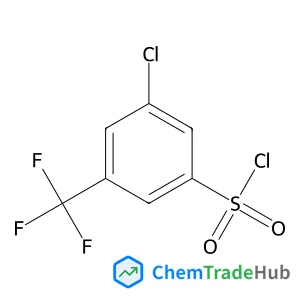
3-Chloro-5-(trifluoromethyl)benzenesulfonyl chloride(CAS: 875167-01-4)
CAS Number
Related Products
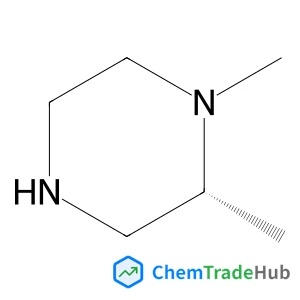
(2R)-1,2-Dimethylpiperazine
CAS Number: 623586-02-7
![(2S)-4-Hydroxy-7-(hydroxymethyl)-2-(2-hydroxy-2-propanyl)-2,3-dihydro-5H-furo[3,2-g]chromen-5-one](https://static.chemtradehub.com/structs/496/49624-66-0-7116.webp)

O~15~-Heptanoylretinol
CAS Number: 88641-44-5
![1-Methoxy-2-[1-(4-methoxyphenyl)propyl]benzene](https://static.chemtradehub.com/structs/334/33451-22-8-2ef2.webp)
CAS Number: 1350524-27-4
Other Suppliers for 3-Chloro-5-(trifluoromethyl)benzenesulfonyl chloride






Basic Information
Molecular Formula
C7H3Cl2F3O2S
Molecular Weight
279.07 g/mol
Physical Properties
Boiling Point
288℃
Density
1.626
Flash Point
128℃
Chemical Identifiers
SMILES
FC(F)(F)c1cc(Cl)cc(c1)S(=O)(=O)Cl
InChIKey
JYUGVORTFRFETG-UHFFFAOYSA-N
Database References
MDL Number
MFCD13185471
FAQ
3-Chloro-5-(trifluoromethyl)benzenesulfonyl chloride is a crystalline solid with a high melting point. Its molecular weight is approximately 335.01 g/mol. This compound has low water solubility but is soluble in polar organic solvents like DMSO and DMF. It is known for its high reactivity, particularly in nucleophilic substitution and electrophilic aromatic substitution reactions.
3-Chloro-5-(trifluoromethyl)benzenesulfonyl chloride is typically synthesized via the sulfonation of 3-chloro-5-(trifluoromethyl)benzene using concentrated sulfuric acid. The reaction is conducted in a fume hood to manage the volatile gases produced. The product is then chlorosulfonated, often using thionyl chloride, to generate the sulfonate chloride. The process requires careful control of temperature and concentration to achieve high yield and selectivity.
3-Chloro-5-(trifluoromethyl)benzenesulfonyl chloride is utilized in the pharmaceutical industry for its reactivity and functional groups, aiding in the synthesis of drug intermediates. It is also employed in the polymer industry as a monomer or additive due to its unique chemical properties. Additionally, it has applications in the production of sensors and semiconductors, where its high reactivity makes it suitable for specific chemical reactions.
When handling 3-Chloro-5-(trifluoromethyl)benzenesulfonyl chloride, it is essential to wear appropriate personal protective equipment (PPE), including gloves, safety goggles, and a lab coat. Work should be conducted in a well-ventilated area or a fume hood to minimize exposure to the volatile gases. Spills should be contained and treated with an appropriate neutralizing agent before disposal. Always refer to a Material Safety Data Sheet (MSDS) for detailed safety information and emergency procedures.
Safety Notice
Please verify product specifications and safety data before use. Contact the supplier for detailed safety information.
Always follow proper handling procedures