



AD
6-Deoxy-alpha-L-galactopyranosyl-(1->2)-beta-D-galactopyranosyl-(1->3)-2-acetamido-2-deoxy-beta-D-glucopyranosyl-(1->3)-beta-D-galactopyranosyl-(1->4)-D-glucose(CAS: 7578-25-8)
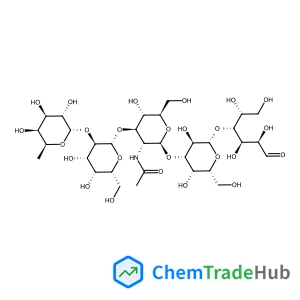
CAS Number
Related Products
![(3aR,4S,5S,5aR,8aR,8bR)-5-Methoxy-2,2,7,7-tetramethylhexahydro[1,3]dioxolo[4,5-e][1,3]benzodioxol-4-ol](https://static.chemtradehub.com/structs/578/57819-56-4-e1c5.webp)
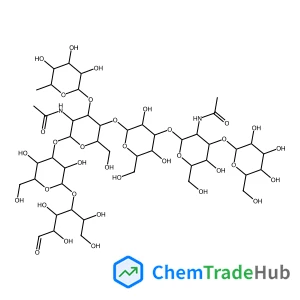
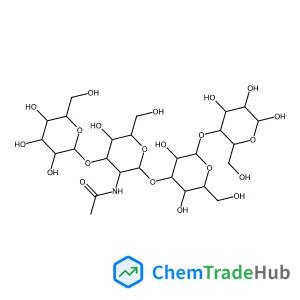
Monofucosyl-para-lacto-N-hexaose IV
CAS Number: 115236-58-3
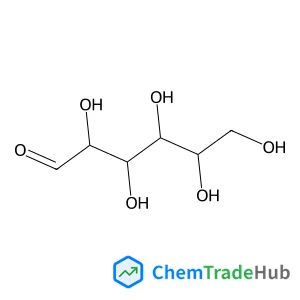
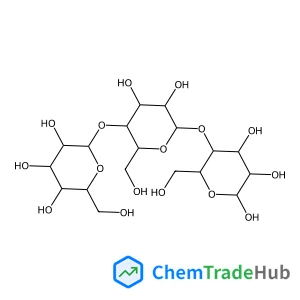
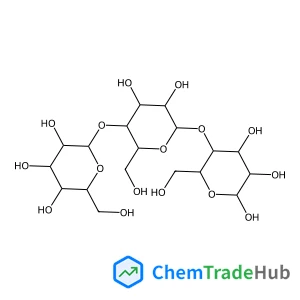
Maltotriose
CAS Number: 1109-28-0
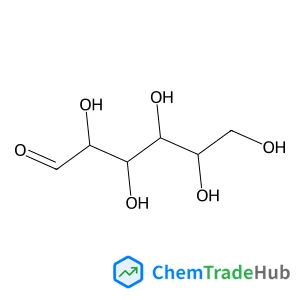
L-(-)-MANNOSE
CAS Number: 10030-80-5
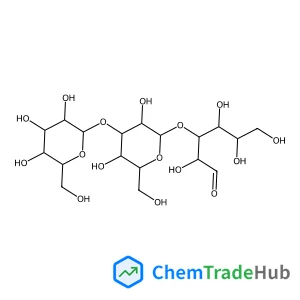
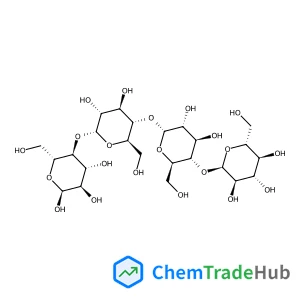
Maltotetraose
CAS Number: 34612-38-9
Other Suppliers for 6-Deoxy-alpha-L-galactopyranosyl-(1->2)-beta-D-galactopyranosyl-(1->3)-2-acetamido-2-deoxy-beta-D-glucopyranosyl-(1->3)-beta-D-galactopyranosyl-(1->4)-D-glucose





Basic Information
Molecular Formula
C32H55NO25
Molecular Weight
853.77 g/mol
Chemical Identifiers
SMILES
C[C@H]1[C@H]([C@H]([C@@H]([C@@H](O1)O[C@@H]2[C@H]([C@H]([C@H](O[C@H]2O[C@@H]3[C@H]([C@@H](O[C@@H]([C@H]3O)CO)O[C@H]4[C@H]([C@H](O[C@H]([C@@H]4O)O[C@H]([C@@H](CO)O)[C@@H]([C@H](C=O)O)O)CO)O)NC(=O)C)CO)O)O)O)O)O
InChIKey
DTVXXTISAIGIBA-LDODJJGTSA-N
Database References
MDL Number
MFCD00792849
FAQ
This compound is subject to the Globally Harmonized System of Classification and Labelling of Chemicals (GHS), REACH regulations in the European Union, and FDA/EPA guidelines for hazardous substances. Manufacturers and distributors must ensure compliance with these regulations, including proper labeling, documentation, and storage to prevent exposure and environmental hazards.
There are several alternatives, including isomers and analogs such as 6-deoxy-L-galactose and 2-acetamido-2-deoxy-D-glucose, which can be used as substitutes in synthesis. Common alternative reagents include various galactopyranosides and glucopyranosides, depending on the specific reaction conditions and desired product.
The market for this compound is predominantly focused on pharmaceuticals and biotechnology due to its unique structure and potential in drug development. Research trends indicate increasing interest in its use as a glycoside building block for synthesizing complex carbohydrates and glycoconjugates. Prices are influenced by research interest and demand, with trends showing steady growth in both market value and academic publications.
Waste containing this compound should be collected in appropriate containers and stored under controlled conditions to prevent degradation. It should be disposed of through professional waste disposal services that comply with local regulations. Environmental precautions include proper incineration or chemical treatment to minimize environmental impact, ensuring that no hazardous materials are released into the environment without proper treatment and disposal.
Safety Notice
Please verify product specifications and safety data before use. Contact the supplier for detailed safety information.
Always follow proper handling procedures
Contact Information
sevensci@7sci.com