



AD
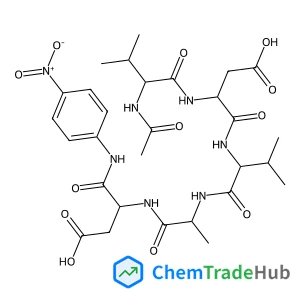
Ac-VDVAD-pNA(CAS: 189684-53-5)
CAS Number
Related Products
methyl}benzamide](https://static.chemtradehub.com/structs/224/2247491-97-8-c197.webp)
![4-Amino-2-({[(2-methyl-2-propanyl)oxy]carbonyl}amino)butanoic acid](https://static.chemtradehub.com/structs/289/2899-79-8-863a.webp)
![2-Methyl-2-propanyl 7-(4,4,5,5-tetramethyl-1,3,2-dioxaborolan-2-yl)-2-azaspiro[4.4]nonane-2-carboxylate](https://static.chemtradehub.com/structs/230/2304631-27-2-21b7.webp)
![Methyl 3-(4-{3-[3-(trifluoromethyl)phenyl]-1H-pyrazol-5-yl}-1-piperidinyl)propanoate](https://static.chemtradehub.com/structs/103/1030386-15-2-7851.webp)
Other Suppliers for Ac-VDVAD-pNA





Basic Information
Molecular Formula
C29H41N7O12
Molecular Weight
679.7 g/mol
Chemical Identifiers
SMILES
CC(C)C(C(=O)NC(CC(=O)O)C(=O)NC(C(C)C)C(=O)NC(C)C(=O)NC(CC(=O)O)C(=O)NC1=CC=C(C=C1)[N+](=O)[O-])NC(=O)C
InChIKey
SIOKOOKURWWOID-UHFFFAOYSA-N
Database References
MDL Number
MFCD01862575
FAQ
Ac-VDVAD-pNA (CAS: 189688-53-5) falls under the regulatory guidelines of the Globally Harmonized System of Classification and Labelling of Chemicals (GHS), which includes classification for health hazards, environmental hazards, and flammability. In the European Union, it is subject to the REACH regulations for the registration, evaluation, authorization, and restriction of chemical substances. Additionally, the U.S. FDA and EPA have specific requirements for the handling, transport, and disposal of such compounds, particularly regarding their potential biological effects and environmental impact.
For synthesizing similar functions, alternatives to Ac-VDVAD-pNA (CAS: 189688-53-5) include other fluorometric substrates like Ac-DEVD-pNA and Ac-LEHD-pNA, which are commonly used for caspase activity assays. These alternatives offer similar enzymatic cleavage properties but may have different specificities and substrate affinities. Researchers often choose based on the specific caspase isoform they are studying and the experimental requirements.
The market for Ac-VDVAD-pNA (CAS: 189688-53-5) is growing due to its increasing use in biochemical and cellular assays for caspase activity. Research trends indicate a rising interest in understanding apoptosis pathways, which Ac-VDVAD-pNA is a key reagent for. The compound is also gaining popularity in cancer research and drug discovery, where it helps in identifying and validating caspase inhibitors. Demand is expected to continue increasing with advancements in these fields.
Waste containing Ac-VDVAD-pNA (CAS: 189688-53-5) should be managed according to the relevant regulations of GHS, REACH, FDA, and EPA. Proper collection should occur in designated waste containers, ensuring that the waste is labeled appropriately. Safe disposal methods include incineration or professional chemical waste disposal services. Precautions should be taken to prevent environmental contamination, and all handling should comply with local and international environmental protection standards to ensure safety and sustainability.
Safety Notice
Please verify product specifications and safety data before use. Contact the supplier for detailed safety information.
Always follow proper handling procedures
Contact Information
Contact Person
Manager Gu
sales@gh-reagent.com
Mobile
18939883912
Telephone
021-34536277
Visit Website
https://www.gh-reagent.com/Address
No. 91, Building 2, Block 537, Sanada Road, Minhang District, Pujiang Town, Shanghai