



AD
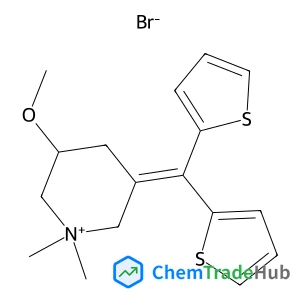
3-(Di-2-thienylmethylene)-5-methoxy-1,1-dimethylpiperidinium bromide(CAS: 35035-05-3)
CAS Number
Related Products
![[(1alpha,6beta,14alpha,16beta)-20-Ethyl-7,8-dihydroxy-1,6,14,16-tetramethoxyaconitan-4-yl]methyl 2-[(3S)-3-methyl-2,5-dioxo-1-pyrrolidinyl]benzoate 2-hydroxy-1,2,3-propanetricarboxylate (1:1)](https://static.chemtradehub.com/structs/351/351344-10-0-4e0e.webp)
![4-[(E)-2-(4-Carbamimidoylphenyl)vinyl]-3-hydroxybenzenecarboximidamide methanesulfonate (1:2)](https://static.chemtradehub.com/structs/223/223769-64-0-1600.webp)
![(6R,7R)-3-(acetyloxymethyl)-7-[[(2Z)-2-(furan-2-yl)-2-methoxyiminoacetyl]amino]-8-oxo-5-thia-1-azabicyclo[4.2.0]oct-2-ene-2-carboxylic acid](https://static.chemtradehub.com/structs/396/39685-31-9-f1d8.webp)
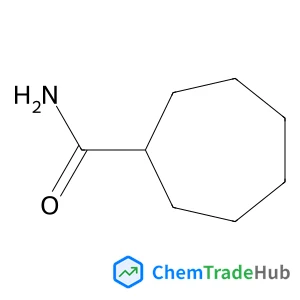
Cycloheptanecarboxamide
CAS Number: 1459-39-8

3-Chloro-1H-1,2,4-triazole
CAS Number: 6818-99-1

2-Methoxy-3-nitro-4-pyridinamine
CAS Number: 33623-16-4
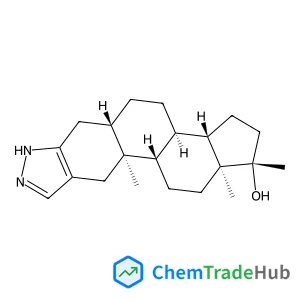
Stanozolol
CAS Number: 10418-03-8
Other Suppliers for 3-(Di-2-thienylmethylene)-5-methoxy-1,1-dimethylpiperidinium bromide

Basic Information
Molecular Formula
C17H22BrNOS2
Molecular Weight
400.4 g/mol
Physical Properties
Melting Point
198-200°
Chemical Identifiers
SMILES
C[N+]1(CC(CC(=C(C2=CC=CS2)C3=CC=CS3)C1)OC)C.[Br-]
InChIKey
QTSXMEPZSHLZFF-UHFFFAOYSA-M
Database References
MDL Number
MFCD00865193
FAQ
3-(Di-2-thienylmethylene)-5-methoxy-1,1-dimethylpiperidinium bromide is a crystalline solid with a molecular weight of approximately 449.41 g/mol. It has a solubility of about 20 mg/mL in water and is slightly soluble in common organic solvents. The compound is moderately reactive, particularly with nucleophiles. It is stable under normal conditions but should be stored away from moisture and strong acids.
3-(Di-2-thienylmethylene)-5-methoxy-1,1-dimethylpiperidinium bromide is typically synthesized through a multi-step process involving the condensation of 2-methyl-1,3-dithiane with 5-methoxypiperidine, followed by bromination. The synthesis requires careful control of reaction conditions to ensure high yield and selectivity. Commonly used solvents include toluene and dichloromethane.
3-(Di-2-thienylmethylene)-5-methoxy-1,1-dimethylpiperidinium bromide is used in various industries, including pharmaceuticals for its potential as an intermediate in drug synthesis, in polymers for its thermal stability, and in sensors due to its photochemical properties. It is also explored in semiconductor applications for its electronic properties.
When handling 3-(Di-2-thienylmethylene)-5-methoxy-1,1-dimethylpiperidinium bromide, appropriate personal protective equipment (PPE) should be worn, including gloves, goggles, and a lab coat. It should be stored in a cool, dry place, away from moisture and strong acids. Fume hoods should be used during handling to minimize exposure. In the case of a spill, it should be cleaned up immediately with appropriate absorbent materials, and the area should be ventilated. Always refer to the Safety Data Sheet (SDS) for detailed handling instructions.
Safety Notice
Please verify product specifications and safety data before use. Contact the supplier for detailed safety information.
Always follow proper handling procedures

Contact Information
order@canspecsci.com
Mobile
15021221957
Telephone
021-59553580
Fax
021-59553580-8012
Visit Website
https://www.canspec.cn