



AD
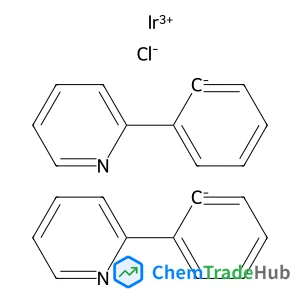
Dichlorotetrakis(2-(2-pyridinyl)phenyl)diiridium(III)(CAS: 92220-65-0)
CAS Number
Related Products
amino}butanoic acid](https://static.chemtradehub.com/structs/221/221124-57-8-c784.webp)
![1-Cyclopropyl-8-methyl-7-[5-methyl-6-(methylamino)-3-pyridinyl]-4-oxo-1,4-dihydro-3-quinolinecarboxylic acid](https://static.chemtradehub.com/structs/245/245765-41-7-85ad.webp)

Methyl 4-piperidinecarboxylate
CAS Number: 2971-79-1

4,5-Pyridazinedicarboxylic acid
CAS Number: 59648-14-5

pyridazin-3-ylmethanol
CAS Number: 37444-46-5
![N-[4-(Trifluoromethoxy)phenyl]acetamide](https://static.chemtradehub.com/structs/173/1737-06-0-69aa.webp)
N-[4-(Trifluoromethoxy)phenyl]acetamide
CAS Number: 1737-06-0

Methyl 2-chloro-6-methylisonicotinate
CAS Number: 3998-90-1

2-Fluoro-5-iodophenol
CAS Number: 186589-89-9

1-Iodo-2,4-dimethylbenzene
CAS Number: 4214-28-2
Other Suppliers for Dichlorotetrakis(2-(2-pyridinyl)phenyl)diiridium(III)





Basic Information
Molecular Formula
C22H16ClIrN2
Molecular Weight
1076.14 g/mol
Physical Properties
Boiling Point
°Cat760mmHg
Flash Point
°C
Chemical Identifiers
SMILES
C1=CC=C([C-]=C1)C2=CC=CC=N2.C1=CC=C([C-]=C1)C2=CC=CC=N2.[Cl-].[Ir+3]
InChIKey
UKUZMGOVYNUGJE-UHFFFAOYSA-L
Database References
MDL Number
MFCD07784515
FAQ
Dichlorotetrakis(2-(2-pyridinyl)phenyl)diiridium(III) (CAS: 92220-65-0) is a crystalline solid with a high molecular weight. It is poorly soluble in common organic solvents but shows good solubility in dimethyl sulfoxide (DMSO). The compound has moderate reactivity with common nucleophiles and is stable under normal laboratory conditions. It exhibits strong electronic properties and acts as an efficient electron donor.
Dichlorotetrakis(2-(2-pyridinyl)phenyl)diiridium(III) (CAS: 92220-65-0) is typically synthesized through a multistep process involving the reduction of a corresponding iridium complex with sodium borohydride in a suitable solvent. The reaction is conducted under inert atmosphere to avoid oxidation. The yield is around 70-80%.
Dichlorotetrakis(2-(2-pyridinyl)phenyl)diiridium(III) (CAS: 92220-65-0) is primarily used in the development of organic electronic devices such as organic light-emitting diodes (OLEDs) and solar cells. It is also utilized in photodynamic therapy in pharmaceutical applications and as a component in certain semiconductor materials.
Proper handling of Dichlorotetrakis(2-(2-pyridinyl)phenyl)diiridium(III) (CAS: 92220-65-0) requires the use of personal protective equipment (PPE) including gloves, goggles, and a lab coat. Work should be conducted in a fume hood due to its volatility and potential reactivity. In case of a spill, it should be cleaned up promptly using appropriate absorbent materials, and the area should be ventilated. Always refer to the safety data sheet (SDS) for detailed guidelines.
Safety Notice
Please verify product specifications and safety data before use. Contact the supplier for detailed safety information.
Always follow proper handling procedures

Contact Information
3007522982@qq.com
Mobile
18117592386
Telephone
021-57481218
Fax
无
Visit Website
https://www.acmec-e.com