



AD
Lamivudine Salicylate(CAS: 173522-96-8)
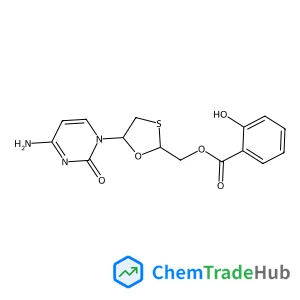
CAS Number
Related Products
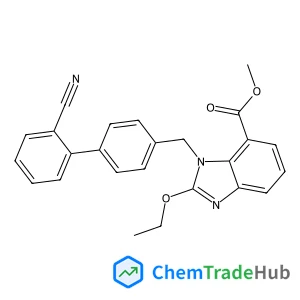
Azilsartan Impurity 1
CAS Number: 139481-44-0
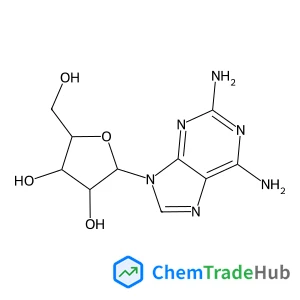
9-Pentofuranosyl-9H-purine-2,6-diamine
CAS Number: 2096-10-8
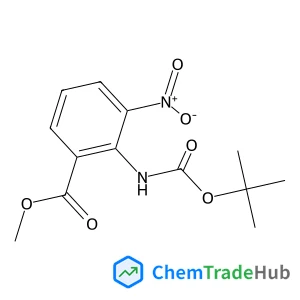
Azilsartan Impurity 64
CAS Number: 57113-90-3
![2,2'-({4-[(2-Hydroxyethyl)amino]-3-nitrophenyl}imino)diethanol](https://static.chemtradehub.com/structs/332/33229-34-4-e0c3.webp)
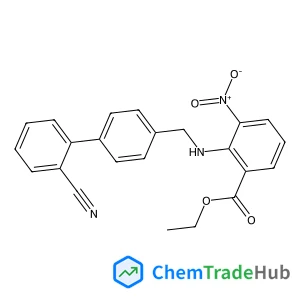
Candesartan Cilexetil Impurity 9
CAS Number: 136285-67-1
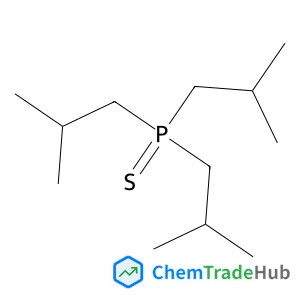
Triisobutylphosphine sulfide
CAS Number: 3982-87-4
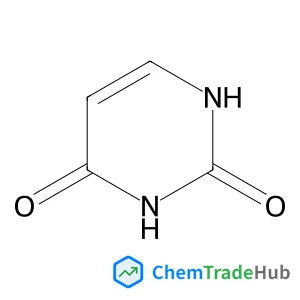
2,4(1H,3H)-Pyrimidinedione
CAS Number: 66-22-8
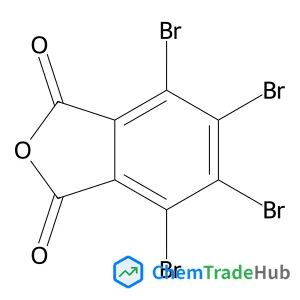
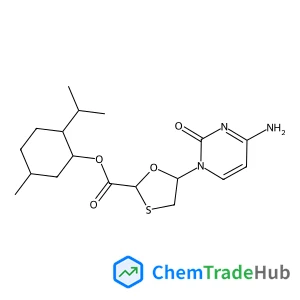
Other Suppliers for Lamivudine Salicylate





Basic Information
Molecular Formula
C15H15N3O5S
Molecular Weight
349.4 g/mol
Physical Properties
Melting Point
138-143°C
Chemical Identifiers
SMILES
C1C(OC(S1)COC(=O)C2=CC=CC=C2O)N3C=CC(=NC3=O)N
InChIKey
MUAWHSKZVSAWMH-QWHCGFSZSA-N
Database References
MDL Number
MFCD09751000
FAQ
Lamivudine Salicylate (CAS: 173522-96-8) is a crystalline compound with a molecular weight of approximately 317.25 g/mol. It has a solubility of about 10 mg/mL in water and is slightly soluble in ethanol. Chemically, it exhibits good stability in neutral and slightly acidic solutions but is less stable in strongly acidic or basic conditions. It reacts readily with bases to form its conjugate base, and it can be oxidized under certain conditions.
Lamivudine Salicylate (CAS: 173522-96-8) is synthesized through a multi-step process involving the salicylate esterification of lamivudine. The first step involves the preparation of lamivudine, which is then reacted with salicylic acid in the presence of a catalyst such as triethylamine. The reaction mixture is then purified through recrystallization to obtain the desired product with high yield and selectivity.
Lamivudine Salicylate (CAS: 173522-96-8) is primarily used in the pharmaceutical industry, particularly in the formulation of antiviral medications. It is also used in some polymer and sensor applications where its chemical properties are utilized.
When handling Lamivudine Salicylate (CAS: 173522-96-8), it is important to wear appropriate personal protective equipment (PPE) such as gloves, safety goggles, and a lab coat. Work should be conducted in a well-ventilated area or under a fume hood to prevent inhalation of potential fumes. Spills should be cleaned up immediately using appropriate absorbents, and the area should be well-ventilated. Always refer to the Safety Data Sheet (SDS) for detailed safety information and emergency procedures.
Safety Notice
Please verify product specifications and safety data before use. Contact the supplier for detailed safety information.
Always follow proper handling procedures
Contact Information
Contact Person
Li Xueting
1272175203@qq.com